Compliance you can audit — automatically, on every shift
Continuous camera-based monitoring catches missing PPE, skipped hygiene steps, zone violations, and floor hazards the moment they happen — not during the next audit. Shift leads get WhatsApp clip alerts; compliance managers get scorecards; HQ gets a multi-site evidence dashboard ready for FSSAI, ISO, and aggregator inspections.
Works with any IP camera · Hikvision · CP Plus · Dahua · ONVIF
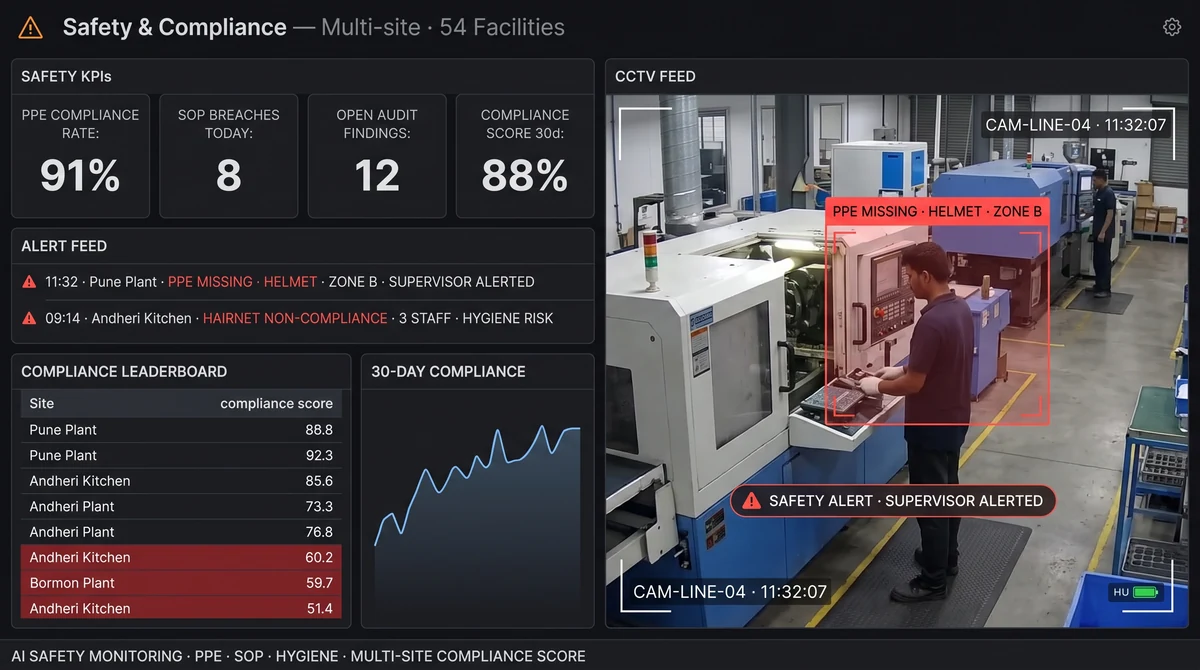
What does Slinai safety & compliance monitoring cover?
Slinai safety and compliance monitoring runs eight or more computer-vision detection models across your existing cameras to verify PPE (hairnets, gloves, masks, helmets, hi-vis vests, lab coats), hygiene SOP steps (handwash, sanitiser, glove-change sequences), restricted-zone entry (forklift lanes, chemical storage, clean rooms), and floor hazards (spills, wet floors). Breaches trigger WhatsApp alerts to shift leads within 30 seconds. Compliance events are logged by station, shift, and site — exportable for FSSAI, ISO 22000, and internal safety audits — and roll up into a multi-site compliance scorecard for regional and HQ teams.
Detection model count and alert latency based on standard Slinai deployment on existing IP cameras. Accuracy improves over the first 2–4 weeks of per-station calibration. Specific outcomes vary by camera angle, lighting, and site format.
What is automated safety and compliance monitoring?
Safety and compliance monitoring is the ongoing verification that employees, contractors, and visitors at a facility are following the safety procedures, PPE requirements, and operational standards that protect both people and the organisation. In India's manufacturing, food-service, logistics, and education sectors, compliance requirements are extensive and legally enforced: FSSAI regulations govern food-handling hygiene across every commercial kitchen and food preparation facility; factory safety legislation mandates PPE at specific workstations and restricted-zone controls around machinery and chemical storage; ISO 22000 requires documented evidence of continuous monitoring for food safety management systems; and aggregator platforms like Swiggy and Zomato now conduct hygiene audits at cloud kitchen and QSR facilities that can result in delisting for persistent non-compliance.
The structural challenge in compliance monitoring is not that operators lack knowledge of what is required — it is that enforcement depends on human supervisors being physically present at the right station at the right moment, across three shifts, every operating day. A safety officer cannot simultaneously monitor the stamping-bay entry, the chemical-handling station, the dock-gate PPE checkpoint, and the clean-room access point. A kitchen manager cannot verify glove-change compliance at six prep stations across two brands while managing order flow during the lunch rush. Quarterly audits by external inspectors or internal compliance teams verify that SOPs are being followed when the auditor is in the building — which is structurally not the same as continuous compliance across every shift.
Automated safety and compliance monitoring closes this enforcement gap by running AI detection models on existing CCTV camera streams to observe compliance events continuously, flag breaches in real time, and build an evidence record that does not depend on who was present when. Slinai's detection models identify missing PPE at configurable monitoring stations, verify hygiene SOP steps against per-site definitions, detect unauthorised entry into restricted zones, and flag floor hazards such as liquid spills before they create slip-and-fall liability. Breaches trigger WhatsApp alerts to the relevant shift lead within 30 seconds of detection — while the event is still actionable, rather than appearing in a report the following morning.
The compliance evidence layer is as important as the real-time alerting. FSSAI inspections, ISO 22000 audits, factory safety reviews, and aggregator platform hygiene checks all require documented evidence that continuous monitoring is actually occurring — not just a supervisor's attestation. Slinai's compliance log captures every detected event with a timestamp, station ID, shift metadata, and clip reference, exportable as structured CSV, API JSON, or an access-controlled clip pack. Audit preparation that previously consumed two to three days of compliance team time — pulling NVR footage station by station, collating paper sign-in records, building Excel summaries — now takes under an hour. The chain of custody is built into the platform: every access to the evidence pack is logged with user ID and timestamp.
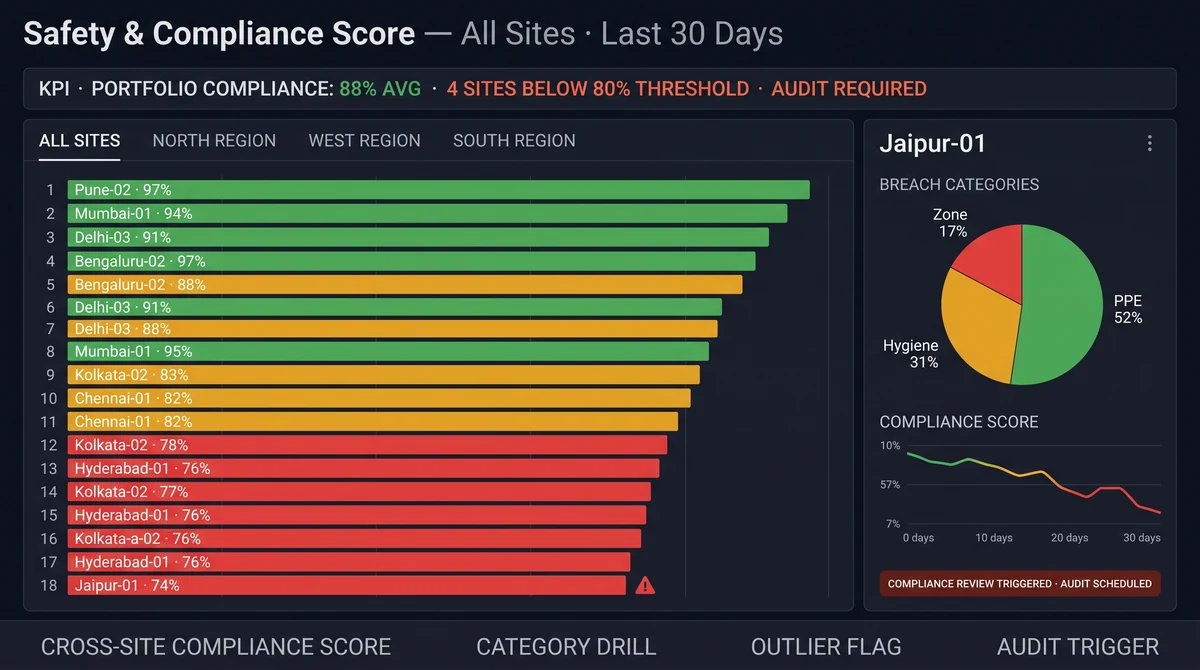
For multi-site operators — QSR franchise networks, manufacturing groups, logistics providers, education campuses — the compliance analytics layer aggregates event rates into a normalised scorecard that ranks sites by compliance performance. Regional compliance managers see which sites are trending below threshold before an audit reveals the gap; HQ quality teams can document coaching interventions and track whether they are holding week-over-week. New sites added to the network inherit calibration templates from top-performing sites of the same format, reducing go-live time and standardising detection methodology across the entire compliance programme. The goal is a compliance management posture that is continuous, evidence-based, and scalable — replacing the episodic, observation-dependent audit cycle that creates systematic blind spots between inspection visits.
Ask your cameras anything about compliance
Safety officers and compliance managers query breach rates, shift scorecards, and audit evidence in plain language — no dashboard navigation or NVR scrubbing required.
- PPE
Real-time PPE detection
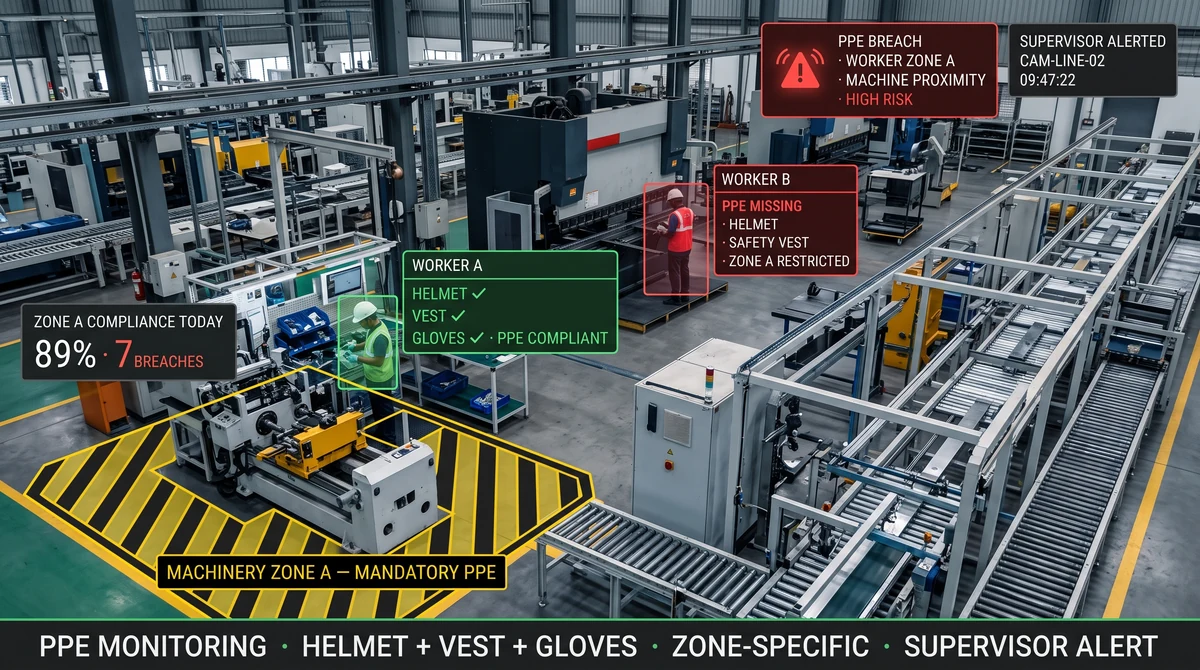
Hairnets, gloves, masks, helmets, hi-vis vests, lab coats, and aprons detected at configurable station entry points — breach alerts reach the shift lead within 30 seconds, while the non-compliant worker is still at the station.
- AUDIT
One-click audit evidence
FSSAI, ISO 22000, and aggregator hygiene audits require continuous compliance evidence — not a supervisor's attestation. Slinai's timestamped clip packs and event logs are ready to export in under an hour.
- BENCHMARK
Multi-site compliance ranking
Normalised compliance scores across every plant, kitchen, warehouse, and campus — ranked by station, shift, and site. Regional managers see underperformers before an external audit surfaces the gap.
Which of our manufacturing plants has the lowest PPE compliance this week?
Across your six monitored plants, Aurangabad has the lowest PPE compliance this week at 74% — driven primarily by stamping-bay entry where helmet non-compliance is running at 31%. Pune and Nashik are both above 92%. The Aurangabad drop started Tuesday and correlates with a new crew group on the B-shift. I've flagged the shift and station in your compliance alert queue with the relevant clips.
Walk me through what a hygiene SOP breach alert looks like for a QSR kitchen.
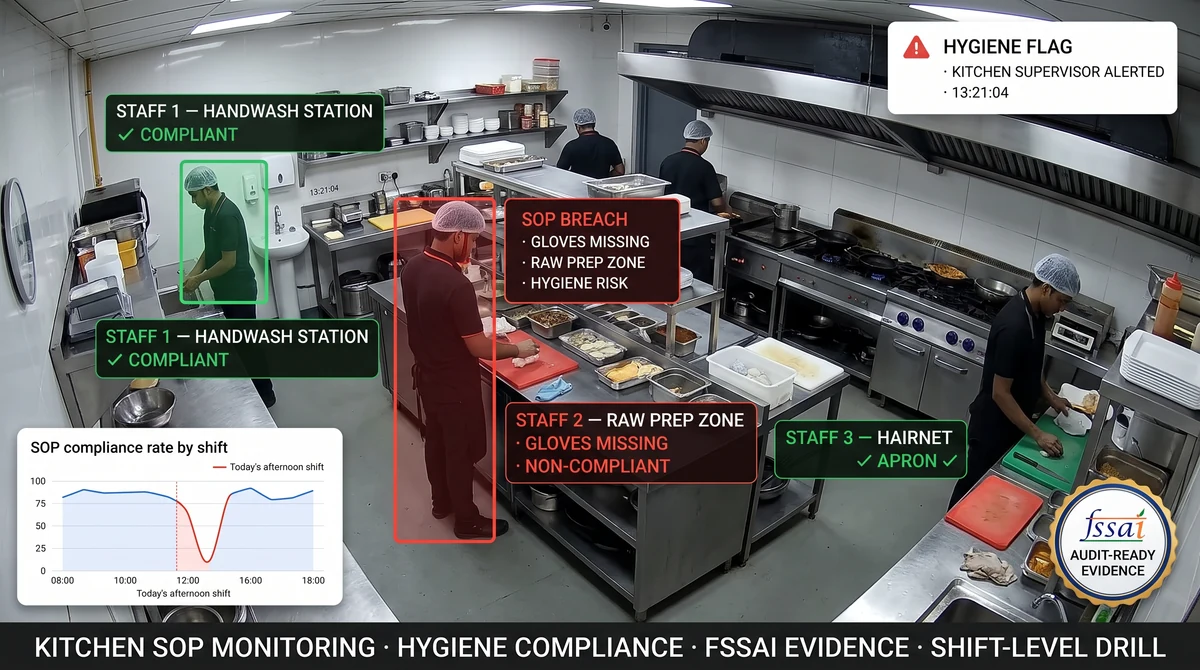
A glove-change event is required in your SOP when a crew member moves from raw to cooked food handling. Slinai's hygiene model monitors the prep station continuously. At 13:42, a crew member at Station 3 moves from raw chicken prep to cooked assembly without a glove change. Within 28 seconds, the kitchen supervisor receives a WhatsApp alert: 'Hygiene breach — Station 3, [Outlet Name], 13:42' with a 30-second clip showing the transition. The supervisor addresses the crew member in real time, the corrective action is logged, and the event appears in the shift compliance scorecard with clip evidence.
What is the average spill response time across our hypermarket outlets this month?
Average spill response time across your 11 monitored hypermarket outlets this month is 4 minutes 20 seconds — down from 11 minutes 45 seconds in the month before Slinai deployment. The fastest responder is Whitefield at 2 minutes 10 seconds average; the slowest is Koramangala at 7 minutes 40 seconds. Koramangala has had three spill events in the last 14 days — all during the 6–8 PM window when floor supervisor coverage is thinnest. Would you like me to flag this for a staffing review?
Generate an audit evidence pack for our Hyderabad cloud kitchen — FSSAI inspection is tomorrow.
I've compiled the audit evidence pack for your Hyderabad cloud kitchen covering the last 30 days. It includes 847 compliance events across 6 stations, 23 breach events with timestamped clips and corrective action logs, daily compliance rate by station and shift, PPE adherence per brand station, and hygiene SOP completion rates by crew group. The pack is ready for download as a structured CSV with clip references, or as an access-controlled link you can share directly with the FSSAI inspector. Average compliance rate across the period was 91.4%.
Which education campus labs had unauthorised after-hours access this week?
Three labs across your two monitored campuses had after-hours access events this week. Chemistry Lab B at the North Campus had one event on Wednesday at 22:17 — a single individual confirmed on camera, clip delivered to the duty warden within 22 seconds, acknowledged and resolved. Electronics Workshop at the South Campus had two events: Tuesday 23:05 (maintenance crew, pre-authorised) and Thursday 20:44 (unrecognised individual, escalated to security). The Thursday event clip is attached in your security alert queue for follow-up.
Every safety and compliance check, continuously
Built for the operational reality of Indian manufacturing, QSR, cloud kitchens, warehouses, and campuses — where auditors cannot be everywhere and manual walk-throughs miss the second the inspector leaves.
PPE detection
Hairnets, gloves, masks, aprons, helmets, hi-vis vests, and lab coats detected at configurable camera stations — entry points, prep lines, assembly bays, and dock areas.
Hygiene SOP monitoring
Handwash-station visits, sanitiser application, glove-change sequences, and food-contact hygiene steps tracked frame-by-frame against per-site SOP definitions.
Zone restriction enforcement
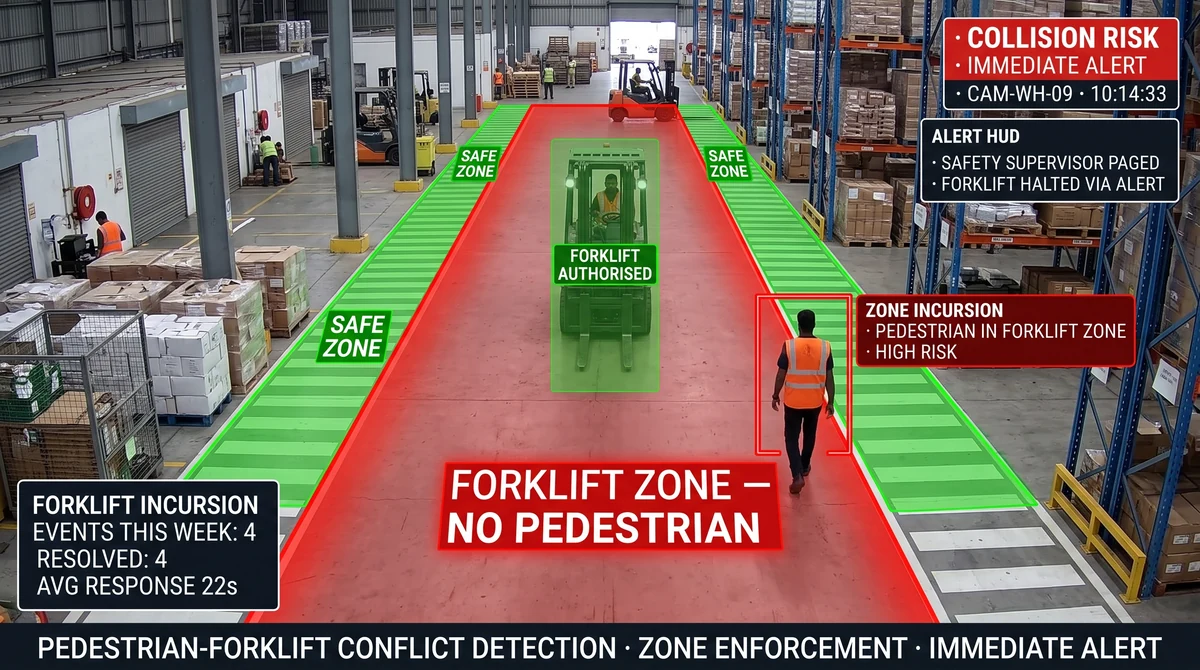
Forklift lanes, chemical storage, clean rooms, server rooms, and restricted machinery zones monitored continuously — unauthorised entry triggers an immediate alert before a hazard materialises.
Real-time breach alerts
WhatsApp notifications with a clip link reach the shift lead within 30 seconds of a verified compliance event — at the right station, from the right camera, with the right context.
Shift compliance scorecards
Hourly and daily compliance rates by station, crew, and site replace clipboard walk-through tallies — trend lines show whether coaching is working shift over shift.
Audit-ready evidence export
Timestamped clip packs, station-level event logs, and shift summaries export as CSV or API payloads for FSSAI, ISO 22000, internal quality management, and aggregator inspections.
See safety & compliance on your cameras
Book a walkthrough — we'll map detections, alerts, and dashboards to your sites.
How Slinai sets up continuous compliance monitoring
From camera survey to live compliance scorecard in under two weeks — with calibration tuning that continues to improve accuracy across the first month.
- 1
Survey existing cameras
Slinai's onboarding team reviews camera coverage at each critical station — line entry, prep bench, dock gate, lab door — and identifies any coverage gaps before model deployment.
- 2
Draw zones and configure models
Safety zones, restricted areas, and compliance checkpoints are mapped as polygons on each camera view. Detection models are selected and sensitivity tuned per station type and operational context.
- 3
Set alert rules and recipients
Breach thresholds, quiet-hour windows, escalation paths, and recipient lists are configured per site. Shift leads get WhatsApp; compliance managers get email digests; HQ gets the multi-site dashboard.
- 4
Run calibration period
A 2–4 week calibration cycle captures site-specific uniform colours, lighting conditions, and PPE variations. False-positive feedback refines models until precision meets operational requirements.
- 5
Expand, benchmark, and audit
Once the first site is live and accurate, zone templates replicate to similar sites in days. Regional compliance scores populate the multi-site dashboard automatically.
Line-entry PPE checks without a supervisor at every gate
Assembly lines, welding bays, chemical-handling stations, and press-shop entries all carry their own PPE requirements — helmets, steel-toed boots, hi-vis vests, gloves, face shields. Enforcing compliance at every gate across three shifts and rotating crews is operationally impossible with human supervisors alone. Slinai monitors camera feeds at every line-entry checkpoint and flags non-compliant workers within seconds of detection — before the person reaches the hazard zone, not after the incident report is filed.
A Pune-based automotive components supplier running three production shifts deployed Slinai across their stamping and assembly buildings. Line-entry PPE violations dropped by more than 80% within six weeks as shift leads acted on WhatsApp alerts rather than discovering gaps during quarterly safety audits. The safety officer's role shifted from clipboard rounds to coaching the 5% of flagged events each week — a measurably more productive use of compliance headcount.
Pune automotive supplier reduces PPE violations by 80%+ in six weeks
A Pune-based automotive components manufacturer running three production shifts across stamping, assembly, and quality inspection buildings was conducting safety audits quarterly — a cycle that revealed PPE gaps weeks after they had been occurring daily. Line supervisors were aware of persistent non-compliance among rotating crew members on the B and C shifts but lacked a systematic mechanism to enforce requirements consistently without being physically present at every entry gate. After deploying Slinai PPE detection at line-entry checkpoints, shift leads began receiving WhatsApp alerts within 30 seconds of any non-compliant entry. Line-entry violations dropped by more than 80% within six weeks. The safety officer's time shifted from unproductive clipboard rounds to targeted coaching conversations backed by specific clip evidence — a change the officer described as 'the difference between knowing we had a problem and being able to fix it.'
Hygiene visibility across every franchise kitchen — without auditors on payroll
Franchise QSR networks have a structural enforcement problem: brand standards require hairnets on through late-night shifts, glove changes before raw-to-cooked transitions, and handwash compliance every time a crew member moves between food and non-food contact tasks. Area managers cannot be physically present in 80 or 120 kitchens simultaneously. Quarterly hygiene audits tell you what happened — they do not prevent the FSSAI notice or the aggregator penalty that arrives first.
A 120-outlet QSR network operating across North and South India used Slinai to monitor critical prep stations continuously. Central QA teams identified three outlier outlets trending below 70% kitchen compliance before a scheduled aggregator audit cycle — switching from surprise failures to structured coaching conversations backed by timestamped clip evidence. Average hygiene event response time across the network fell from the next-day report review to under two minutes from alert to corrective action.
120-outlet QSR network prevents aggregator hygiene penalties with continuous monitoring
A 120-outlet QSR franchise network operating across North and South India was relying on quarterly aggregator hygiene audits and bi-annual internal inspections to manage kitchen compliance. Between audit cycles, compliance performance was invisible — until a complaint, a failed surprise inspection, or an aggregator penalty notice surfaced the gap. After deploying Slinai across critical prep stations at all outlets, the central QA team gained a live compliance view for the first time. Three outlier outlets trending below 70% kitchen hygiene compliance were identified and addressed two weeks before a scheduled aggregator audit cycle — with coaching conversations anchored by specific clip evidence rather than general observations. The network's average hygiene event response time fell from next-day report review to under two minutes from alert to corrective action by kitchen supervisors.
Ready to improve safety & compliance?
Tell us about your sites — we'll map safety & compliance to your cameras.
Forklift-zone and dock-PPE compliance without clipboard rounds
Loading docks and active forklift aisles are the highest-risk zones in any warehouse. Hi-vis vest requirements at dock gates, pedestrian exclusion from forklift lanes, and hard-hat compliance at overhead storage areas are standard SOPs — but three-shift, high-turnover warehouse operations make consistent enforcement exceptionally difficult without continuous monitoring. Safety officers conducting clipboard rounds cover a fraction of the warehouse and cannot observe every gate simultaneously.
A Bengaluru third-party logistics operator managing a 200,000 sq ft distribution centre reduced dock-area PPE non-compliance by 65% after deploying Slinai zone alerts across seven loading bays and three forklift corridors. Safety officers spent less time on scheduled rounds and more time on coaching the events the system surfaced — escalating only repeat offenders and stations with persistent gaps rather than reacting to discovered-late incidents.
Bengaluru 3PL cuts dock PPE violations by 65% across seven loading bays
A Bengaluru third-party logistics operator managing a 200,000 sq ft distribution centre was experiencing persistent hi-vis vest and hard-hat compliance gaps at loading dock gates and forklift corridor entry points. Safety officers were spending the majority of their shift on scheduled clipboard rounds that covered each zone approximately once per two hours — leaving significant monitoring gaps during which compliance behaviour reverted. After deploying Slinai across seven loading bays and three forklift corridors, dock-area PPE non-compliance dropped by 65% within the first month. Safety officers reallocated their patrol time to coaching conversations triggered by the system's alerts, focusing on persistent repeat offenders and specific time windows where compliance was most variable. The operations director noted that the shift in approach 'changed safety from a reactive discipline to a proactive coaching programme.'
Ready to improve safety & compliance?
Tell us about your sites — we'll map safety & compliance to your cameras.
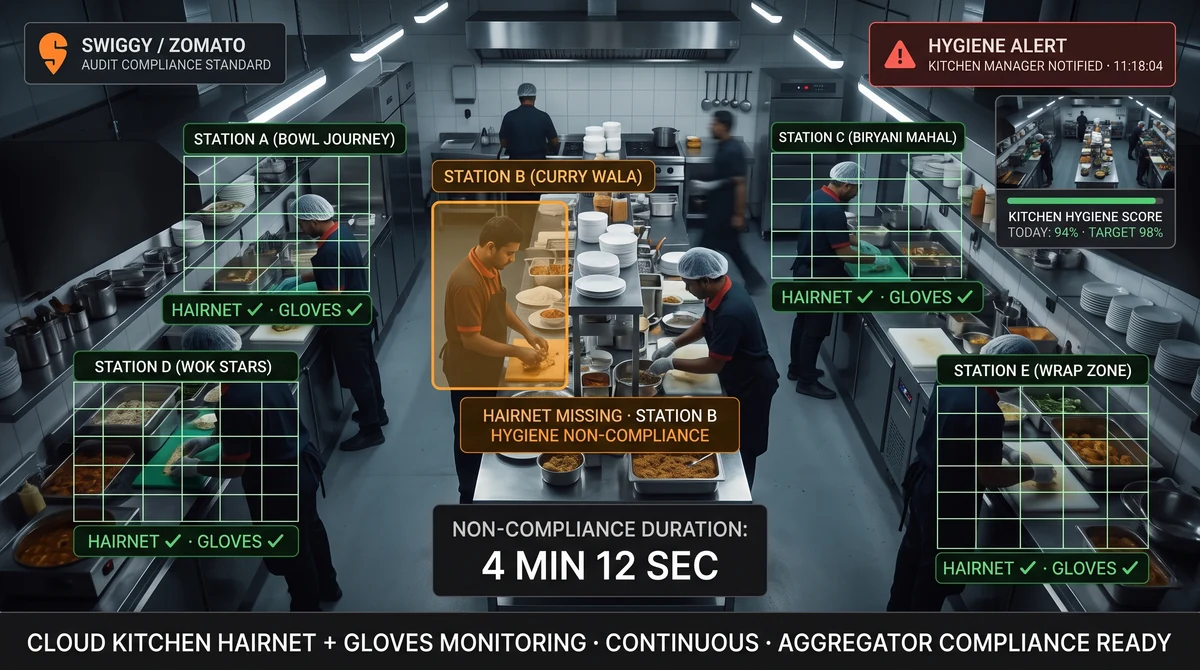
FSSAI-grade hygiene evidence for every aggregator audit — across every brand
Cloud kitchens operating six to ten brands from a single shared kitchen face compounded hygiene complexity: multiple brand SOPs, shared prep surfaces, different allergen protocols, and both FSSAI inspections and aggregator-platform hygiene checks arriving on short notice. Hairnet, apron, and glove compliance must hold across every brand station simultaneously — and evidence must be demonstrably continuous, not cherry-picked from the 20 minutes before the inspector arrived.
A cloud kitchen operator running eight brands out of a Hyderabad hub used Slinai to generate per-station, per-brand hygiene compliance evidence across all shifts. When Swiggy and Zomato auditors conducted unannounced inspections two months post-deployment, the kitchen manager produced compliance logs with timestamped clip references for any requested station and time window in under five minutes — eliminating the pre-audit CCTV scramble that previously consumed an entire shift supervisor's day.
Hyderabad cloud kitchen produces full audit evidence pack in under 5 minutes
A cloud kitchen operator running eight brands out of a Hyderabad hub was facing an operational compliance challenge familiar to multi-brand kitchen operators: maintaining FSSAI and aggregator hygiene standards across multiple brand stations simultaneously, with evidence records that could withstand an unannounced inspection. The pre-deployment process for producing audit evidence — pulling NVR footage station by station, building a spreadsheet of events, writing a summary for the inspector — consumed a full shift supervisor's day. Two months after deploying Slinai, the kitchen received simultaneous unannounced audits from two aggregator platforms. The kitchen manager produced timestamped compliance logs with clip references for any requested station and time window in under five minutes, generating no citations across either audit. The regional operations director described it as 'the first time we went into an audit feeling prepared rather than hoping for the best.'
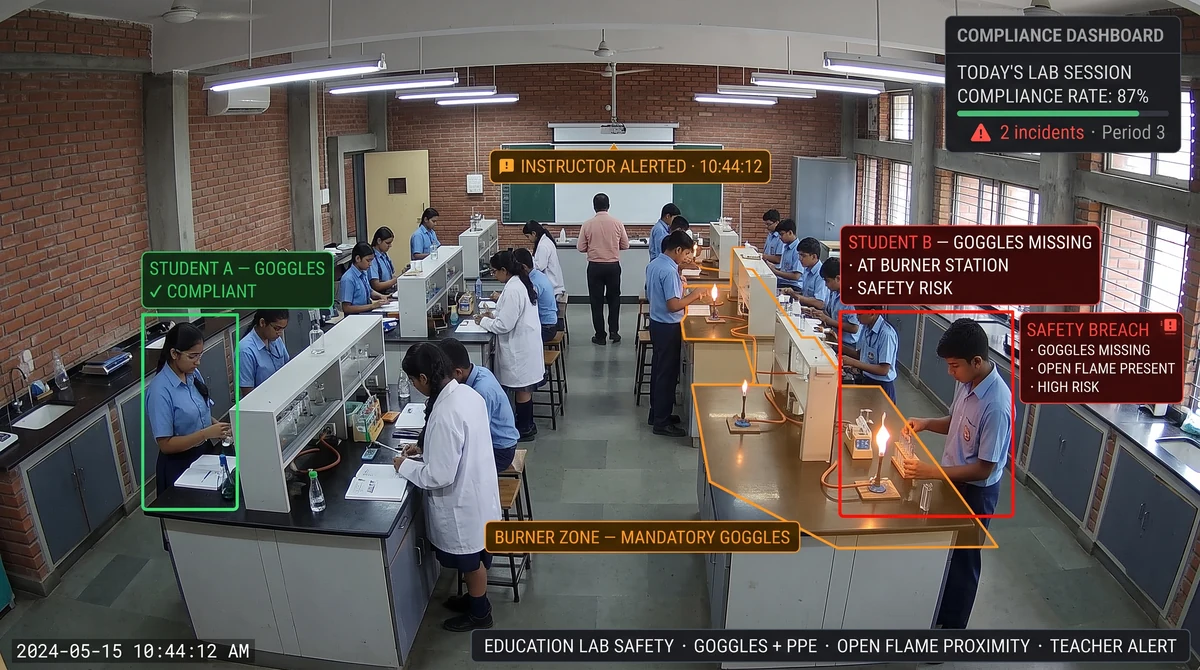
Chemistry labs, server rooms, and restricted zones — monitored without extra security headcount
University and school campuses operate increasingly high-risk spaces: chemistry and biology labs storing hazardous reagents, server and network rooms housing sensitive infrastructure, workshop areas with active machinery, and roof or plant rooms that require restricted access. Enforcing entry restrictions and lab-specific PPE — gloves, goggles, lab coats, anti-static footwear — cannot rely on a faculty member being present during every student or maintenance session, particularly outside teaching hours.
A Delhi NCR engineering college deployed Slinai across four laboratory buildings covering chemistry, electronics, and mechanical engineering labs. Unauthorised after-hours entries to the electronics instrumentation lab dropped to zero in the first month after real-time alert rules fired the moment a door zone was breached — faculty safety officers were notified on WhatsApp before any equipment interaction occurred. Campus security redirected patrol time from low-risk corridors to areas with historically higher incident rates.
Delhi NCR engineering college reaches zero unauthorised lab entries in month one
A Delhi NCR engineering college managing four laboratory buildings had experienced two confirmed unauthorised after-hours entries to its electronics instrumentation lab in the preceding academic year, both discovered after the fact — one through a faculty member noticing displaced equipment, one through a security officer's morning inspection. The college was operating legacy CCTV recording to a DVR without real-time monitoring. After deploying Slinai restricted-zone detection on lab door cameras, the first month of operation recorded zero unauthorised after-hours entries to any monitored lab. Faculty safety officers received WhatsApp alerts within 22 seconds of any door-zone breach, before any equipment interaction could occur. Campus security redirected patrol time from low-risk corridors to areas the system identified as requiring more consistent coverage.
Ready to improve safety & compliance?
Tell us about your sites — we'll map safety & compliance to your cameras.
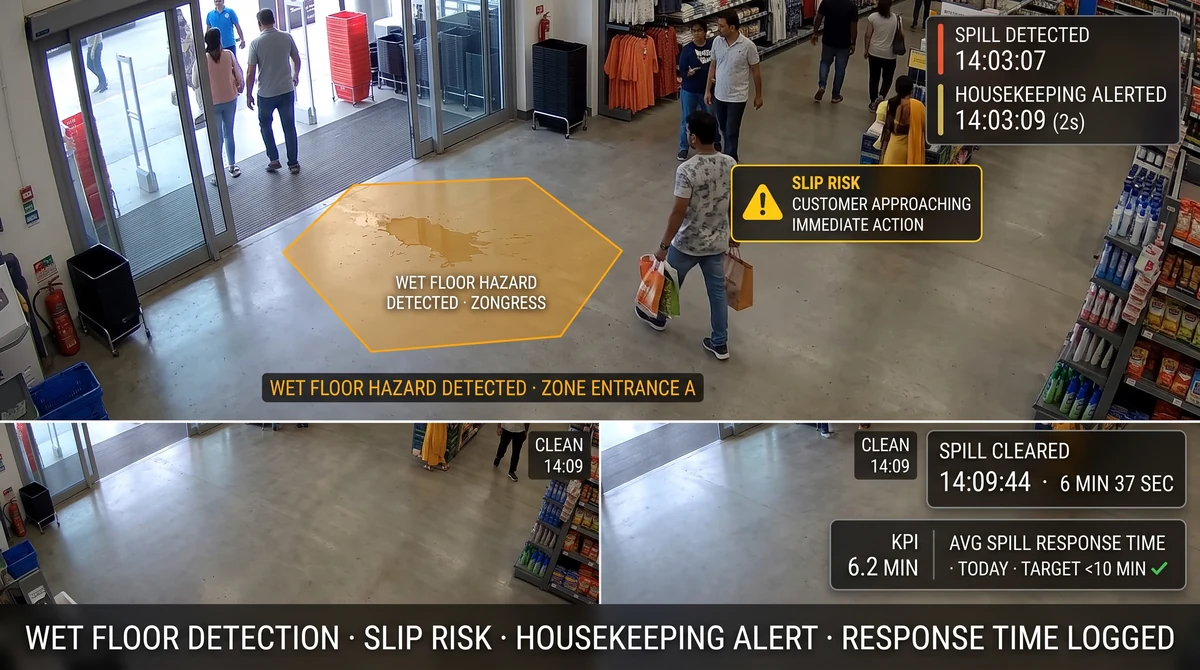
Spot wet floors and spill hazards before someone slips
Liquid spills in hypermarket aisles, food-court service areas, and warehouse pick lanes create immediate slip-and-fall liability. Standard SOP requires floor staff to place wet-floor signs within one to two minutes and complete cleanup within a defined response window — but monitoring compliance with those response timelines has historically depended on incident reports filed after the fall rather than verification that the SOP was followed in the first place.
A hypermarket chain running high-footfall outlets in metro cities across India deployed Slinai on aisle cameras to detect liquid-spill signatures and trigger immediate WhatsApp alerts to floor supervisors. Average spill response time across monitored zones dropped from over twelve minutes — the average time between occurrence and discovery under the prior system — to under three minutes from alert-to-action verified on clip evidence. Slip-incident reports in monitored zones fell markedly in the subsequent quarter.
Hypermarket chain reduces spill response from 12+ minutes to under 3 minutes
A hypermarket chain operating high-footfall outlets across metro cities was experiencing slip-and-fall incidents in aisle zones that their risk team attributed to inadequate spill response times. Under the prior system, spill detection depended on a floor staff member or customer noticing the hazard — an average of 12 minutes after the spill occurred based on incident timestamp analysis. After deploying Slinai spill-detection on aisle cameras, average response time across monitored zones dropped to under three minutes — alert to floor supervisor WhatsApp to clip-verified cleanup. The reduction in response time correlated with a marked decline in slip-incident reports in monitored zones in the following quarter, reducing both liability exposure and customer complaints related to floor hazards.
Ready to improve safety & compliance?
Tell us about your sites — we'll map safety & compliance to your cameras.
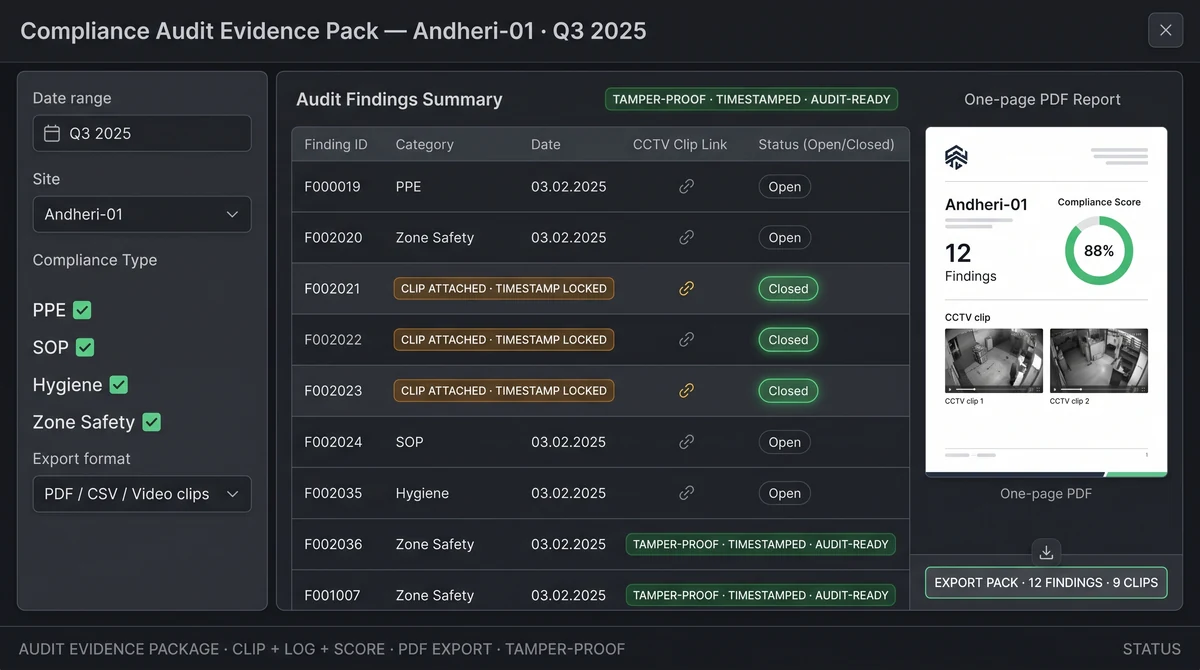
Turn every compliance detection into a timestamped, exportable evidence pack
FSSAI inspections, ISO 22000 audits, factory safety reviews, and aggregator-platform hygiene checks all require documented evidence — not a shift supervisor's recollection. Slinai's compliance logs capture event timestamps, clip references, zone IDs, shift metadata, and the specific detection model that fired. All of that exports as structured CSV, JSON via API, or an access-controlled clip pack — ready to share with an inspector, quality management system, or insurance underwriter without manual trawling through NVR footage.
Audit preparation that once consumed two to three days of compliance team time — pulling CCTV clips station by station, collating paper sign-in records, building Excel summaries — now takes under an hour. Filter by site, date range, event type, and severity; download a timestamped clip pack with metadata attachments; and share via an access-controlled link with a full audit log of who opened the pack, when, and from which device. The chain of custody is built in.
Compliance team reduces audit preparation from three days to under one hour
A food-service operator managing 18 cloud kitchen and QSR sites across three cities was spending two to three days before each FSSAI inspection compiling compliance evidence — pulling NVR footage station by station, building event timelines in spreadsheets, writing narrative summaries of monitoring practices for each site. The process was both time-intensive and structurally incomplete: footage retention limits meant some audit windows had gaps, and the resulting documentation was inconsistent in quality across sites. After deploying Slinai, audit preparation time dropped to under one hour per site: filter by site, date range, and event type; download a structured compliance log with clip references; share via access-controlled link. The operator described the change as 'the difference between dreading an inspection and being able to welcome it.'
Ready to improve safety & compliance?
Tell us about your sites — we'll map safety & compliance to your cameras.
One compliance scorecard across every plant, kitchen, warehouse, and campus
Safety and quality leads at HQ need a single, comparable metric across sites that operate very differently — a stamping plant, a QSR franchise cluster, a dark-store network, and a university campus all run different SOPs and different PPE requirements. Slinai normalises compliance rates into a consistent scorecard — percentage of monitored events with no breach, per shift, per station — that can be ranked across the entire estate. Regional heat maps highlight underperformers for targeted intervention without requiring individual site visits.
Drill-down from a regional compliance tile to a specific site, shift, station, and clip takes one click. Trend lines over the previous four weeks show whether a coaching intervention is holding or whether a site is reverting. New sites added to the network inherit calibration templates from top-performing sites of the same format — shrinking go-live time and standardising the detection methodology across the entire compliance programme.
National food-service operator centralises compliance across 14 sites
A national food-service operator managing 14 sites across manufacturing, QSR, and cloud kitchen formats had compliance data spread across site-level NVR archives, paper audit logs, and a quarterly third-party audit report. The compliance director described the state as 'knowing we had gaps but not knowing where to apply pressure.' After centralising compliance data in Slinai's multi-site scorecard, the team identified two sites trending below 80% compliance — one a cloud kitchen with persistent hairnet issues on late-night shifts, one a manufacturing prep area with seasonal PPE variation. Targeted coaching interventions anchored by clip evidence brought both above 90% within four weeks. New sites added to the network subsequently went live with calibration templates inherited from top performers, halving the go-live time compared to the first deployment.
Ready to improve safety & compliance?
Tell us about your sites — we'll map safety & compliance to your cameras.
Safety and compliance monitoring for every industry
Detection models calibrated for the specific PPE requirements, hygiene SOPs, and zone configurations relevant to each operational format.
Manufacturing & industrial plants
- Line-entry PPE detection for helmets, hi-vis vests, and gloves across all shifts
- Restricted-zone enforcement for forklift lanes, chemical storage, and press bays
- Shift compliance scorecards per station for safety officer coaching
- Factory safety audit evidence export for ISO and statutory reviews
- Real-time breach alerts to safety officers and shift supervisors via WhatsApp
QSR & restaurant kitchens
- Hairnet, glove, and apron detection at all prep stations continuously
- Handwash and glove-change SOP step verification against brand standards
- FSSAI and aggregator audit evidence export in under one hour
- Network-wide compliance league table for QA team oversight
- Breach alert to kitchen supervisor within 30 seconds of detection
Cloud kitchens & ghost brands
- Per-brand, per-station hygiene compliance tracking in shared kitchens
- Allergen-protocol zone monitoring for multi-brand prep surfaces
- Timestamped clip evidence ready for unannounced aggregator inspections
- FSSAI documentation package with chain-of-custody access log
- Continuous monitoring across all operating hours and all brands
Warehouses & logistics
- Hi-vis vest and hard-hat compliance at dock gates and forklift corridors
- Forklift-lane pedestrian exclusion enforcement with immediate breach alerts
- Shift-level PPE compliance rates for all loading and storage zones
- Audit-ready compliance log for client SLA and insurance documentation
- Zone templates replicable across multi-site warehouse networks
Education campuses
- Lab-specific PPE enforcement for goggles, lab coats, and anti-static footwear
- Restricted-zone detection on server rooms, exam storage, and chemical labs
- After-hours entry alerts to duty wardens within 30 seconds of breach
- Campus-wide compliance dashboard for safety officer oversight
- 24/7 monitoring without additional security headcount per lab
Retail & consumer services
- Spill and floor-hazard detection with SOP response-time tracking
- Uniform compliance monitoring for customer-facing and back-of-house staff
- Opening and closing compliance for hygiene and safety checklists
- Food-handling zone compliance for in-store bakery, deli, and café formats
- Evidence export for health department and insurance inspections
Call us now — or book a live walkthrough
Share your camera count and sites. We'll show detections on sample footage from your industry.
Safety & compliance: with Slinai vs without
The enforcement gap between periodic manual audits and continuous camera-based compliance monitoring — across every shift, every station, every site.
| Capability | Without Slinai | With Slinai |
|---|---|---|
| Monitoring coverage | Safety officer clipboard rounds covering each zone once every 2–4 hours — with significant gaps on busy shifts when supervisors are occupied elsewhere | Continuous camera-based monitoring across every configured station on every shift — no coverage gaps, no Hawthorne-effect compliance during observation windows |
| Breach detection speed | Discovered during the next supervisor round, during the next shift's inspection, or at a quarterly audit — hours to weeks after the non-compliance event | WhatsApp alert to shift lead within 30 seconds of a verified compliance breach — while the worker is still at the station and corrective action is immediately possible |
| FSSAI audit preparation | 2–3 days of compliance team time: pulling NVR footage station by station, collating paper logs, building Excel event summaries for the inspector | Under one hour: filter by site, date range, and event type; download structured CSV with clip references; share access-controlled pack with the inspector |
| Multi-site compliance visibility | Fragmented across site-level audit reports, area manager summaries, and third-party audit cycles — no normalised comparison across formats or regions | Normalised compliance scorecard across all sites ranked by station, shift, and site — with drill-down from regional tile to specific clip in one click |
| Aggregator hygiene audit risk | Evidence of continuous monitoring is unavailable — inspector sees only current state and self-reported logs, creating risk of citation for undocumented non-compliance periods | Timestamped compliance evidence for any station, any time window, continuously recorded — demonstrably continuous monitoring rather than point-in-time attestation |
| New-site calibration time | Full compliance programme setup at each new site from scratch — SOP documentation, training, audit schedule, clipboard templates — typically 4–8 weeks per site | Zone templates and calibration configurations inherited from top-performing similar-format sites — new-site go-live typically in 2–5 days after initial deployment |
| Spill and hazard response | Discovered when a customer reports it, a staff member notices it, or an incident is filed — average discovery lag of 8–15 minutes in high-footfall environments | Automated spill detection with WhatsApp alert to floor supervisor — average response time under 3 minutes from detection to clip-verified cleanup action |
| Evidence for HR and disciplinary action | Supervisor's written observation or verbal recollection — difficult to sustain in formal HR proceedings, particularly for repeat non-compliance patterns | Timestamped clip evidence with station ID, shift metadata, and access-controlled export — chain-of-custody documentation suitable for HR, legal, and regulatory proceedings |
| Hardware requirement | No additional hardware required — but manual compliance monitoring cost scales with headcount and cannot achieve continuous coverage regardless of staffing level | Works on existing IP cameras via RTSP or ONVIF — no new cameras, no PPE detection hardware, no IoT sensors required to achieve continuous compliance monitoring |
Safety and compliance monitoring for Indian manufacturing, food-service, and logistics businesses
India's safety and compliance landscape for commercial operations is governed by an overlapping set of regulatory frameworks that create real enforcement obligations — and real consequences for non-compliance. The Food Safety and Standards Authority of India (FSSAI) mandates documented hygiene monitoring for every licensed food-handling business, with registration renewal and licensing renewal contingent on evidence of continuous compliance rather than periodic inspection. Factory safety legislation under the Factories Act requires documented PPE enforcement and hazardous-zone controls at industrial facilities. ISO 22000 and BRC certification programmes — increasingly required by retail and QSR chains as a condition of supplier or franchise approval — specify continuous monitoring requirements that periodic audits cannot satisfy. Slinai is purpose-built to generate the continuous, timestamped, exportable compliance evidence that these frameworks require — from the camera infrastructure Indian operators have already installed.
The aggregator compliance dynamic is an additional enforcement layer specific to India's food-service market. Swiggy, Zomato, and the growing network of B2B aggregator platforms now conduct hygiene audits at cloud kitchen and QSR facilities as a condition of continued platform listing. Unannounced audits with short-notice evidence requirements have been increasing since 2023, driven by platform liability concerns and consumer complaints. Cloud kitchen operators who relied on periodic internal audits and informal evidence practices have been caught unprepared — facing temporary delisting while scrambling to compile documentation that Slinai generates automatically. A platform with 12 brands across three kitchen hubs cannot afford the revenue disruption of a delisting, even a temporary one. Continuous compliance monitoring with one-click evidence export is the risk management infrastructure that India's food-service aggregator economy now requires.
WhatsApp is the enforcement channel that actually works for Indian safety and compliance teams. A safety officer managing 80 line-entry points across a manufacturing plant does not log into a web dashboard to verify that the alert triggered at Bay 7 has been resolved — they receive the clip on WhatsApp, instruct the shift supervisor in the same thread, and confirm resolution from the follow-up clip. Slinai's compliance alerting is designed around this operational reality: breach alerts route to the WhatsApp number or group the recipient already uses, with clip evidence embedded in the message rather than attached to a separate login. For QA managers overseeing franchise networks across multiple cities, the multi-site compliance scorecard updates automatically and surfaces non-compliant outlets before the quarterly aggregator audit cycle — giving the team time to address gaps through coaching rather than through emergency remediation during an active inspection.
Make every shift a compliant shift — automatically
Slinai connects to your existing cameras and starts monitoring compliance within days. Our team will map PPE zones, SOP detection, and alert routing to your specific requirements — and show you live results before you commit.
Employee privacy and DPDP compliance in safety monitoring
Safety and compliance monitoring involves continuous camera observation of workplaces, which intersects with employee privacy interests and the obligations introduced by India's Digital Personal Data Protection Act (DPDP Act, 2023). Slinai's compliance monitoring is designed with proportionality as a foundational principle: detection zones are positioned at specific compliance checkpoints — line-entry gates, prep station views, restricted-zone doors — that have a clear and documentable safety and regulatory justification, rather than on general employee movement throughout the facility. Compliance detection models classify whether required PPE is present or required SOP steps are completed; they do not build per-person movement histories or biometric records. Where identification is necessary for HR follow-up on specific breach events, that access is role-restricted to authorised compliance personnel and logged with full audit trail.
Data retention configurations in Slinai allow operators to set archive periods aligned with their compliance documentation requirements and DPDP obligations — retaining flagged compliance event clips for audit and HR purposes while cycling background monitoring footage on shorter schedules. All access to retained footage and compliance event data is logged with user ID, timestamp, and purpose. Slinai strongly recommends that operators include camera monitoring disclosure in employment agreements and post visible compliance monitoring notices at camera stations — a practice that additionally produces a measurable deterrent effect on non-compliance behaviour. The onboarding process includes documentation templates and guidance to support DPDP-compliant disclosure practices, and India-region cloud hosting options are available for operators who require data residency within the country's borders.
For operators pursuing or maintaining FSSAI, ISO 22000, or factory safety certifications, Slinai's compliance evidence architecture is designed to support documentation requirements without requiring employees to take additional compliance actions — the camera record is generated automatically from existing monitoring infrastructure. Compliance teams can generate evidence packs for any site, station, and time window on request, with a chain-of-custody access log that demonstrates to regulators that the documentation reflects genuinely continuous monitoring rather than a curated selection of footage prepared for inspection.
Questions teams ask about safety & compliance
Does Slinai replace safety officers or compliance auditors?
No — it makes their time more effective. Slinai provides continuous monitoring between visits and surfaces the specific events that need a safety officer's attention. Auditors and officers can focus coaching and investigation time on the 5–10% of flagged incidents rather than covering every station manually every shift.
Which PPE items can the system detect?
Currently supported detection categories include hairnets, gloves, surgical and dust masks, hard hats or helmets, hi-vis or reflective vests, aprons, lab coats, and shoe covers. Detection accuracy varies by station camera angle, lighting, and PPE colour contrast against backgrounds — confirmed during per-site calibration.
How quickly are breach alerts sent to shift supervisors?
Verified breach alerts typically reach WhatsApp within 30 seconds of the event being detected and confirmed by the site's configured alert logic. Latency depends on site internet connectivity and whether human verification is required in the alert workflow.
Can breach alerts go to WhatsApp groups, not just individuals?
Yes. Alerts can route to WhatsApp groups, individual numbers, email addresses, or webhook endpoints — with per-site and per-event-type routing rules. A kitchen hygiene breach might alert the kitchen supervisor on WhatsApp while also logging to a central compliance email.
Is the monitoring system DPDP-compliant?
Slinai is designed with DPDP principles: role-based access controls, purpose-limited data processing, configurable video retention periods, audit logs for all access events, and India-region cloud hosting options. Identifiable footage access is restricted to authorised roles; compliance dashboards expose event rates rather than individual identities where possible. See Security & privacy for full deployment guidance.
Can compliance data export for FSSAI, ISO 22000, or factory safety audits?
Yes. Event logs with timestamps, station IDs, shift metadata, and clip references export as structured CSV, API JSON, or access-controlled clip packs. The export format and metadata fields are designed to align with FSSAI documentation expectations. Organisations pursuing ISO 22000 certification have used Slinai records as supporting evidence for continuous monitoring requirements.
How are false positives reduced over time?
During a 2–4 week calibration period, accuracy feedback from site supervisors (marking true versus false positives) is used to refine station-level model parameters — PPE colour profiles, detection polygon boundaries, and sensitivity thresholds. Most sites reach stable precision within the first month. Similar sites added later can inherit the tuned configuration, reducing their calibration time significantly.
Can Slinai detect liquid spills or wet-floor hazards?
Yes, on supported camera views with sufficient resolution and contrast. Spill detection identifies reflective surface anomalies consistent with liquid accumulation and triggers an alert for the floor response team. This capability is particularly effective in brightly lit retail aisles and kitchen service areas.
Do I need to replace existing cameras to use this?
No. Slinai runs on existing IP cameras connected via RTSP or ONVIF — Hikvision, CP Plus, Dahua, Axis, and most mixed-vendor NVR setups. Camera image quality and angle are assessed during the onboarding survey; where a critical station has a gap in coverage, a targeted camera addition may be recommended rather than a full site upgrade.
How long does calibrating a new site take?
Initial zone mapping and model activation typically completes within 5–10 days of receiving camera credentials. The calibration tuning period runs for 2–4 weeks. Sites in the same format as an already-calibrated location can go live faster by inheriting zone templates.
Can I compare compliance performance across sites and regions?
Yes. The multi-site compliance dashboard normalises event rates into comparable compliance scores per station, shift, and site — rankable across any combination of region, city, and operational format. Regional managers see league tables; HQ sees aggregate trends and outlier flags.
What happens to monitoring when a site loses internet connectivity?
On cloud-native deployments, stream ingestion and AI processing pause during connectivity loss and resume automatically when connectivity is restored. For bandwidth-constrained or critical sites, Slinai's edge deployment model processes detections locally and syncs alerts, clips, and compliance logs to the central dashboard when connectivity is available. Camera-offline alerts fire to IT and site managers immediately on stream loss.
Keep exploring
Industries
- Manufacturing
PPE, safety zones, line monitoring
- Restaurants & QSR
Kitchen hygiene, queues, POS oversight
- Cloud kitchens
Hygiene, prep SLA, safety alerts
- Logistics & warehouses
Dock TAT, PPE, perimeter security
- Education campuses
Campus safety, attendance, exam integrity
Product modules
- SOP & PPE compliance
Core detection pack
- Video AI
Detection & agentic intelligence
- Cloud VMS
Multi-site video layer
- Alert channels
WhatsApp, Slack, SMS
- Security & privacy
DPDP-aligned design
Related use cases
- Operations & productivity
Throughput, staffing, multi-site KPIs
- Physical security
Intrusion, perimeter, after-hours
- Multi-site oversight
Regional dashboards, benchmarking
Talk to us — or see it live
Tell us about your sites and goals, and we'll show you exactly what Slinai surfaces on your existing cameras.
Book a live demo
A focused 30-minute session, tailored to your operation.
- Live walkthrough on footage like yours
- Your top use-cases mapped to detections
- Deployment plan for your cameras & sites
- Indicative pricing and ROI estimate
Or reach us directly