Stop shrinkage before it leaves the store
Slinai turns existing CCTV into a continuous loss prevention layer — detecting suspicious behaviour in high-shrink zones, correlating POS voids with camera evidence, and routing clip-backed alerts to LP managers on WhatsApp in under thirty seconds.
Works with any IP camera · Hikvision · CP Plus · Dahua · ONVIF
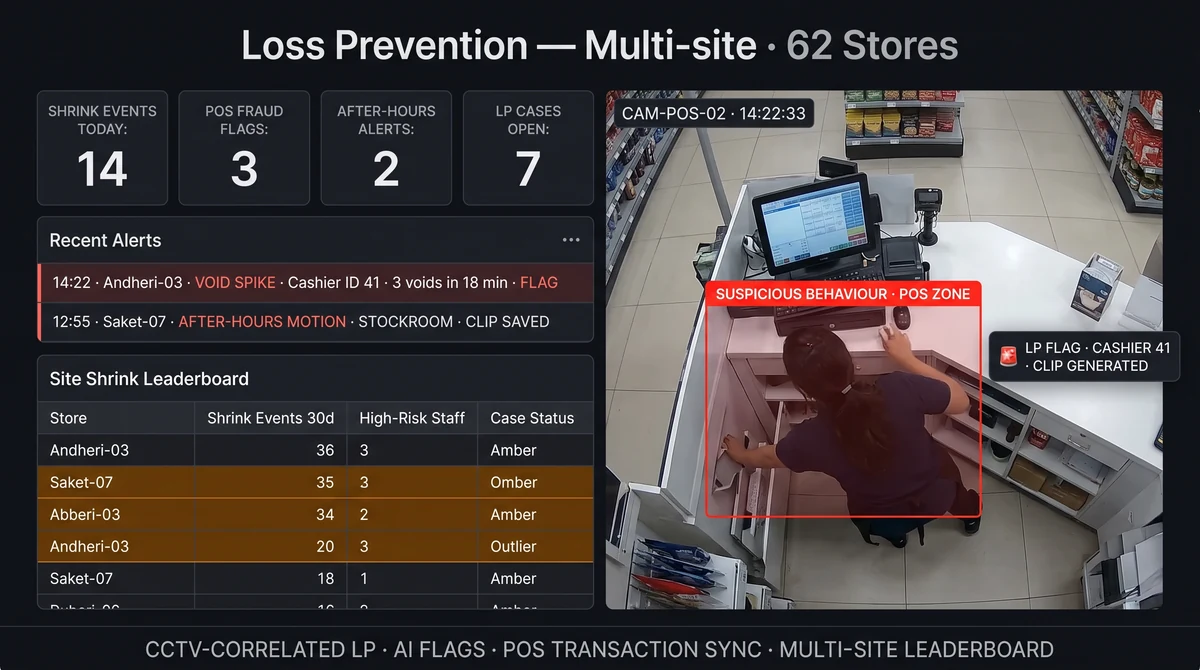
What is loss prevention video analytics?
Loss prevention video analytics uses AI models running on existing CCTV to detect shrinkage-related behaviour in real time — suspicious dwell in high-value zones, cashier anomalies correlated with POS void events, after-hours stockroom motion, and coordinated movement toward exits. Verified clip-backed alerts reach LP teams within seconds, replacing post-incident footage reviews with proactive, evidence-first incident management.
Why traditional LP can't keep pace with modern retail shrinkage
India's organised retail sector loses an estimated ₹9,000–₹12,000 crore annually to shrinkage, according to surveys spanning supermarket chains, fashion retailers, and electronics outlets across FY 2022–24. The causes cluster into four persistent buckets: internal theft by staff (28–35% of total shrink), shoplifting and organised retail crime (40–45%), vendor and supplier short-shipping (15–20%), and administrative errors including receiving gaps, mis-tags, and system-level write-offs (10–12%). The frustrating reality for LP directors is that most of this loss is detectable in camera footage — but only if someone is watching the right feed at the right moment, which manual NVR review cannot deliver at scale across a 50- or 500-site estate.
Traditional loss prevention in Indian retail relied on a combination of uniformed security at entrances, periodic internal audits, and post-incident footage scrubs. Each carries a structural gap that compounds over time. Visible guards displace but do not eliminate determined theft, particularly organised retail crime that scouts guard patterns in advance. Internal audits arrive weeks after the shrinkage has already closed, and they lack the granularity to distinguish pilferage from receiving error without video evidence to anchor the investigation. Post-incident reviews require LP staff to manually search hours of NVR footage across eight to sixteen cameras per event — a labour cost that scales exponentially as store networks grow beyond a hundred outlets.
Video-based loss prevention has evolved from passive CCTV archiving to active AI-driven monitoring. Modern LP video analytics runs detection models continuously on live camera streams, watching for behavioural signatures — prolonged dwell in low-traffic bays, items transferred between containers without scanning, coordinated movement toward unmonitored exits, loitering near stockroom entry points — and surfaces only the events that warrant attention, rather than generating noise from every pixel change. An LP coordinator managing 80 stores can review verified incidents in two hours rather than spending two days scrubbing raw footage.
Slinai extends video-based LP with three capabilities that raw CCTV analytics cannot provide alone. First, POS correlation: when a void, no-sale, or high-discount transaction fires in the point-of-sale system, Slinai automatically surfaces the matching billing-counter footage at the correct timestamp, converting transaction anomalies into investigable clip events without manual lookup. Second, agentic investigation: LP managers query the system in plain language — 'Show me all after-hours events at Bengaluru stores last week' — and receive clip links and incident summaries rather than raw footage indexes. Third, multi-site aggregation: incident data from every monitored location normalises into a single dashboard so HQ loss prevention teams see the full risk picture rather than a patchwork of site-level NVR reports.
The business case becomes compelling when modelled against even a modest shrinkage reduction. A retail chain turning ₹500 crore annually at 2.0% shrinkage absorbs ₹10 crore in annual loss. A 20% reduction through consistent LP monitoring — a conservative benchmark from comparable deployments — returns ₹2 crore per year from infrastructure the business already owns. For QSR networks, dark stores, warehouses, and manufacturing plants, the same logic applies to the specific loss vectors prevalent in each format.
Questions your LP team already need answered
Slinai's agentic assistant surfaces shrinkage data, POS exceptions, and incident clips from across your estate — ask in plain English or Hindi, get evidence-backed answers.
- Zone ranking
Shrink by zone
Identify which bays, stockrooms, and checkout lanes generate the most confirmed incidents — ranked by event count and estimated loss value — so physical controls and camera coverage target the highest-impact zones first.
- POS layer
Exception correlation
Surface void, no-sale, and refund transactions alongside the matching billing-counter clip in a single investigation view — complete cases in under 30 minutes rather than after multi-day footage reviews.
- After-hours
Armed zone alerts
Arm loss-sensitive zones automatically when the last till closes. The first verified human motion after curfew fires a clip alert to the duty security contact within thirty seconds — while the incident is still in progress.
What's the shrinkage rate across my monitored stores this quarter compared to last?
Confirmed shrinkage incidents across your 38 monitored stores are down 26% quarter-on-quarter — from 214 flagged events in Q3 to 158 in Q4. The electronics-bay cluster at your Tier 1 stores accounts for 61% of remaining events. Three stores in Pune are outliers at 2.3× the format average — I can pull their incident clips.
Walk me through what a cashier void alert looks like in Slinai.
When a void fires in your POS, Slinai captures the terminal ID and timestamp, clips a 90-second segment from the billing-counter camera, and sends the LP manager a WhatsApp message with the clip, void amount, terminal number, and store name — all within 30 seconds. The manager taps to view, sees the customer interaction, and flags or clears the event before the shift ends. No manual timestamp lookup, no footage scrubbing.
What does an after-hours stockroom intrusion look like in the system?
At 02:14 AM, Slinai detects verified human motion in the armed stockroom zone. Within 28 seconds, the duty security manager's WhatsApp receives: 'Alert — Stockroom, [Store Name], 02:14 AM' with a 60-second clip showing the entry point and movement toward the high-value bay. The security team dispatches while the subject is still on premises — versus discovering the loss the next morning.
Which stores have the most LP incidents this month, and what's driving them?
Your top 5 incident stores this month account for 38% of all flagged events across the estate. Three are in standalone buildings with older NVR coverage on stockroom entrances — after-hours events dominate. Two are high-footfall mall stores where electronics-bay dwell anomalies cluster between 14:00 and 17:00. I can generate a zone-coverage gap report for the standalone-building sites.
How does Slinai detect pick-shrink in dark stores and quick-commerce hubs?
Slinai monitors pick-zone aisles for anomalous dwell at high-value SKU bays and off-tote item handling. When integrated with your WMS, pick-event timestamps correlate with specific order IDs — so a customer complaint about a missing ₹800 item resolves in a 90-second clip review rather than an entire shift's footage scan. Dark store hub managers receive anomaly alerts in real time rather than discovering gaps at end-of-day count.
Every shrinkage vector, one platform
Slinai's LP capability set spans the full loss lifecycle — from real-time zone monitoring and POS correlation to multi-site dashboards and audit-ready evidence exports.
High-shrink zone monitoring
AI models run continuously on high-value bays, stockroom doors, exits, and electronics displays — flagging suspicious dwell, coordinated movement, and loitering patterns that correlate with theft events.
POS void & exception correlation
Void, no-sale, and high-discount POS events automatically surface the matching billing-counter clip — converting transaction anomalies into video-evidenced investigation tasks without manual timestamp lookup.
WhatsApp clip-backed alerts
Verified LP events route to store managers, LP supervisors, or security leads on WhatsApp with clip links, store name, zone, and timestamp — in English or Hindi — within thirty seconds of detection.
Agentic investigation assistant
Ask in plain language — 'Show me all after-hours events at NCR stores this week' or 'Which terminals had the most voids yesterday?' — and receive clip-linked summaries rather than footage indexes.
Shrinkage trend dashboards
Week-over-week incident trends by zone, store, city cluster, and format surface persistent hot spots and emerging patterns — moving LP strategy from reactive audits to predictive zone management.
Chain-of-custody evidence exports
Watermarked clips, access logs, and incident case files export with timestamps and site metadata for HR, legal, insurer, or police handoffs — meeting evidentiary standards for disciplinary proceedings.
Anomalous movement heatmaps
Movement pattern heatmaps overlay on floor plans to show where LP incidents cluster — identifying blind spots, poorly positioned cameras, and layout changes that inadvertently create cover for theft.
After-hours zone arming
Loss-sensitive areas arm automatically at closing time based on POS close triggers or duty-manager commands. Verified after-hours motion fires clip alerts in under thirty seconds before the incident escalates.
Business-hours & schedule rules
Detection thresholds, alert routing, and zone sensitivity adjust by daypart, day of week, and store format — preventing false positives during restocking while maintaining vigilance during sales hours.
Counter-level audit trails
Every billing counter generates a timestamped event log — voids, no-sales, high discounts, long transactions — with clip references, enabling rapid exception audits without footage scrubbing.
See loss prevention & shrink reduction on your cameras
Book a walkthrough — we'll map detections, alerts, and dashboards to your sites.
From existing cameras to active LP in five steps
Slinai connects to the CCTV already installed in your stores, warehouses, and kitchens — no hardware replacement, no rip-and-replace. Go-live typically completes in 5–10 business days per site.
- 1
Connect existing cameras
Slinai ingests RTSP/ONVIF streams from Hikvision, CP Plus, Dahua, TVT, and mixed-vendor NVRs without hardware replacement. A site survey confirms camera angles and coverage for LP zone calibration during onboarding.
- 2
Define LP zones & detection models
The onboarding team draws loss-specific zones — stockroom doors, electronics bays, cosmetics displays, billing counters, loading docks, exit corridors. Models calibrate per site format so thresholds reflect your store layout and traffic density.
- 3
Connect POS & inventory systems
API or webhook connectors link Slinai to your POS — Oracle Simphony, Posist, NCR Aloha, Petpooja, or custom platforms. Void, no-sale, and refund events immediately correlate with matching camera footage from go-live.
- 4
Configure alert routing & schedules
LP managers, area supervisors, and security contacts receive alerts through their preferred channels — WhatsApp groups, email, or API webhooks. After-hours arming schedules, escalation paths, and quiet-hour rules configure per site without engineering involvement.
- 5
Review, refine & scale
Detection accuracy improves over the first 2–4 weeks as site-specific feedback reduces false positives. Configurations that perform well at pilot stores publish as templates to similar-format locations — scaling from 10 to 100 monitored sites without repeating calibration from scratch.
The invisible drain hiding in your NVR archive
India's organised retail shrinkage rate of 1.8–2.5% hides in plain sight because the evidence is recorded but never reviewed in time to matter. Every camera captures the moment a high-value item leaves the shelf without a corresponding scan — but that footage sits in an NVR until it overwrites, seven to thirty days later, while the stock gap shows up as a variance line in the quarterly inventory report. The gap between evidence and investigation is not a technology problem; it is a workflow problem that real-time video analytics solves by eliminating the need for post-incident footage hunting entirely.
Slinai shifts LP from archive-first to alert-first. Instead of LP staff reviewing yesterday's footage to understand last week's loss, the system watches defined high-shrink zones continuously and surfaces only the two percent of moments that contain an actionable signal — extended dwell at a cosmetics display, a bag placed near an electronics peg without subsequent basket movement, two individuals whose movement to an exit correlates with the blind spot between fixed cameras. Each signal arrives as a clip-backed alert — not a raw timestamp — so the LP coordinator triages in minutes rather than hours.
For retailers running 30 to 150 stores on mixed camera hardware — a common situation in India where store rollouts span multiple hardware generations and vendors — Slinai normalises footage into a single LP workflow regardless of whether individual sites run Hikvision DVRs, CP Plus NVRs, or newer IP camera arrays. The LP team in HQ sees one incident queue, not 80 separate NVR logins.
Fashion chain reduces confirmed shrinkage by 31% in sixteen weeks
A mid-market fashion retailer operating 38 stores across Maharashtra and Gujarat was recording consistent shrinkage of 2.1% annually — roughly double its franchise-cluster benchmark. LP investigations were almost entirely reactive: NVR footage reviewed after stock counts revealed gaps, with attribution rates below 20% due to the elapsed time. After connecting existing floor cameras to Slinai and enabling high-shrink zone monitoring on fitting-room corridors, stockroom entry points, and high-value accessory bays, the LP team began receiving same-day clip alerts. Response time dropped from an average of four days per confirmed incident to under two hours. Within sixteen weeks, the chain recorded a 31% reduction in confirmed shrinkage events at monitored outlets.
When the void button becomes your biggest liability
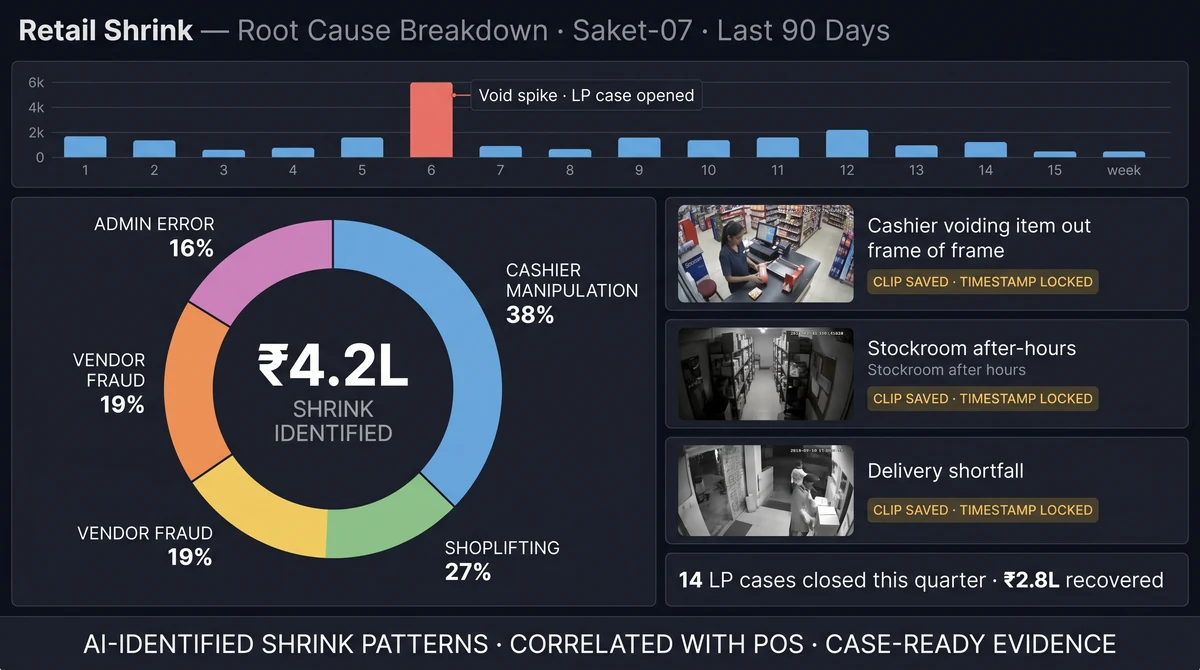
Cashier-level fraud is the most difficult category of retail loss to detect and the most expensive to ignore at scale. A single cashier who voids legitimate transactions, accepts goods without scanning, or applies unauthorised discounts may generate ₹5,000–₹20,000 in loss per shift — small enough to evade individual stock audits but substantial when multiplied across hundreds of counters over a full financial year. The structural gap in traditional LP is that POS exception reports produce data without context. A void on its own is ambiguous: it could be a genuine correction, a training error, or a coordinated fraud mechanism. Only the video of that transaction resolves the ambiguity.
Slinai's POS correlation layer integrates with Oracle Simphony, Posist, NCR Aloha, Petpooja, and custom-developed systems through API and webhook connectors. When a void, no-sale, refund, or high-discount transaction fires in the POS log, Slinai captures the terminal ID and timestamp, correlates the event to the matching billing-counter camera view, clips a 90-second segment centred on the transaction, and routes a combined alert — transaction record and clip — to the LP manager in a single investigation package. No manual timestamp lookup. The LP team sees both the anomalous transaction and the corresponding customer interaction simultaneously and resolves the event in minutes rather than after multi-day investigations.
Over time, the correlation layer builds behavioural baselines per terminal — average void frequency by daypart, discount rates by weekday, refund patterns by category — and surfaces deviations in weekly exception reports ranked by risk score. LP supervisors focus coaching and disciplinary conversations on specific evidenced events rather than suspicion and gut feel. For chains running 80 or more billing counters, this shift to evidence-based cashier management typically yields a 15–25% reduction in exception event rates within the first two financial quarters.
Grocery chain identifies sweethearting pattern across three stores
A regional grocery supermarket network operating 22 outlets across Uttar Pradesh was recording a persistent gap between COGS and POS revenue that internal audits could not explain through receiving variance alone. After enabling Slinai POS correlation, the LP team identified a pattern of high-frequency no-sale events at two specific billing counters during the final two hours of each afternoon shift — events that coincided, in clip review, with specific regular customers receiving items in bags without a scan recorded. The LP director described the clip evidence package as 'the first time in five years we could build a complete HR case in 48 hours rather than waiting six weeks for an inconclusive audit.'
Kitchen waste, cash shortfalls, and aggregator gap
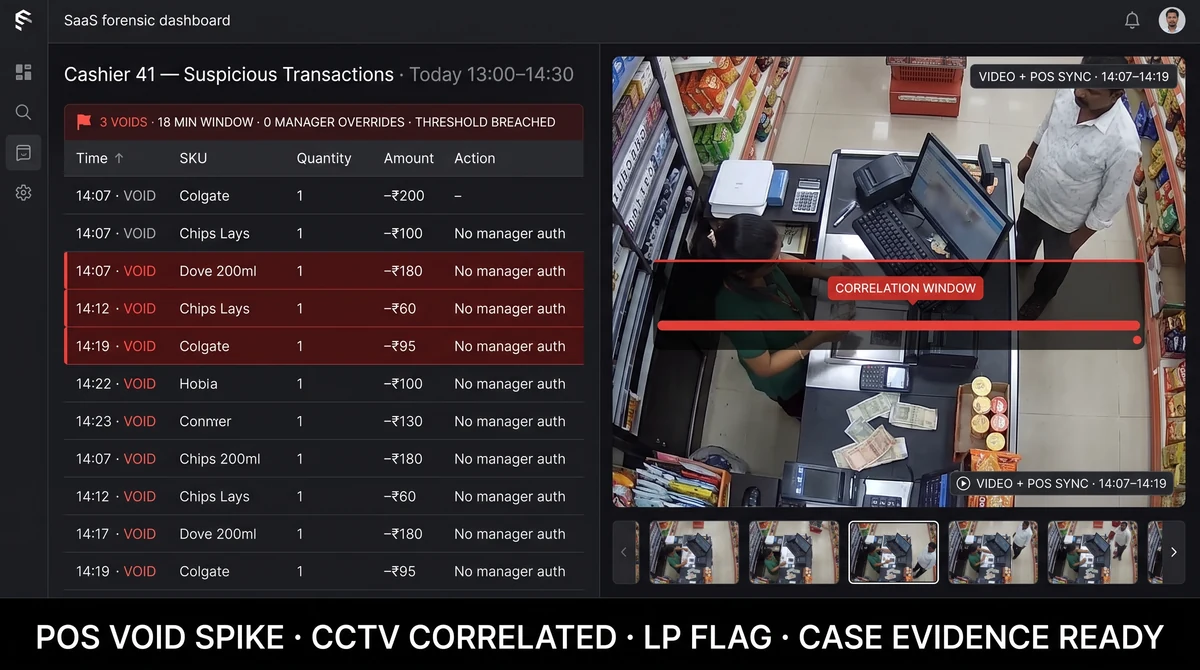
Loss prevention in quick service restaurants and food-service outlets takes a different shape from general retail. The primary loss vectors are kitchen food waste above SOP norms, cashier void and void-swap fraud on meal combos and add-on items, cash handling gaps at front-counter and takeaway windows, and aggregator order fulfilment disputes — where food leaves the kitchen, fails to reach the delivery rider, and generates a refund claim that splits loss between the brand and the platform. Each of these events has a camera signature, and each can be monitored continuously rather than discovered through periodic audits weeks after the loss has accumulated.
Slinai QSR loss prevention monitors kitchen prep stations for waste events — food prepared significantly beyond the active order volume, trays and portions returned to the kitchen without SOP waste documentation, and handling patterns at the packaging station that suggest diversion rather than disposal. At the front counter, cashier audit trails link terminal void events to the camera view of the till, the customer interaction, and any handoff at the takeaway or drive-through window. For aggregator handoff, timestamps at the dispatch counter correlate with rider arrival and departure events on entry cameras — creating an auditable chain from kitchen to bag to rider that QSR brands typically lack for dispute resolution.
For franchise networks managing 30 to 150 QSR outlets under a single brand umbrella, the multi-site LP dashboard aggregates events by outlet and city cluster, enabling the brand's LP function to identify which franchisees show systematic loss patterns versus isolated incidents. Regional LP managers receive daily digests on WhatsApp with drill-down links to specific outlet event logs, so they can address issues in routine operational calls rather than scheduling special audit visits.
QSR franchise group recovers aggregator dispute credits in quarter one
A franchise group managing 61 outlets of a national QSR brand across South India was absorbing aggregator refund disputes at an estimated ₹18–22 lakh per month — largely because they had no footage-based evidence to contest claims through the aggregator's dispute portal. After deploying Slinai dispatch-counter monitoring and correlating camera timestamps with order IDs from the aggregator API, the group was able to provide video evidence for 73% of disputed orders in the first quarter. Approved dispute resolutions partially offset their Slinai subscription cost by month three.
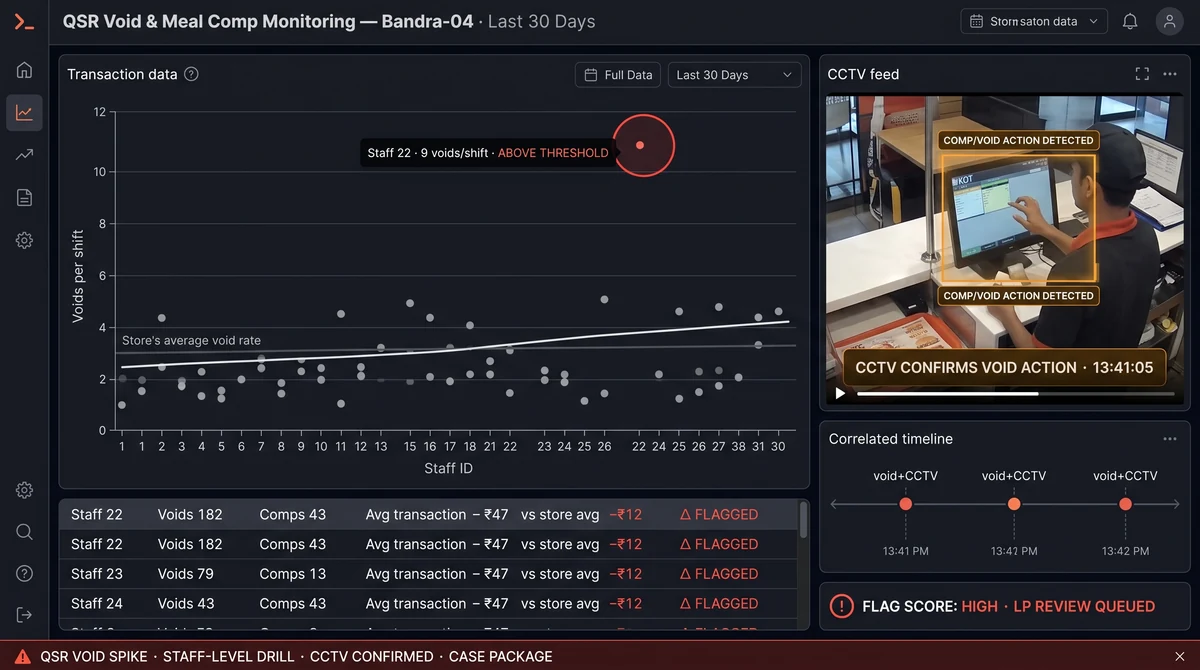
Watch loss prevention working in a live QSR environment
We'll run a custom walkthrough against your outlet layout, POS system, and aggregator setup.
Dock-to-shelf gaps that erode margin quietly
Warehouse and distribution-centre shrinkage in India is harder to detect than retail floor theft — it is more easily masked as administrative error and more rarely attributed to deliberate loss. Shrinkage events cluster around three phases: inward receiving, where short shipments are recorded as full acceptance; storage and picking, where high-value goods are diverted during low-supervision night shifts; and dispatch, where cases are sealed without full contents or riders substitute at exit points. In each phase, the camera evidence exists — but without a system correlating footage to GRN timestamps, WMS pick records, and dispatch manifests, that evidence sits passive in an archive.
Slinai monitors receiving docks with zone-calibrated cameras that capture unloading sequences alongside GRN timestamps — so variance between what arrived on the vehicle and what entered the WMS can be correlated with video evidence rather than attributed to vendor counting error by default. In pick zones, anomaly detection flags unusual dwell near high-value SKU locations during low-traffic periods, capturing the behavioural signature of pilferage before a stock audit reveals the gap. Dispatch gates benefit from automated vehicle and personnel tracking that confirms handoff sequences against WMS-generated order manifests when integrations are available.
For 3PL operators managing multiple warehouse clients from a shared facility, Slinai provides client-separated zone monitoring with access controls — so Client A's LP team cannot view footage of Client B's stock locations while both benefit from the same underlying camera infrastructure and LP event logging platform.
3PL operator reduces dock-level receiving variance by 40% in one quarter
A third-party logistics provider managing five fulfilment centres across NCR, Pune, and Hyderabad was experiencing a persistent gap between vehicle manifests and GRN entries that their inward team attributed to vendor counting errors. After mounting Slinai monitoring at receiving docks with GRN timestamp correlation, a pattern emerged of consistent short-counts on specific high-value SKU categories during particular morning shift windows — not random vendor error, but a systematic receiving gap with a human behavioural signature. The operations director used clip evidence simultaneously in vendor negotiations and internal HR proceedings, recovering the equivalent of three months of inventory variance within one quarter.
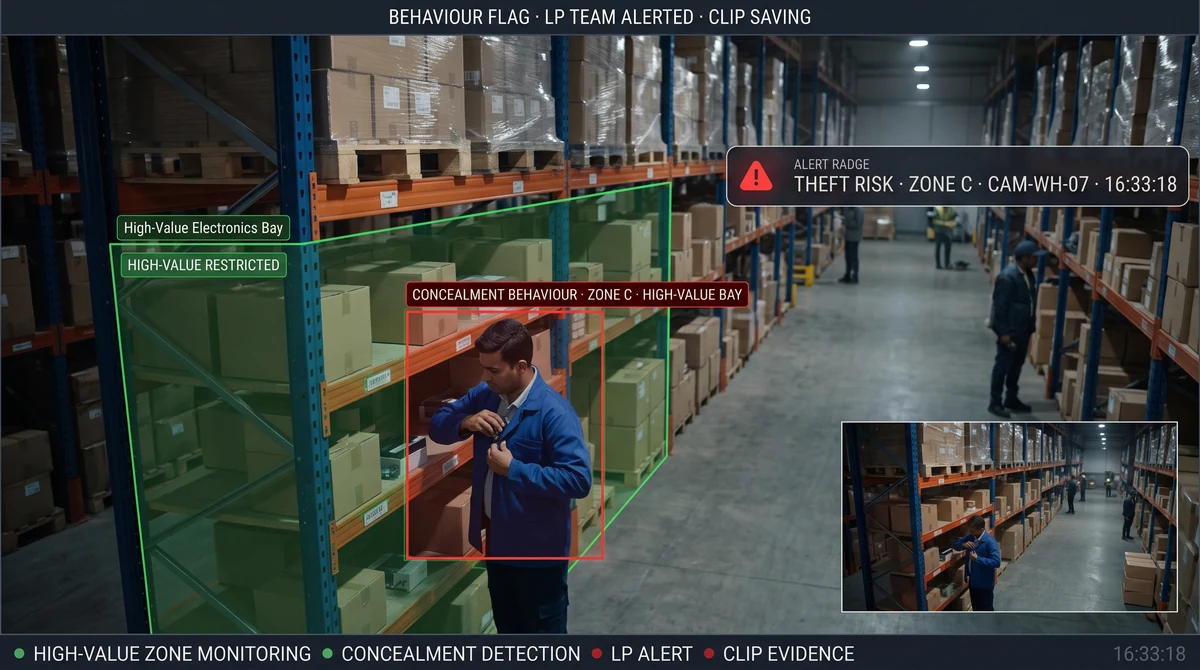
Component pilferage and tool accountability
Manufacturing plants in India face a specific and systematically underreported category of shrinkage: high-value component and precision tool pilferage. In automotive components, electronics assembly, pharmaceutical packaging, and precision engineering facilities, individual parts worth ₹500 to ₹50,000 apiece can leave the plant in pockets, tool bags, or vehicle compartments during shift-end exits — losses that surface only in quarterly physical inventory audits by which time attribution is nearly impossible and HR action is legally difficult to sustain. Slinai monitors gate exit zones, component storage areas, and high-value tooling stations for behavioural anomalies during shift changeovers and end-of-shift periods, when supervisor presence characteristically decreases.
Tool accountability is a secondary LP use case that delivers independent ROI. Many Indian manufacturing operations run an informal economy of tool borrowing, substitution, and disappearance that costs ₹20–₹60 lakh annually in replacement procurement — typically buried in maintenance budgets rather than attributed to loss. Slinai monitors designated tool storage zones and machine bays, flagging access events outside approved windows and creating an audit trail that shifts accountability from informal to documented. When tools are confirmed missing, clip evidence frequently resolves whether loss was accidental, negligent, or deliberate — a distinction that matters for insurance claims, vendor charge-backs, and internal disciplinary proceedings.
Auto components manufacturer recovers tooling insurance claim and cuts pilferage by 58%
A mid-sized automotive components manufacturer in Pune was experiencing quarterly write-offs of precision CNC tooling that their finance team categorised as wear, breakage, or vendor short-supply rather than investigating as pilferage. After installing Slinai zone monitoring in tooling storage and CNC machine bay areas, the LP coordinator identified a pattern of tools being removed during night-shift changeovers without being returned to designated stations — a behavioural signature distinct from standard tool use during active production. Confirmed tooling loss dropped by 58% within two quarters, and one significant loss case was supported by clip evidence used successfully in a formal police complaint.
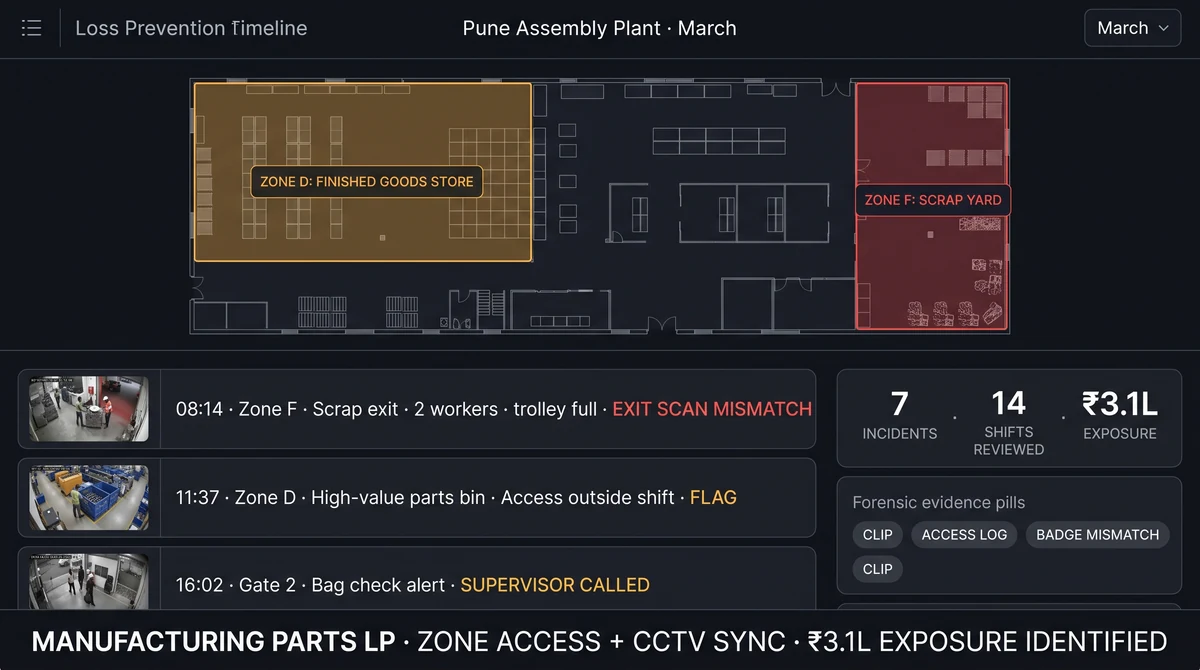
Pick accuracy, order integrity, and shrinkage at speed
Dark stores — fulfilment hubs designed to deliver groceries and essentials within 10 to 30 minutes — operate at a pace that makes traditional loss prevention methods structurally incompatible with the business model. Pickers move at 800 to 1,200 items per hour. Orders are sealed, dispatched, and in customers' hands before any physical variance can be caught by on-shift supervision. The result is a category of loss that appears in the P&L as customer complaints, platform refunds, and inventory gaps — but cannot be attributed to specific pick events, specific operatives, or specific shift windows without video correlation to the WMS data already captured in the system.
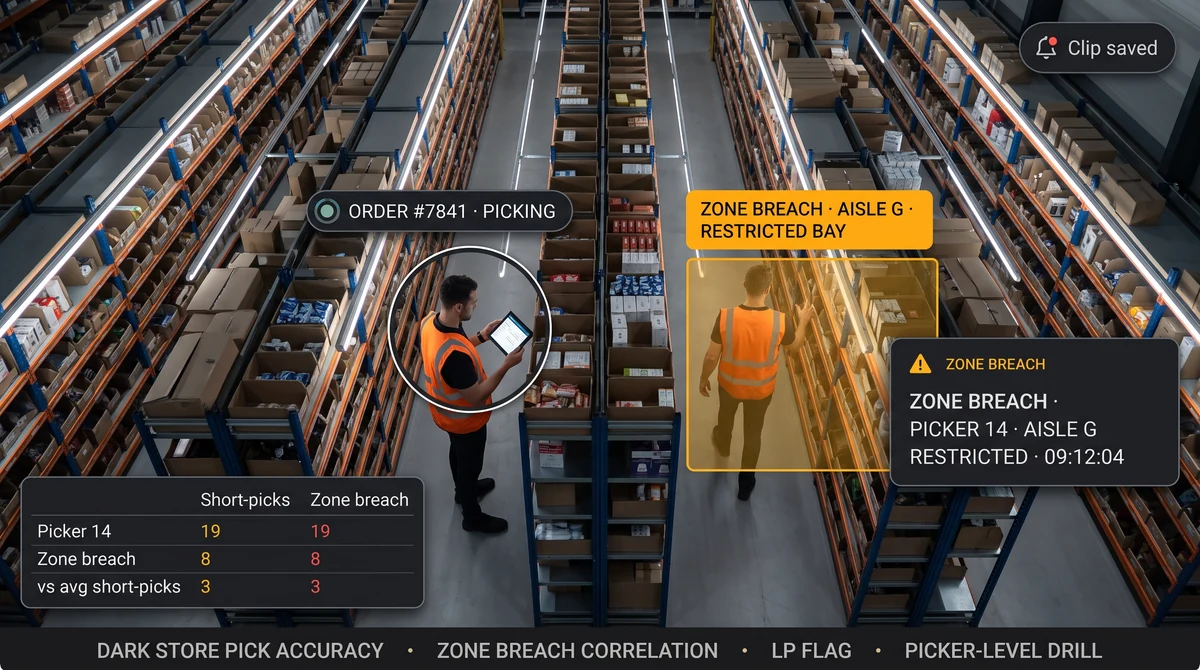
Slinai monitors pick-zone aisles in dark stores with camera coverage calibrated to high-value SKU bays and fast-moving product sections, flagging unusual dwell at premium product locations, items placed into personal containers rather than order totes, and picking patterns that deviate significantly from the expected route for the active order type. When integrated with WMS data, pick-event timestamps correlate with specific order IDs and picker assignments — so a customer complaint about a missing ₹800 item resolves in a 90-second clip review rather than an entire shift's footage scan. The investigation that previously took two days completes in twelve minutes.
For quick-commerce operators running 40 to 200 dark stores across multiple cities, multi-site roll-up dashboards display pick-shrink incidents by city hub, operational time slot, and product category. Shrinkage patterns recurring across multiple hubs in the same SKU category often indicate a systematic receiving gap rather than a picking problem — a distinction that changes the remediation from people management to vendor management, with clip evidence to anchor both conversations.
Q-commerce operator attributes unaccounted per-order cost gap across pilot hubs
A quick-commerce operator running 34 dark stores across eight cities was tracking a persistent gap between COGS and delivered order value that internal analytics attributed partly to customer fraud claims and partly to unquantified pick errors. The finance team estimated the unattributed gap at ₹28–35 lakh monthly but could not isolate its source without per-event video evidence. After enabling Slinai pick-zone monitoring at 12 pilot hubs, LP analysis revealed that approximately 60% of the unattributed gap concentrated in three specific high-value SKU categories during late-night operational slots when supervisor coverage was thinnest. A targeted intervention reduced the unattributed gap by 44% across those sites within ten weeks.
Talk to us about multi-site dark store loss prevention
We'll map detection zones and alert routing to your WMS and operations team structure.
The shift ends. The risk does not.
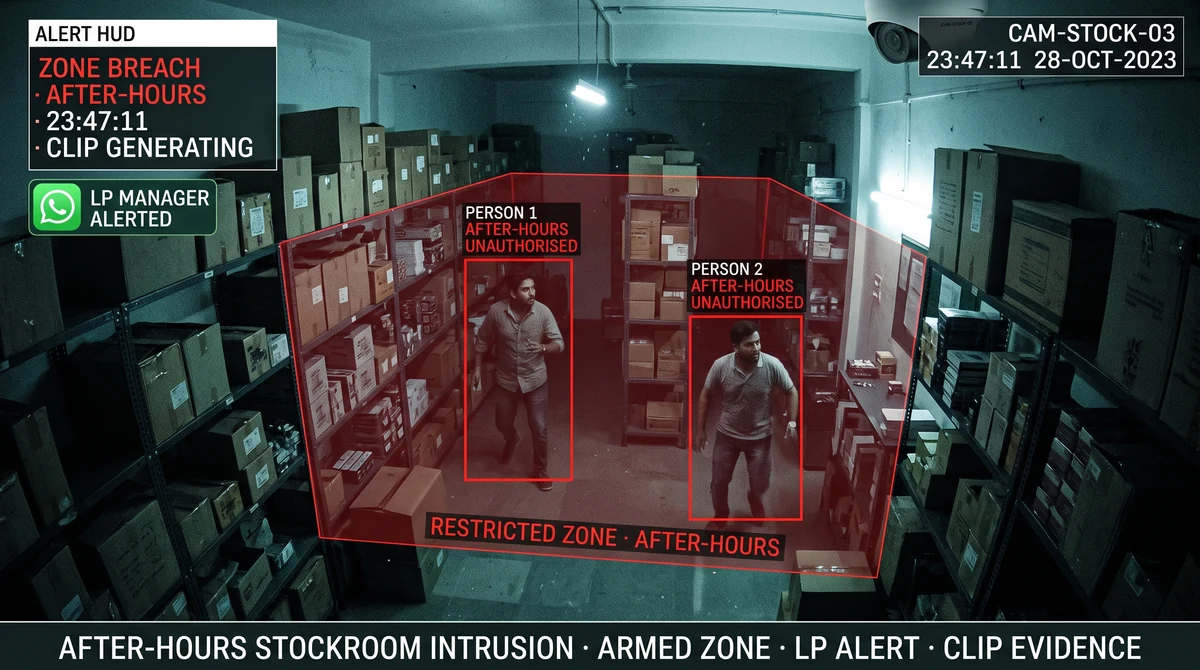
After-hours incidents — break-ins, staff re-entry for pilferage, and vehicle-bay intrusions — represent a disproportionate share of high-value single-event losses in Indian retail and warehousing. A single after-hours stockroom breach can cause ₹5–₹50 lakh in loss at a medium-sized electronics or fashion outlet — damage that appears as a complete inventory gap in the next morning's opening count rather than as a gradual shrinkage trend. Traditional responses rely on static guards — expensive, unevenly effective — or on passive alarm systems whose high false-positive rates erode team response discipline until genuine events are treated with the same scepticism as sensor noise.
Slinai Video alarms automatically arm configured loss-sensitive zones when business hours close — triggered by the last POS session close, the final access badge swipe, or a manual arm command from the duty manager via WhatsApp bot. In armed mode, any verified motion event in a restricted zone fires a clip-backed alert to the designated duty manager and security response contact within thirty seconds. Unlike passive alarms that generate a binary trigger, the alert contains the clip itself — so the recipient sees immediately whether the motion is a cleaning crew, a delivery exception, or a genuine intruder before dispatching security or calling police.
For chains running 80 or more stores, the after-hours monitoring dashboard provides a real-time arm/disarm status view by site, with nightly event logs exportable for security auditors and commercial property insurance providers. Sites triggering repeated after-hours anomalies flag automatically for physical security review — identifying design vulnerabilities, access-control gaps, or staffing patterns that require structural remediation.
Electronics retailer eliminates repeat stockroom breaches across 27 stores
A multi-format electronics retailer operating 27 stores across Karnataka and Tamil Nadu was experiencing three to four verified stockroom incidents per quarter at standalone-building sites, each resulting in losses between ₹4 lakh and ₹22 lakh. Post-incident NVR review supported police complaints but was inadequate to prevent recurrence — by the time footage was reviewed, the perpetrators had been gone for hours. After enabling Slinai after-hours arming and clip-backed alerts, average response time from incident trigger to security team verification dropped from fourteen minutes to under three minutes. The following two quarters recorded zero successful stockroom breaches at all 27 monitored stores.
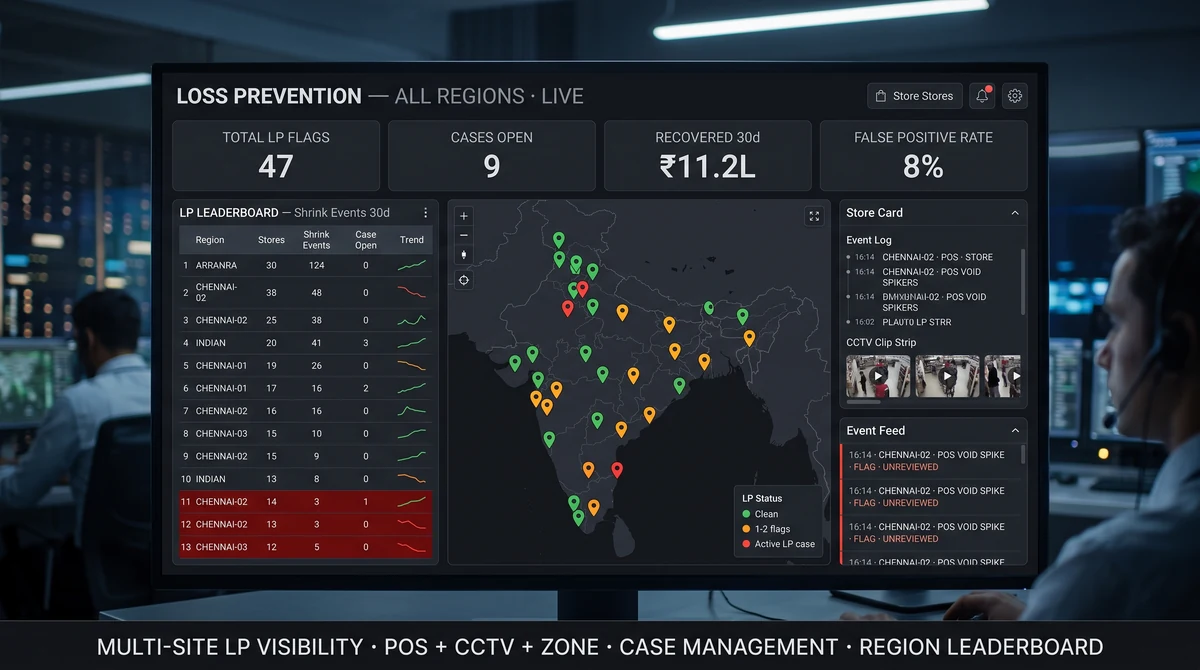
One view across your entire loss prevention programme
Running a loss prevention programme across 50, 150, or 500 locations requires a fundamentally different toolset than managing LP at a single flagship store. The challenge is not that individual store incidents are hard to investigate — it is that incident data from 150 stores, generated by different camera hardware, interpreted by different store managers, and tracked in different formats across area-manager spreadsheets, cannot be aggregated into a coherent picture without a purpose-built multi-site platform. Without that aggregation, HQ LP directors are dependent on what area managers choose to escalate — creating systematic blind spots precisely where LP intervention is most needed.
Slinai's multi-site LP dashboard provides a hierarchical view from regional cluster down to individual zone — normalised across camera brands, NVR generations, and site formats. LP managers see incident counts by category — shrinkage anomaly, cashier exception, after-hours event, compliance gap — by region, and by time window. Outlier stores, those showing incident rates two or more standard deviations above their format cluster average, surface automatically, enabling targeted site visits, audit prioritisation, and format-specific control deployments based on data rather than manager intuition. The same dashboard surfaces camera health and zone coverage status per site, so LP managers can identify blind spots before those gaps are exploited.
For LP directors managing franchise networks, the multi-site view supports brand-to-franchisee reporting — sharing anonymised loss rate benchmarks and remediation guidance without exposing one franchisee's footage to another. API exports of incident data and site-level metrics allow LP event flows to join broader risk management frameworks, ERP audit trails, or insurance reporting requirements rather than remaining siloed in the camera system.
National apparel chain centralises LP across 140 stores and reduces group shrinkage by 19%
A pan-India apparel retailer managing 140 stores across 24 cities had LP data spread across store-level NVR archives, an inconsistent area-manager spreadsheet incident log, and quarterly third-party audit reports. The LP director described the situation as 'knowing we had a material loss problem without knowing where to apply pressure.' After centralising incident data and camera health status in Slinai's multi-site LP dashboard, the team identified five stores in two cities generating 31% of all confirmed incidents despite representing only 12% of group revenue. Targeted physical security upgrades and staff changes at those five sites — informed by specific clip evidence — reduced group-level shrinkage by 19% over the following twelve months.
Run LP from one dashboard across your full estate
Our implementation team will scope zone coverage, alert routing, and POS integrations across your complete site list.
Loss prevention for every operational context
The same platform adapts to the specific shrinkage vectors, camera layouts, and operational rhythms of each industry — without a new hardware rollout.
Retail stores & supermarkets
- Continuous monitoring of high-shrink bays — electronics, cosmetics, accessories, and high-margin pegs
- Cashier void and no-sale POS correlation with billing-counter footage
- Stockroom access anomaly detection and after-hours zone arming
- Organised retail crime pattern detection — coordinated movement and exit loitering
QSR & food-service outlets
- Kitchen waste and food diversion detection against SOP prep norms
- Front-counter cashier void and discount fraud correlation
- Aggregator dispatch handoff audit trail with rider timestamps
- Cash handling anomaly monitoring at takeaway and drive-through windows
Manufacturing plants
- Component storage and tooling bay access monitoring during shift changeovers
- Gate exit zone anomaly detection for parts and equipment leaving premises
- After-hours perimeter arming for component storage buildings
- Tool accountability audit trails supporting insurance claims and HR proceedings
Warehouses & fulfilment centres
- Receiving dock footage correlated with GRN timestamps to attribute short-shipments
- Night-shift pick-zone anomaly detection for high-value SKU bays
- Dispatch bay handoff monitoring against manifest records
- Client-separated zone access controls for multi-tenant 3PL facilities
Dark stores & Q-commerce hubs
- High-value SKU pick-zone dwell anomaly detection and off-tote item flagging
- WMS order-ID correlation for customer complaint resolution in minutes
- Multi-city hub shrinkage benchmarks by product category and time slot
- Late-night shift supervisor alerts for pick anomaly clusters
Cloud kitchens & ghost restaurants
- Ingredient handling anomalies against portion and recipe standards
- Aggregator pickup sequence monitoring for order integrity
- After-hours cold storage and ingredient stockroom access alerts
- FSSAI and brand compliance audit trail with timestamped clip exports
Call us now — or book a live walkthrough
Share your camera count and sites. We'll show detections on sample footage from your industry.
Loss prevention: before and after Slinai
The same CCTV infrastructure that passively records loss events can actively prevent them — the difference is the AI layer on top.
| Capability | Without Slinai | With Slinai |
|---|---|---|
| Shrinkage alert speed | Discovered during weekly or monthly stock audit — typically 7–30 days after the loss has occurred and evidence has aged | Verified clip alert to LP manager's WhatsApp within 30 seconds of detection — while the event is still in progress |
| POS fraud investigation | LP investigator manually scrubs 4–8 hours of NVR footage per event using a POS timestamp and terminal ID, taking 2–5 business days | Void and no-sale events automatically surface matching billing-counter clips — complete investigation package ready in under 30 minutes |
| After-hours coverage | Guard patrols on limited schedules or passive alarm systems with high false-positive rates that erode team response discipline | AI-verified zone arming with clip-backed WhatsApp alerts in under 30 seconds — team confirms before dispatching security response |
| Multi-site visibility | Area-manager spreadsheets and site-level NVR logins — no aggregated view, no outlier detection, significant reporting gap between sites and HQ | Centralised LP dashboard showing incident counts, outlier stores, and camera health across all sites — normalised across camera brands |
| Evidence quality | Patchy NVR footage with no audit trail — clip extraction requires physical NVR access and depends on retention period not having elapsed | Timestamped clips with site metadata, watermarked exports, access logs, and chain-of-custody documentation for HR, legal, and police handoffs |
| Investigation turnaround | 2–5 business days from incident discovery to LP report — assuming footage has not already overwritten on the NVR | 30 minutes from alert to case documentation with clip, transaction record, site details, and LP notes in a single shareable package |
| Cashier anomaly detection | Periodic till counts, end-of-day cash reconciliation, and manager observation — no continuous monitoring or automated anomaly surfacing | Behavioural baselines per terminal surface systematic exceptions in weekly risk-ranked reports, supported by clip evidence for each flagged event |
| Pick-shrink attribution | Post-dispatch customer complaint review with no pick-level attribution — shrinkage absorbed as fulfilment cost or platform refund | WMS-correlated pick events with zone anomaly clips — customer complaints resolve in minutes rather than shift-level investigations |
| Incident trend analytics | Quarterly LP audit report with site-level loss totals and no zone-level attribution — trending requires manual aggregation across multiple reports | Week-over-week shrinkage trends by zone, site, city cluster, and format — enabling predictive LP deployment rather than reactive auditing |
| Deployment requirement | Dedicated LP camera system or manual workforce addition — procurement cycles of 2–6 months, capital expenditure, and ongoing maintenance cost | Works on existing CCTV from any major vendor — 5–10 days go-live per site with no hardware procurement, no rewiring, no new cameras |
Loss prevention for India's growing retail and food-service estate
India's organised retail sector is among the fastest-growing in Asia, expected to reach ₹25 lakh crore by 2030 — and its shrinkage problem is growing in proportion. The Retailers Association of India estimates that Indian chains lose 1.8–2.5% of revenue to shrinkage annually, compared to 0.9–1.1% in Western European markets with more mature LP infrastructure. The gap reflects both the rapid expansion of store networks into Tier 2 and Tier 3 markets — where LP resources are proportionally thinner — and the speed at which organised retail crime has professionalised in response to higher-value product mixes in modern trade. For India-focused LP teams, the priority is deploying scalable technology that works with the CCTV infrastructure already installed across the estate, which Slinai is purpose-built to do.
The Digital Personal Data Protection Act (DPDP Act, 2023) introduces a compliance dimension to retail and enterprise video monitoring in India that LP directors must factor into their technology decisions. Slinai's loss prevention platform is designed with DPDP-aligned principles from the ground up: video data is processed for defined LP purposes with documented justification, retention periods are configurable per site and per zone rather than defaulting to maximum storage, access to footage is role-scoped so store managers see only their sites and LP investigators see only authorised location data, and audit logs capture every access event for accountability under the data fiduciary obligations the Act introduces. For enterprise customers operating under DPDP, Slinai's India-region hosting options keep data within the country's borders, removing cross-border transfer considerations for standard LP workflows.
WhatsApp is the operational communication platform for India's retail and food-service field teams — not a convenience feature, but the channel where store managers, area supervisors, and shift leads actually work. Slinai's LP alerting is WhatsApp-first by design, routing verified incident clips and POS correlation alerts to store WhatsApp groups or individual LP manager numbers with message templates available in both English and Hindi. An LP manager at a regional grocery chain does not need to log into a web dashboard to see that a void event at their Lucknow outlet just fired — the clip arrives on the phone they are already using, in the language they prefer, with a one-tap link to the full investigation timeline. This is not a minor UX consideration: it directly determines whether LP alerts receive real-time responses or accumulate unread in a platform nobody checks between weekly review meetings.
Ready to close the shrinkage gap?
Slinai connects to your existing cameras in days — not months. Our LP team will map detection zones, POS correlation, and alert routing to your estate and show you a live walkthrough before you commit.
Monitoring employees fairly and within DPDP principles
Loss prevention video analytics involves continuous monitoring of workplaces, which intersects with employee privacy interests and the obligations introduced by India's DPDP Act. Slinai is designed to enable effective LP monitoring while maintaining proportionality: detection zones focus on stock locations, billing counters, exits, stockrooms, and dispatch bays — areas with a clear and documentable LP justification — rather than on general employee movement throughout the building. Role-based access controls ensure that footage and incident data are visible only to personnel with a legitimate LP function for that site, preventing casual or managerial access to video that falls outside the LP use case.
Footage retention policies in Slinai are configurable per site and zone, allowing operators to align archiving periods with their specific LP investigation cycles and DPDP compliance documentation. Standard configurations retain flagged incident clips for LP case management purposes while cycling background footage on shorter schedules, reducing the volume of personal data held at any point in time. All access to retained footage is logged with user ID, timestamp, and purpose — creating the accountability trail that DPDP's data fiduciary obligations require and that internal HR and legal teams rely on when incident evidence is used in disciplinary proceedings.
Employee awareness of monitoring is a best-practice component of a DPDP-compliant LP programme. Slinai recommends that operators include camera monitoring disclosure in staff employment agreements and post visible camera notices at monitored locations — a practice that also delivers a measurable deterrent effect on opportunistic internal theft independent of any detection outcome. Slinai's onboarding process includes documentation templates and guidance for LP teams setting up disclosure frameworks aligned with DPDP principles.
Questions teams ask about loss prevention & shrink reduction
What types of loss does Slinai video analytics detect?
Slinai detects a broad range of LP-relevant events across retail, QSR, warehouses, dark stores, and manufacturing: suspicious dwell in high-shrink zones such as electronics bays, cosmetics displays, and stockroom entry points; cashier anomalies correlated with POS void and no-sale events; after-hours and perimeter intrusions in armed zones; pick-zone handling deviations in dark stores and warehouses; aggregator dispatch handoff gaps in QSR and cloud kitchen environments; and tool or component access anomalies in manufacturing settings. Detection models are calibrated per site format during onboarding rather than applied generically.
Does Slinai require new cameras to be installed?
No. Slinai connects to existing IP cameras and NVR streams via RTSP/ONVIF protocols, which are supported by Hikvision, CP Plus, Dahua, TVT, Reolink, and most other cameras widely deployed in Indian commercial premises. Image quality, camera height, and viewing angle affect detection accuracy — the onboarding survey confirms which existing cameras are suitable for LP zone calibration and identifies any coverage gaps that might require repositioning rather than replacement.
How does POS correlation work, and which systems are supported?
Slinai connects to POS systems through API or webhook integrations. When a configured exception event fires in the POS — a void, no-sale, high-discount application, or refund above a threshold — Slinai captures the terminal ID, timestamp, and transaction value, then automatically surfaces the billing-counter camera footage from that moment in a combined investigation view. Supported systems include Oracle Simphony, Posist, NCR Aloha, Petpooja, and custom-built POS platforms through standard API connectors. Integration setup typically completes within the go-live window.
Can Slinai detect internal employee theft specifically?
Yes. Internal theft — estimated at 28–35% of total organised retail shrinkage — is the primary LP use case for several of Slinai's detection capabilities. Cashier fraud via POS void correlation, stockroom access anomalies, after-hours re-entry detection, pick-zone dwell anomalies in dark stores, and tool removal in manufacturing environments are all primarily internal-facing detection scenarios. The system provides clip evidence that supports HR investigations and disciplinary proceedings, and over time builds behavioural baselines per location so deviations surface as risk-ranked alerts rather than requiring manual pattern recognition by LP staff.
How quickly are loss prevention alerts delivered after an event is detected?
Verified events typically reach the designated LP manager or security contact's WhatsApp within 30 seconds of detection confirmation. This includes the AI verification step that filters environmental noise — shadows, air movement, cleaning equipment — before routing the alert. Alert delivery speed depends on site connectivity; Slinai recommends a minimum 4 Mbps uplink for standard alert-with-clip delivery. After-hours zone arming events typically deliver within 25–35 seconds of verified motion detection.
What evidence does Slinai provide for HR investigations and legal proceedings?
Slinai generates timestamped video clips with site name, zone, camera ID, and detection type metadata. Exports include watermarked clip files, access logs showing who viewed footage and when, and incident case notes maintained within the platform. The LP case management module allows incidents to be grouped, annotated, and shared with HR, legal, or external investigators as controlled access packages. Admissibility standards for legal proceedings depend on your organisation's legal counsel and applicable local procedures.
Is Slinai DPDP-compliant for employee monitoring in loss prevention contexts?
Slinai is designed with DPDP Act 2023 alignment as a foundational requirement. Key design elements include purpose-limited detection zones with documented LP justification, configurable retention periods per zone rather than maximum-storage defaults, role-based access controls scoping footage to personnel with legitimate LP function, and comprehensive audit logging of all footage access events. India-region hosting options are available for operators requiring data residency within the country's borders. Slinai provides documentation templates to support DPDP-compliant workplace monitoring disclosure practices.
How does after-hours zone arming and disarming work?
After-hours arming operates through configurable triggers: automatic arming based on the last POS session close event, last access badge swipe, or a scheduled time window; manual arming via WhatsApp bot command from the duty manager; or API-triggered arming from your store management system. In armed mode, verified human motion in designated zones fires a clip alert to configured duty and security contacts. Disarming follows a reverse sequence — opening badge swipe, first POS session open, or manual command — with optional PIN confirmation for high-security locations.
Which POS and WMS platforms does Slinai integrate with?
On the POS side, Slinai supports Oracle Simphony, Posist, NCR Aloha, Petpooja, and custom retail and QSR platforms through standard REST API and webhook connectors. On the WMS and inventory side, integrations are available for leading platforms including Manhattan Associates, SAP EWM, and custom-built fulfilment systems — relevant for dark store pick-shrink correlation and warehouse receiving gap analysis. Custom integrations for specific POS or ERP configurations are scoped during the onboarding process and typically complete within the standard go-live window.
How does multi-site LP management work for chains with 50 or more stores?
Slinai's multi-site LP dashboard aggregates incident data, camera health, and zone status across all monitored locations into a single hierarchical view — navigable from national level down to individual store zone. LP managers see incident counts by category, region, and time window; outlier stores surfacing more than two standard deviations above their format cluster average flag automatically for prioritised attention. HQ LP directors receive daily digest reports, area managers receive site-cluster summaries, and store LP contacts receive real-time alerts — all through configurable routing that matches your existing organisational structure.
Can Slinai integrate with existing physical security systems — access control, guard tours, traditional alarms?
Yes. Slinai connects with physical access control systems to use badge-swipe events as arming and disarming triggers, correlate access-log anomalies with camera footage, and build combined investigation timelines spanning both video and access data. Integration with traditional alarm panels allows Slinai AI verification to act as a second-layer filter — reducing false police dispatch from passive motion alarms while adding clip evidence to genuine intrusion events. Guard tour systems can receive Slinai event data to dynamically route patrol responses toward active alert zones.
How long does deploying Slinai for loss prevention take across a store network?
A single-site go-live — including stream connection, LP zone calibration, POS integration setup, and alert routing configuration — typically completes in 5 to 10 business days. For networks of 10 to 50 stores, a phased rollout approach pilots 3 to 5 representative sites first, refines configurations, then deploys to the remainder using configuration templates — total rollout timelines of 6 to 12 weeks are typical for estates of this size. Networks of 50 to 200 stores are scoped individually based on site format diversity, POS system complexity, and regional distribution.
Keep exploring
Industries
- Retail video analytics
Footfall, conversion, loss prevention
- Restaurants & QSR
Kitchen hygiene, queues, POS oversight
- Dark stores
Pick-pack productivity, dispatch SLA
- Logistics & warehouses
Dock TAT, PPE, perimeter security
- Manufacturing
PPE, safety zones, line monitoring
Product modules
- Video AI
Detection & agentic intelligence
- Data & integrations
POS, API, exports
- Video alarms
Intrusion & verified alerts
- Cloud VMS
Multi-site video layer
- Agentic AI
Talk to your cameras
Related use cases
- Physical security
Intrusion, perimeter, after-hours
- Multi-site oversight
Regional dashboards, benchmarking
- Operations & productivity
Throughput, staffing, multi-site KPIs
Talk to us — or see it live
Tell us about your sites and goals, and we'll show you exactly what Slinai surfaces on your existing cameras.
Book a live demo
A focused 30-minute session, tailored to your operation.
- Live walkthrough on footage like yours
- Your top use-cases mapped to detections
- Deployment plan for your cameras & sites
- Indicative pricing and ROI estimate
Or reach us directly