One command centre for every site in your network
Stop managing video estate one NVR room at a time. Slinai aggregates live camera status, AI-detected KPIs, regional league tables, and WhatsApp digests across your entire footprint — retail chain, QSR group, dark-store network, or consumer-service branches — from a single cloud dashboard.
Works with any IP camera · Hikvision · CP Plus · Dahua · ONVIF
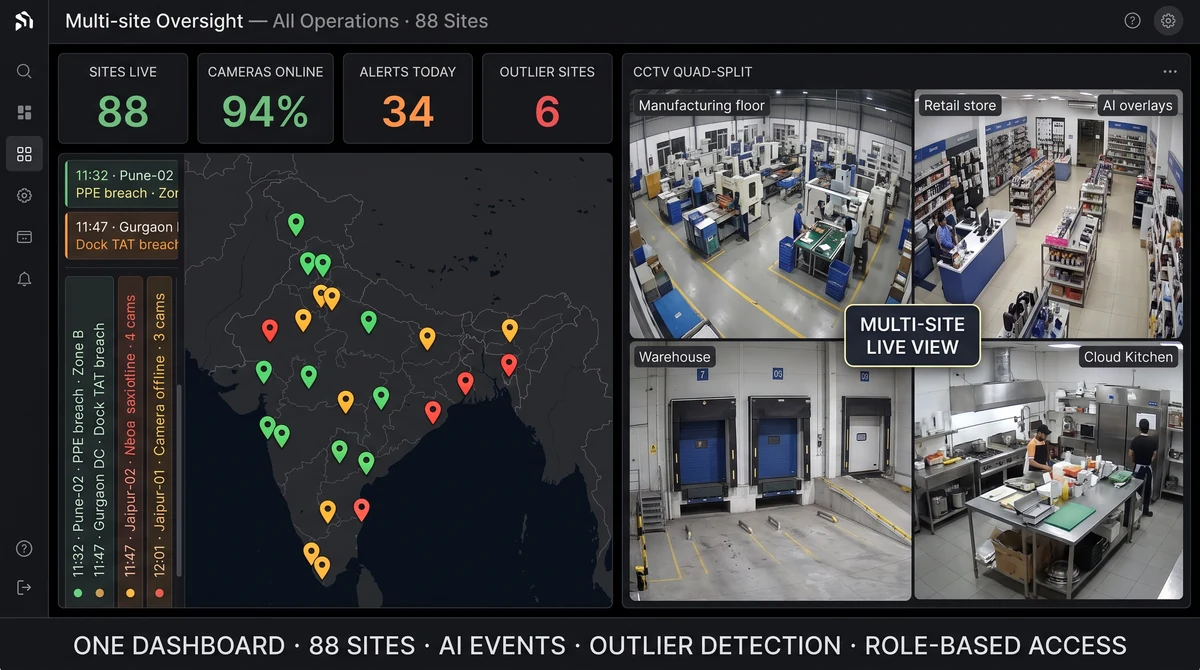
What is multi-site video oversight?
Multi-site video oversight is the discipline of monitoring operational performance, camera health, and security posture across dozens or hundreds of locations from a single platform. Slinai delivers this through hierarchical dashboards (HQ → region → city → site → zone), AI-derived KPIs normalised across formats, real-time camera fleet health, and role-scoped views so each stakeholder sees exactly their span of responsibility — and nothing outside it.
Based on Slinai platform capacity and typical operator deployments. KPI ranges vary by industry format and AI detection bundle.
One platform for your entire camera estate — from Tier-1 flagship to Tier-3 branch
Running twenty stores is a different management challenge from running two. Running two hundred is a different discipline entirely. The critical difference is not the number of cameras — it is the impossibility of maintaining meaningful operational visibility at scale without a system that aggregates, normalises, and surfaces only what requires attention. A head of retail operations managing 120 stores across five states cannot usefully monitor 800 camera feeds. They can usefully see: which ten stores are underperforming their format cluster on queue wait time, which 15 cameras went offline in the last 24 hours, and which three stores triggered security events last night. That is what multi-site video oversight is designed to deliver.
The foundational challenge for Indian multi-site operators is hardware heterogeneity. A typical chain of 80 QSR outlets will have four or five generations of camera hardware — Hikvision DVRs from 2018, CP Plus IP cameras from 2021, newer Dahua NVRs at franchisee-owned locations, and a handful of sites running cloud cameras from a connectivity trial. Each site was onboarded by different contractors with different zone configurations, different retention settings, and different alert thresholds. The idea of 'one dashboard' sounds appealing but historically required either expensive hardware standardisation — rip-and-replace across hundreds of sites — or a patchwork of site-level VMS logins that was almost worse than having no central view at all.
Slinai's multi-site oversight model abstracts hardware heterogeneity at the stream ingestion layer. RTSP and ONVIF streams from any manufacturer connect to the same normalisation pipeline — so whether a site is running a five-year-old Hikvision DVR or a new IP camera array, it shows up identically in the regional dashboard. KPIs are computed from video and expressed in comparable units — compliance rate, dwell time, queue length, alert rate per thousand visitors — so a Tier-1 flagship and a Tier-3 town branch can sit side by side in a league table without the comparison being meaningless.
Role-based visibility is the other structural requirement that makes multi-site oversight operationally effective rather than theoretically impressive. An area manager overseeing 12 stores in two cities does not need to see — and should not see — the 108 stores in the rest of the estate. A franchisee login should show only that franchisee's own outlets. A brand compliance team at HQ should see aggregate scores and flag outliers without accessing individual franchisee camera streams unless there is a specific contractual and operational basis for it. Slinai's scope model enforces these boundaries hierarchically, with every access event logged for DPDP audit compliance.
The practical outcome of getting multi-site oversight right is a shift in the daily workflow of the people responsible for operational performance. An HQ operations VP who previously started the day making calls to area managers to ask for status updates instead opens a single screen showing last night's alerts by region, this week's top-10 and bottom-10 stores on the KPIs that matter, and any camera coverage gaps requiring IT attention. The information that previously arrived hours late through a chain of human intermediaries is now live, structured, and actionable in the first ten minutes of the working day.
Get instant answers about your entire site network
Ask Slinai in plain language — get KPI rankings, camera health summaries, and drill-down clips across your full estate without logging into a single NVR.
- Regional rankings
Live KPI league tables
Rank every store, outlet, or branch in your network by any normalised operational KPI — queue wait time, compliance rate, pick productivity, alert frequency — with bottom-10% performers flagged automatically every 15 minutes.
- Fleet health
Camera estate monitoring
Track the online, offline, degraded, and uncalibrated status of every stream in your estate in real time. Offline-camera alerts route to the right IT contact before operational or LP blind spots appear.
- Digest delivery
WhatsApp & email digests
Shift-end and morning briefing digests arrive in the channel your teams already use — WhatsApp or email — summarising top-performing sites, alert counts, and camera health by region without requiring a dashboard login.
Which of my regions performed worst on queue wait time this week?
West Region was the weakest performer this week — 38% of monitored queue intervals exceeded your 3-minute SLA threshold, compared to 22% in North and 19% in South. The cluster is driven by three stores: Andheri West, Borivali, and Vasai Road, all of which had three or more SLA breaches per shift during Monday and Wednesday evening peaks. I can pull the queue video for any of those three sites if you want to verify whether it is a staffing gap or a layout issue.
How many cameras went offline across my estate in the last 24 hours?
Eleven cameras dropped offline across nine sites in the last 24 hours. Seven are at a single site in Bengaluru — Koramangala — where the NVR appears to have rebooted without recovery at 03:22 AM. The IT alert went to the registered site contact at 03:24 AM but has not been acknowledged. The remaining four outages are single-camera drops at four different stores — likely connectivity drops rather than device failures — and three have already self-recovered. I have flagged the Koramangala NVR as the one that needs a field visit.
Show me what triggered the overnight security alert at Jaipur Central last night.
The alert at Jaipur Central fired at 02:41 AM in the stockroom zone, which was armed from 22:15 PM when the last POS session closed. The trigger was verified human motion — Slinai filtered out two earlier shadow events at 01:10 AM and 01:58 AM before confirming the 02:41 event as an actual presence. The clip shows an individual entering through the staff entrance with what appears to be a key, spending four minutes near the high-value electronics bay, and exiting the same route. I have queued an LP incident case for your review with the 6-minute clip attached.
Which franchise clusters are below brand standard this quarter?
Across your 14 franchise cluster groups this quarter, two are consistently below brand standard: the Lucknow cluster (4 outlets) and the Coimbatore cluster (3 outlets). Lucknow shows kitchen hygiene compliance at 61% versus a brand target of 80%, with the gap concentrated on three specific SOP checks — glove use, handwashing station proximity, and food-safe container coverage. Coimbatore shows uniform compliance at 67% and counter wait SLA at 58%, both materially below their cluster benchmark. I can prepare a corrective-action brief for either cluster with timestamped clip evidence if that would help for your franchisee review calls.
Did any sites fail to open on time this morning?
Four sites showed late-opening signals this morning. Pune Camp opened at 09:47 AM against a 09:30 AM target — first POS session and door-camera activity both confirm the delay. Chandigarh Sector 17 shows no camera activity until 10:02 AM. Nagpur Dharampeth's opening camera came online at 09:41 AM but the POS session did not open until 10:05 AM, suggesting staff present but systems not ready. Surat Adajan looks like a genuine late opening with no explanation in the alert log — I would recommend the area manager contacts them before the lunch session.
Everything a multi-site operator needs in one dashboard
Built for Indian retail chains, QSR groups, dark-store networks, and consumer-service businesses that run mixed-vendor camera estates across many cities.
Regional league tables
Rank stores, branches, or dark stores on any normalised KPI — footfall per sq ft, queue wait, PPE rate, pick productivity — and surface bottom-10% performers for targeted intervention.
Camera fleet health
Know which cameras are offline, which streams are degraded, and which sites still need onboarding — before incidents expose blind spots in your coverage.
Outlier drill-down
One click from a regional scorecard tile lands you in live or historical video for that site — no separate login, no NVR-room visit required.
Role-based scope
Area managers see only their geography; franchisees see only their own stores; HQ retains full override, audit, and cross-site comparison access.
WhatsApp & digest alerts
Daily or shift-end regional digests — top-5 stores by alert volume, camera offline count, SLA breach rate — delivered to area managers and HQ on WhatsApp or email.
Hybrid edge fleet support
On-prem edge nodes at bandwidth-constrained sites still feed KPI metadata and alert clips to the cloud dashboard — no site is a blind spot due to connectivity limits.
See multi-site oversight — regional dashboards & benchmarking on your cameras
Book a walkthrough — we'll map detections, alerts, and dashboards to your sites.
How Slinai connects and unifies your site network
Five steps from first stream to a live national dashboard — no hardware rip-and-replace, no parallel reporting infrastructure to maintain.
- 1
Connect cameras & recorders
Point Slinai at each site's NVR/DVR or IP cameras via RTSP/ONVIF — no rip-and-replace; Hikvision, CP Plus, Dahua, Axis all connect in days.
- 2
Build the site hierarchy
Map regions, cities, site clusters, and zone types so dashboards auto-roll up and every stakeholder finds their scope instantly.
- 3
Assign roles & scopes
Configure HQ admins, regional managers, area managers, and franchisee-level viewers — each with the exact camera and KPI visibility they need.
- 4
Enable AI detection bundles
Activate footfall, queue, compliance, safety, or security detections per site format — retail store templates, QSR kitchen templates, dark-store pick-pack templates.
- 5
Go live & optimise
Regional dashboards populate live from day one; Slinai's onboarding team tunes alert thresholds and digest schedules with your ops team over a two-week UAT.
Turn camera data into a live regional league table
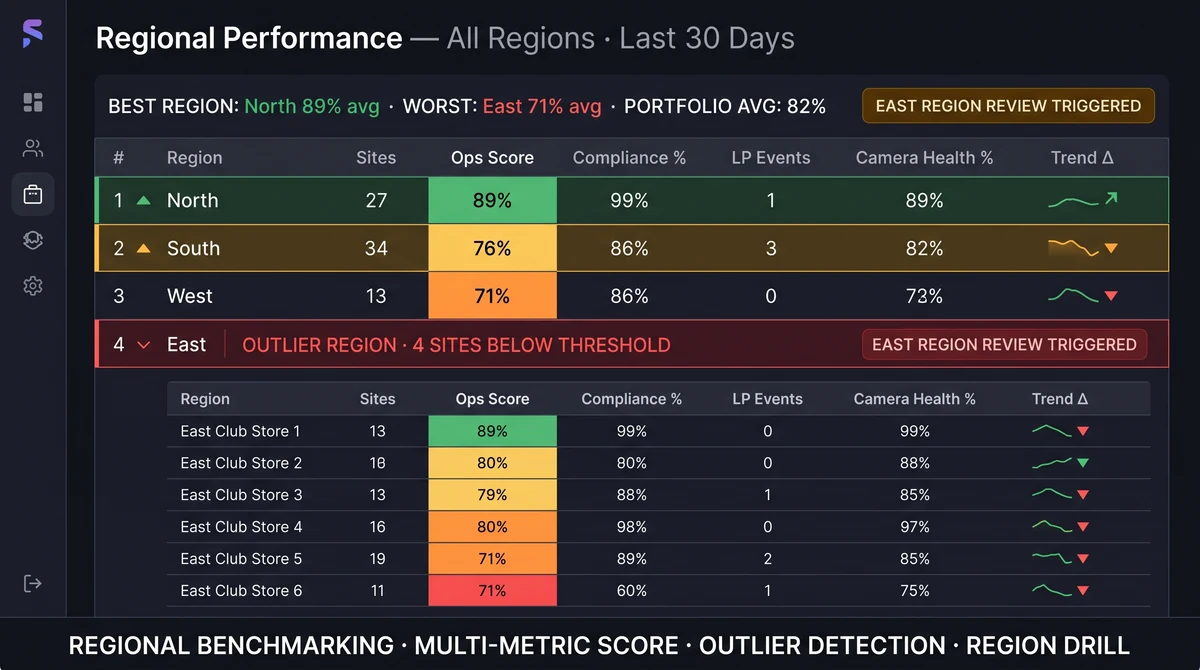
Multi-site operators win when top-performing locations teach the rest. The challenge is that every store, QSR outlet, or dark store calls things differently — footfall measured by door beam, queue depth estimated by manager intuition, hygiene compliance assessed by spot audits. Slinai normalises AI-derived KPIs across formats so a head of retail can rank 200 stores on average dwell time, a QSR ops director can rank 80 outlets on kitchen throughput, and a dark-store network manager can rank 50 hubs on pick-pack cycle time — apples to apples, updated every 15 minutes.
League tables are filterable by region, city cluster, and store format so comparisons stay fair. Bottom-10% performers get flagged automatically; the same dashboard links to the corresponding video feed so an area manager can verify whether a queue anomaly is a data artefact or a real staffing gap before making a call.
Fashion chain COO replaces weekly area-manager status calls with a five-minute dashboard review
A mid-market fashion retailer operating 65 stores across North and West India had a Monday morning ritual the COO described as 'essentially a one-hour status-checking exercise masquerading as a performance review.' Area managers called in to share figures from their own spreadsheets — figures the COO had no way to verify or compare without a shared baseline. After deploying Slinai's regional league table across all 65 stores, the Monday review shifted to five minutes of dashboard review followed by a focused conversation about the bottom eight performers, with video evidence available for any disputed data point. The COO credited the change with eliminating two recurring disagreements that had persisted for over a year about which stores were genuinely underperforming versus which were in catchment areas with structurally lower footfall.
Fix blind spots before they become liability
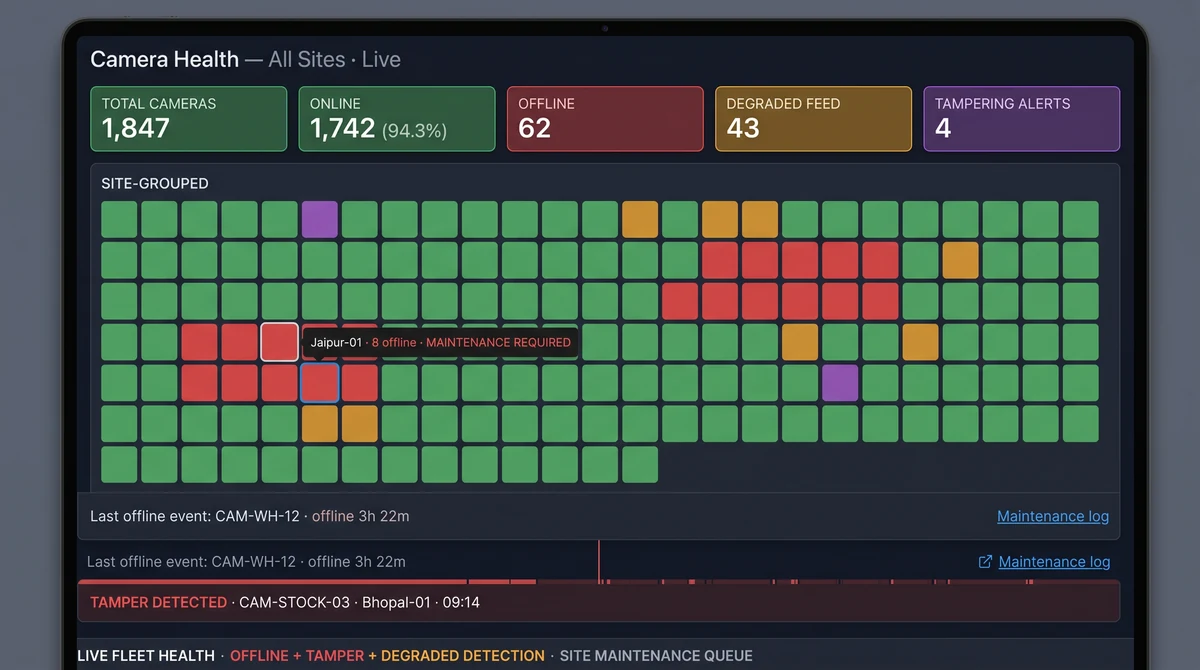
A camera that went offline three days ago is not a minor IT ticket — it is an unrecorded incident, a missed compliance window, and a hole in your LP coverage. Slinai's camera fleet dashboard tracks every stream in the estate: online, offline, degraded signal, storage-near-full, or firmware version mismatched with detection requirements. Operations managers see a site-by-site health matrix rather than discovering blind spots after a theft or audit.
Camera health alerts route to IT administrators before regional managers or franchisee owners start complaining about missing footage. Integration with the alert channel layer means WhatsApp or email notifications fire the moment a stream drops — not at the next scheduled report.
Electronics retailer cuts median camera-outage response time from six days to eleven hours
A national electronics chain operating 42 stores across six cities managed camera health through a shared IT inbox receiving automated alert emails from individual NVR units — a system that worked when someone read the inbox and failed silently when they did not. An internal LP audit revealed that eight stores had at least one high-value zone camera offline for more than five days in the preceding quarter, creating LP coverage gaps during which two confirmed theft incidents occurred. After deploying Slinai camera fleet monitoring with role-routed WhatsApp alerts to both IT and area managers, camera outage response time dropped from a median of 6.3 days to 11 hours across the estate.
See your full camera estate health in one dashboard
We will connect to your existing streams and show you a live fleet health view across every site.
From outlier scorecard to site video in one click
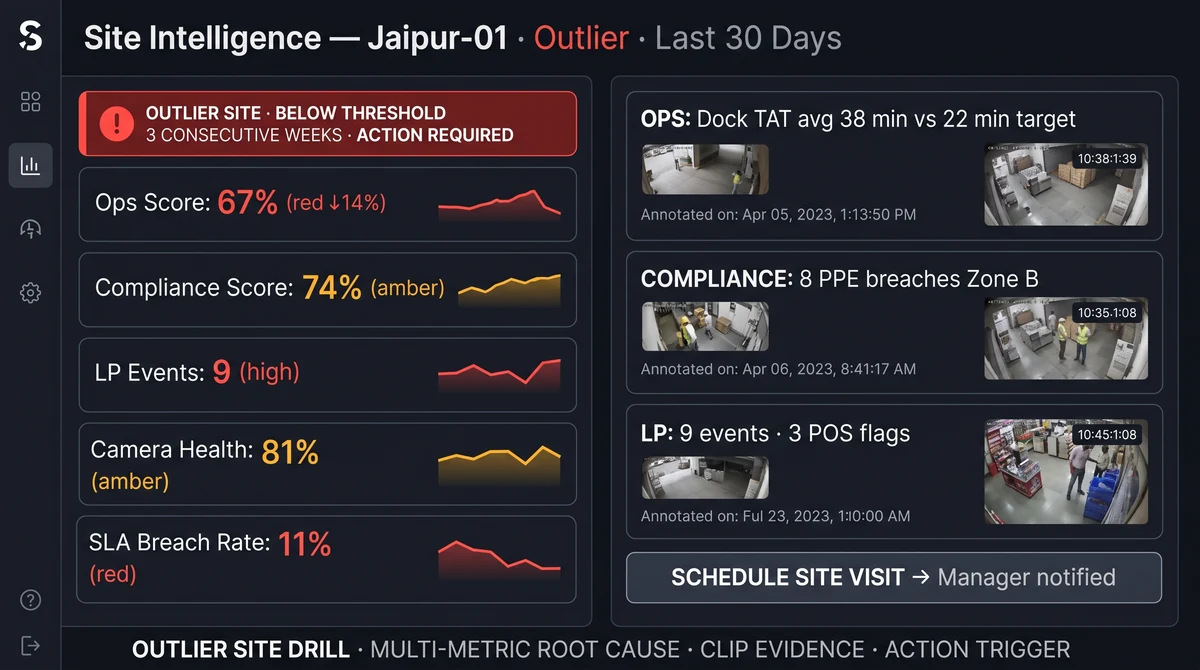
Regional dashboards are only useful if they lead somewhere actionable. When an area manager spots a store at the bottom of the queue-wait ranking, one click opens live or historical video for that location — no separate VMS login, no call to the site manager asking them to pull up the NVR, no half-day visit to confirm what the data is showing. The investigation starts where the anomaly flag ends.
Drill-down paths are consistent across all AI detection categories: a PPE compliance outlier opens the safety camera feed; a pick-rate outlier opens the fulfilment-bay camera; a queue spike opens the checkout or service-counter camera. Context is preserved — the system lands on the relevant camera and the relevant time window rather than dumping the user at an unfiltered video archive.
QSR area manager resolves a franchise queue dispute in three minutes during a live review meeting
During a weekly operations review call, an area manager for a QSR group's Bengaluru south cluster was challenged by a franchise partner who disputed that their outlet was the worst performer on counter wait time in the city. The area manager shared their screen, navigated to the league table, clicked the disputed outlet, and arrived at the checkout camera feed showing the peak-hour queue depth at 12:47 PM the previous Tuesday — the specific shift period where the SLA breach had fired. The franchise partner acknowledged the data and agreed to a staffing adjustment for peak slots. The area manager noted afterwards that the same argument had played out three times in the past six months with manual reports and been unresolvable each time.
Benchmark franchise partners without sharing camera access
Franchise operators face a structural oversight challenge: they own the brand standards and the compliance liability, but individual franchisees own the premises and often resist direct camera access by the franchisor. Slinai's role-based scope model resolves this — franchisees get their own scoped login showing only their stores, while the franchisor's regional managers see aggregated compliance scores and KPI rankings without direct feed access unless contractually permitted.
A QSR group managing 200 outlet operators can see which franchise clusters are underperforming on kitchen hygiene scores, uniform compliance, or food-safety SOP adherence — and route corrective action to the relevant area manager — without maintaining direct video relationships with each franchisee. Brand teams get the data they need; franchisees retain appropriate privacy over their operations.
National QSR brand surfaces two underperforming franchise clusters without accessing franchisee feeds
A national fast-food chain managing 210 franchise outlets across India needed a way to enforce brand standards without the legal and operational complexity of accessing each franchisee's CCTV directly. Slinai's aggregated compliance score model — where franchisees see their own full feed but the brand's regional team sees only KPI scores and alert counts — gave the brand team the benchmarking data they needed while keeping the footage relationship within the franchise boundary. Two clusters consistently showing kitchen hygiene scores below 70% were identified in the first quarter. The regional head used score data, not video, to initiate corrective action conversations — which franchisee legal teams accepted without objection because the evidence was aggregate, not surveillance.
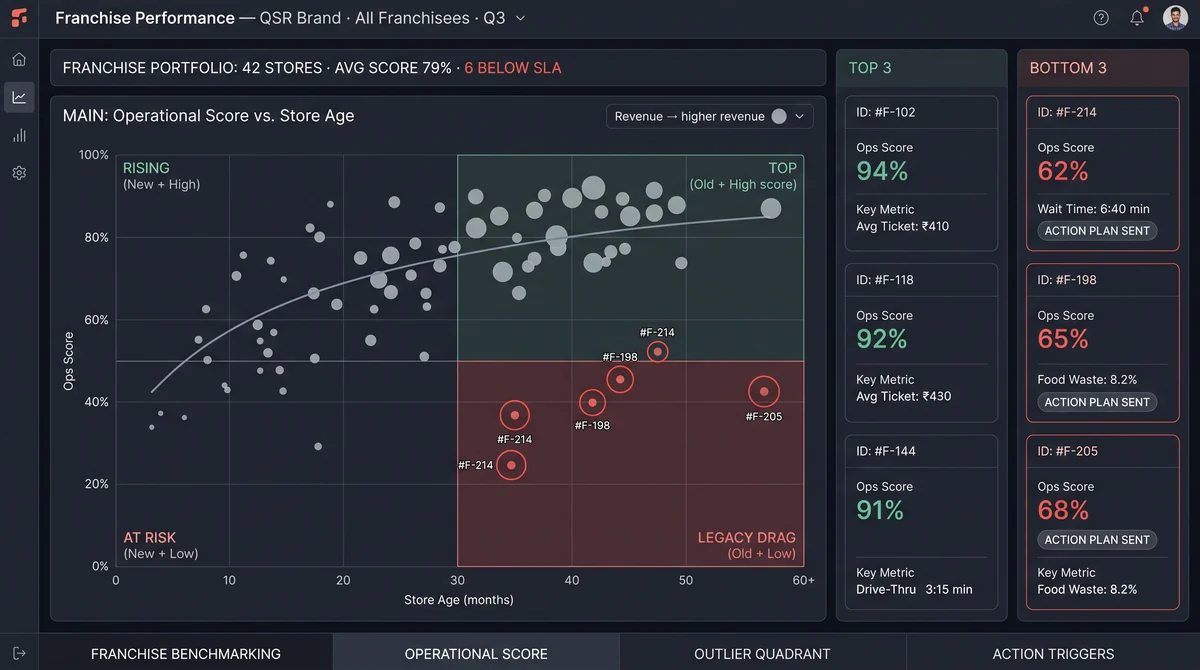
The national view that replaces a hundred status calls
A head of operations at a 300-store retailer should not start the day making calls to area managers asking whether sites opened on time, whether camera coverage is complete, or whether last night's security incidents were investigated. Slinai's HQ command centre surface consolidates opening compliance, camera fleet status, overnight alert volumes, and top-3 operational outliers into a single morning briefing — live, not a report that is already eight hours stale by the time it arrives.
The command centre is configurable by role: a CTO sees camera fleet health and integration uptime; a VP of operations sees KPI trends by region and format; a security lead sees overnight alarm volumes, verified intrusion events, and any sites where camera coverage dropped during vulnerable hours. Each view is derived from the same underlying data — there is no parallel reporting pipeline to maintain.
Retail VP of operations eliminates a ninety-minute Monday morning status circuit
A VP of operations at a 280-store grocery chain described their Monday morning as a ninety-minute phone circuit — calls to eight area managers, one national security head, and a facilities team lead, all to establish basic operational status for the week. After deploying Slinai's HQ command centre, the Monday circuit reduced to a ten-minute dashboard scan followed by a single call to the one area manager whose region showed a genuine anomaly requiring discussion. The VP estimated recovering over an hour of productive work per week across each of their direct reports who ran equivalent circuits for their own teams — a compounding time recovery the organisation had not anticipated when scoping the project.
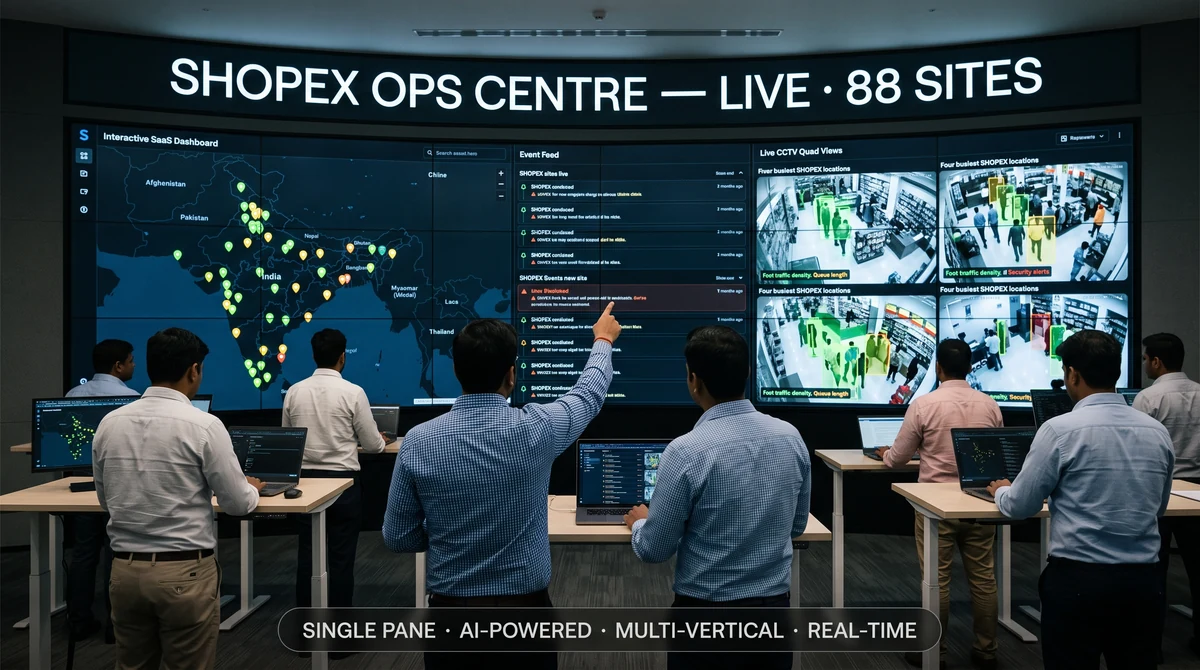
Watch your full estate come alive in one view
We will build a live walkthrough against your site list, camera estate, and hierarchy before you commit to anything.
No site is a blind spot — even on limited uplinks
Dark stores in Tier-3 cities, cloud-kitchen hubs in industrial estates, and consumer-service branches in rural high streets often run on BSNL broadband or shared 4G uplinks that cannot stream full HD video to the cloud continuously. Slinai's edge deployment model processes AI detections and camera health locally on an on-prem edge node, then syncs only metadata, alert clips, and health telemetry to the central dashboard — keeping each site visible even when available uplink is under 2 Mbps.
Hybrid fleet management means the regional dashboard shows a consistent view of every site: cloud-native sites stream live video directly; edge sites contribute KPI data and alert evidence clips. Area managers do not need to know which sites are which — the dashboard abstraction handles it. IT teams see edge node health, last-sync timestamps, and local storage fill rates in the same camera fleet panel.
Quick-commerce operator includes Tier-3 dark stores in the national KPI dashboard for the first time
A quick-commerce operator running 68 dark stores across 11 cities had been excluding 14 Tier-3 and semi-urban hubs from their national KPI dashboard because available uplink at those locations — typically 5–8 Mbps shared 4G — could not sustain continuous cloud video streaming. The excluded sites represented 21% of order volume but were invisible in the performance data. After deploying Slinai edge nodes at those 14 hubs, KPI metadata and alert clips synced to the central dashboard over existing connectivity with no uplink upgrades. The first full quarter of visibility revealed that three of the previously invisible hubs had among the highest pick-shrink rates in the estate — a finding entirely undetectable from the national operations team's previous vantage point.
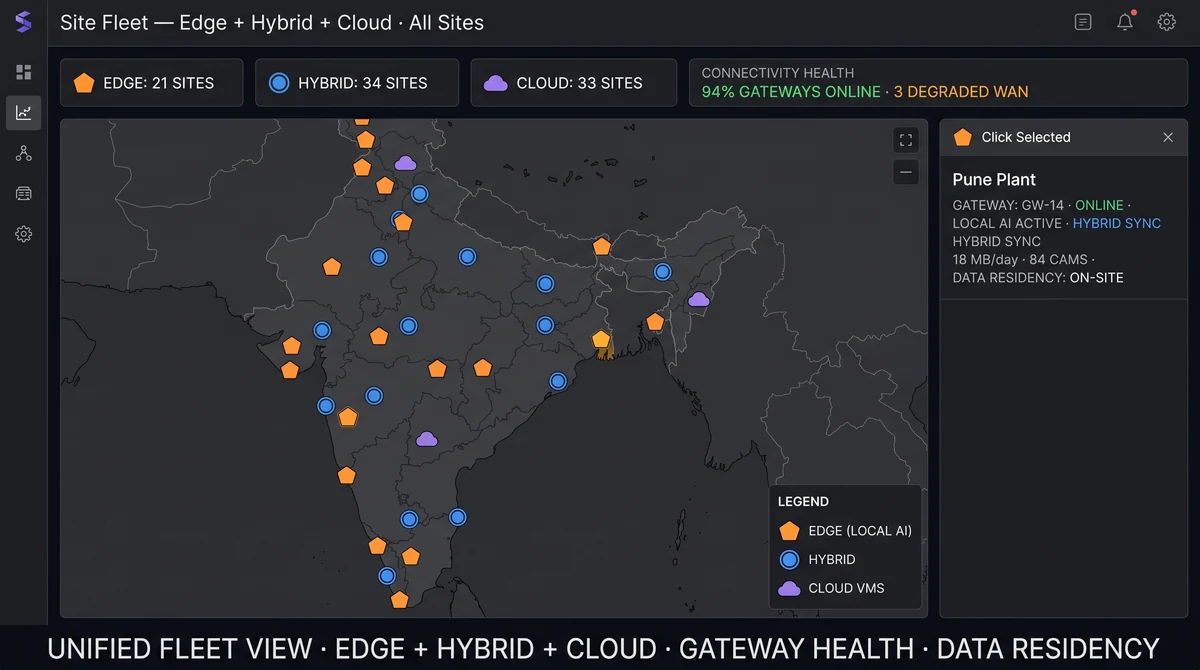
Every stakeholder sees exactly their span — nothing more
Multi-site oversight fails when dashboards show users too much — an area manager confused by 400 sites they do not own, a franchisee who can accidentally view a competitor's outlet performance, or a regional head whose export access inadvertently exposes sensitive LP data to an operations analyst. Slinai's role-based scope system is built hierarchically: each role is assigned a geography scope (one or more regions, cities, or individual sites), a KPI scope (which metrics are visible), and an action scope (can they export clips, trigger alerts, or only view).
Audit logs record every access event, every clip export, and every permission change. Compliance teams can produce a full data-access trail for any user or site for DPDP or internal governance reviews. Scope changes take effect immediately — when a field manager's territory changes, their dashboard updates without IT intervention.
Consumer finance chain passes internal governance review with a complete video access audit trail
A consumer finance company operating 190 service branches across India faced a data governance review following their DPDP compliance programme. The review required evidence that camera footage access at branch level was scoped appropriately and that no branch data was accessible to personnel without operational responsibility for that location. Slinai's access audit logs — which record every login, every camera feed viewed, every clip exported, and every permission change with user ID and timestamp — provided the complete trail the compliance team needed. The governance review concluded without any remediation requirements related to the video oversight programme, which the CISO described as the first technology audit in the company's history where camera access controls were assessed and found sufficient on first review.
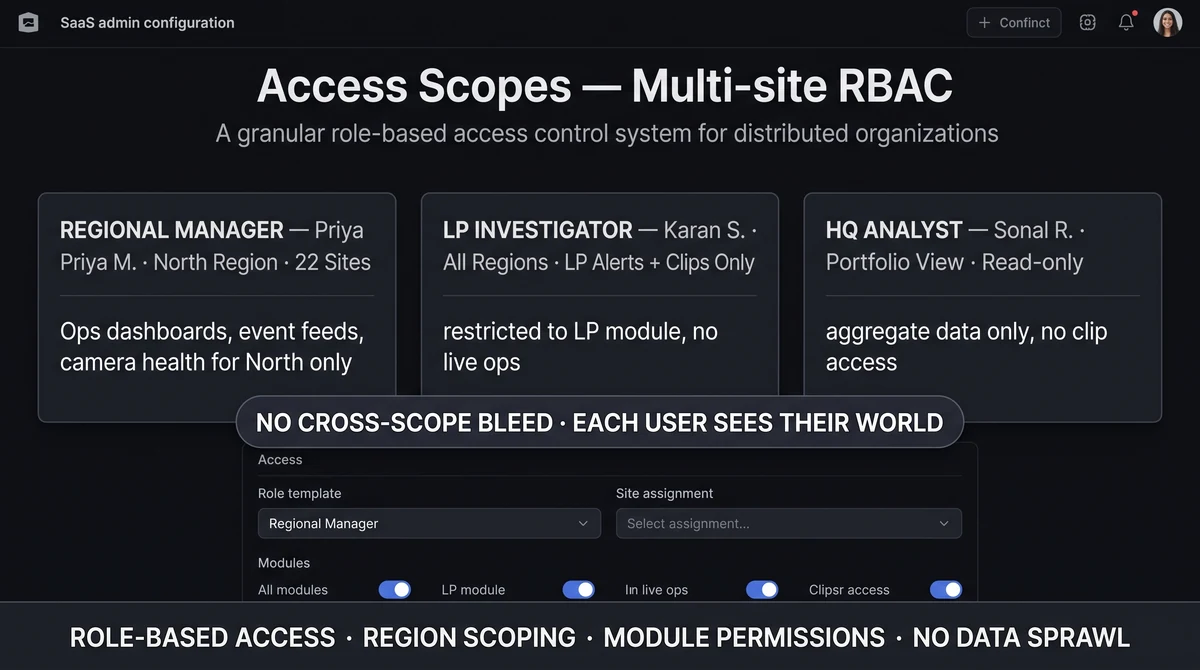
Talk to us about DPDP-aligned multi-site access controls
We will show you how role scoping, audit logging, and India-region hosting work across a large distributed estate.
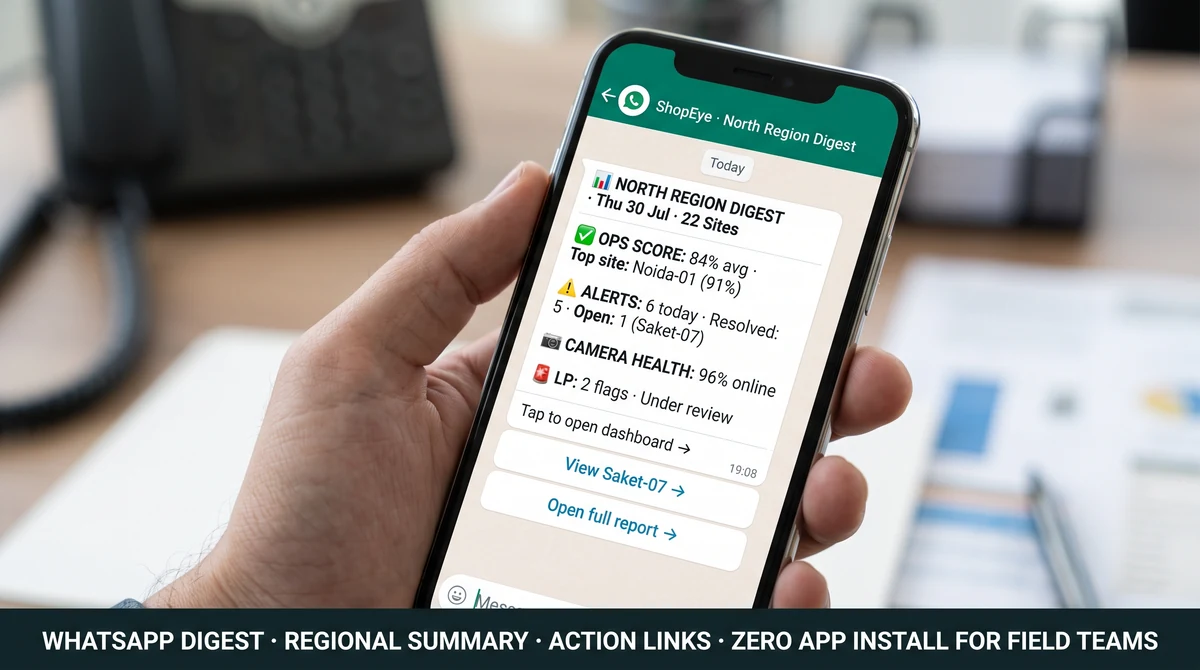
WhatsApp regional digests that replace weekly ops reviews
The best multi-site dashboards go unused if managers must remember to log in. Slinai pushes insight to where teams already work — WhatsApp, email, or Slack. Area managers receive a shift-end digest: top 3 stores by alert volume, any cameras offline in their zone, and a single-line summary of whether opening and closing compliance was met. Regional heads receive a morning briefing with the bottom-5 performing sites on whichever KPIs matter most for their format.
Digest content is fully configurable per role: a retail operations head might want footfall and queue data; a dark-store regional manager wants pick-rate and dispatch SLA; a QSR area manager wants kitchen hygiene and order-accuracy metrics. Frequency — daily, shift-end, weekly — is set per role without IT involvement. Managers who want more context click through to the live dashboard directly from the WhatsApp message.
Salon group replaces a four-step weekly report chain with a single nightly WhatsApp digest
A premium salon chain operating 38 outlets across seven Indian cities had a reporting structure that required store managers to fill a daily Google Form, which an operations executive compiled into a weekly summary, which the regional head forwarded to the VP of operations — a four-step process that introduced errors, delays, and selective omission at each stage. After configuring Slinai's shift-end WhatsApp digest for each of the three area managers, the weekly report chain was retired. Area managers now receive a digest at 10:30 PM each night with their top-3 alerts, any camera issues in their zone, and the KPIs the VP asked to track. The operations executive who previously compiled the weekly summary was redeployed to new-store onboarding work.
Built for every multi-location format in India
Whether you run a retail chain, QSR group, dark-store network, or multi-branch consumer service business, Slinai's multi-site oversight adapts to your hierarchy, your camera hardware, and your operational KPIs.
Retail chains & supermarkets
- Rank stores by footfall per sq ft, queue wait, and compliance rate in a live regional league table
- Camera fleet health monitoring with instant WhatsApp alert on any stream dropout or NVR outage
- Role-scoped access for area managers, regional heads, and HQ LP teams — each seeing only their span
- One-click drill from outlier scorecard tile to live checkout or zone camera feed
- Opening and closing compliance monitoring with daily compliance rate by store and by region
- Multi-format comparisons across standalone stores, mall kiosks, and franchise outlets in the same dashboard
QSR & restaurant groups
- Kitchen throughput, hygiene compliance, and counter speed benchmarked across every outlet in the network
- Franchise-partner KPI scoring without requiring direct camera access to franchisee feeds
- Drive-thru cycle time comparison across city clusters and daypart profiles
- WhatsApp shift-end digest for area managers with kitchen and counter performance summary
- Outlier franchise cluster identification for targeted brand-standard corrective action
- Multi-brand ghost-kitchen and cloud-kitchen estate managed with brand-separated views in one platform
Dark stores & quick commerce
- Pick-pack productivity and dispatch SLA comparison across all fulfilment hubs in a unified dashboard
- Edge-node support for Tier-3 and bandwidth-constrained dark store locations below 2 Mbps uplink
- Unified national view covering cloud-native and edge-hybrid sites side by side without distinction
- Per-hub shrinkage rate and anomaly event tracking for centralised LP teams
- WMS-correlated pick event data surfaced in the multi-site operations view for order complaint resolution
- Late-dispatch and SLA breach alerts routed to ops leads on WhatsApp within 30 seconds of detection
Consumer services & clinics
- Wait-time and station occupancy SLA compliance ranked across all branches in a real-time board
- Unattended-customer event rates by branch and by daypart for roster and layout optimisation
- Anonymous queue counting compliant with DPDP principles — no biometrics or individual tracking
- Regional digest to area managers with per-branch SLA adherence summary each shift
- Drill-down from SLA outlier branch to reception or treatment-area camera in one tap
- After-hours branch security monitoring with verified clip alerts to security lead and branch manager
Bank branches & financial services
- Counter-wait SLA and teller coverage compliance benchmarked across all branches by region
- Role-based scope strictly enforced — branch staff see only their own branch, never a competitor or peer
- Full DPDP-aligned audit log of every camera access, clip export, and permission change by user
- After-hours branch security with AI-verified clip alerts to the duty security contact within 30 seconds
- Monthly SLA adherence report automatically generated per region for operations and compliance reviews
- India-region hosting available for data residency requirements under DPDP and RBI guidance
Manufacturing & logistics
- PPE compliance rate and safety zone adherence ranked by plant section and shift across multi-facility estates
- Dispatch bay and loading-dock camera health monitored in the fleet panel alongside warehouse cameras
- Role-scoped access for plant safety officers, logistics managers, and group-level HSE leads
- After-hours perimeter and component storage monitoring with armed zone arming at shift close
- Per-facility incident trend analytics to identify plants requiring physical security or layout intervention
- Edge deployment for industrial sites with limited cloud connectivity — full KPI visibility at under 2 Mbps
Call us now — or book a live walkthrough
Share your camera count and sites. We'll show detections on sample footage from your industry.
Multi-site visibility: distributed NVRs vs. Slinai
What changes when your entire camera estate is unified under one platform — across every site, every format, and every role.
| Capability | Without Slinai | With Slinai |
|---|---|---|
| Operational visibility | Area managers maintain separate NVR logins per site; HQ has no consolidated view without manual weekly reports from the field | Live national dashboard showing every site's KPIs, alert counts, and camera health updated every 15 minutes, navigable from HQ down to individual camera |
| Camera health monitoring | Cameras discovered offline after an incident exposes the coverage gap — IT ticket raised days after the fact | Real-time per-stream health monitoring with instant WhatsApp alert to the right IT contact the moment any stream drops or degrades |
| Performance benchmarking | Manual spreadsheet comparison of site KPIs using figures submitted by individual store managers — inconsistent methodology, no common baseline | Normalised AI-derived KPI league tables filterable by region, format, and city — apples-to-apples comparison updated continuously from live camera data |
| Outlier identification | Bottom performers surface in monthly reports or when a major incident triggers an investigation — typically weeks after the pattern established | Bottom-10% performers flagged automatically every 15 minutes; one click from the league table to the relevant site video for immediate verification |
| Franchise & partner oversight | Brand teams either have no visibility into franchisee operations or require controversial direct camera access that franchisees resist legally and operationally | Aggregated compliance scores and KPI benchmarks visible to brand teams without direct feed access — franchisees see only their own outlets in a scoped login |
| Role-based access | IT-managed NVR credentials distributed manually; no systematic enforcement of who can see which sites — access accumulates beyond intended scope over time | Hierarchical scope model with geography, KPI, and action permissions enforced per role — changes take effect immediately without IT intervention |
| Connectivity-constrained sites | Tier-3 and bandwidth-limited sites excluded from cloud dashboards or required expensive uplink upgrades before they could participate | Edge nodes process AI detections locally and sync only KPI metadata and alert clips — sites visible in the national dashboard on under 2 Mbps uplinks |
| Alert delivery | Email alerts from individual NVR systems aggregated in a shared inbox that is reviewed inconsistently — response time measured in hours or days | WhatsApp-first alert delivery to the right person per zone — area manager digests and individual incident alerts within 30 seconds of detection |
| DPDP compliance | No systematic access audit trail; camera access log kept by IT on a per-device basis with no cross-site visibility or governance reporting | Every camera access, clip export, and permission change logged by user, site, and timestamp — full data-access trail exportable for DPDP or internal governance reviews |
| New site onboarding | Each new site requires on-site NVR configuration, separate login provisioning, and manual integration into reporting — 2–4 weeks minimum per site | New sites connect via RTSP/ONVIF credentials; format templates pre-populate detection zones and alert routing — typical go-live 5–10 days, faster for repeat formats |
Multi-site video oversight for India's rapidly expanding retail and service networks
India's organised retail sector is on track to add more than 15,000 new stores across Tier-2 and Tier-3 cities between 2025 and 2030, according to CBRE and Retailers Association of India projections. This expansion is not happening in a controlled, hardware-standardised way — it is happening through a mix of company-owned and franchisee-operated sites, across mixed-vendor camera estates, in cities where connectivity infrastructure is improving but not yet uniform. The operators who will manage this growth most effectively are not those who attempt to standardise hardware before deploying oversight — they are those who deploy software that works with the heterogeneous estate they actually have. Slinai's RTSP/ONVIF normalisation layer is purpose-built for this reality: connect what you own, see everything in one place, and roll out at the pace the business is expanding.
India's WhatsApp penetration — over 500 million active users, with WhatsApp as the primary business communication tool for field teams across every industry vertical — makes it the natural alert and digest channel for multi-site operations at scale. International video management platforms designed for Western enterprise contexts typically route alerts to email or web notification inboxes that Indian field teams do not monitor in real time. Slinai's WhatsApp-first alert model is not a convenience feature — it is a structural requirement for achieving sub-three-minute response times from area managers who may be visiting three different stores in a day without consistent access to a laptop or desktop. Regional digest messages arrive in the same WhatsApp group where the area manager is already coordinating with their team, with drill-down links that open the relevant dashboard view without requiring a separate login.
The Digital Personal Data Protection Act (DPDP Act, 2023) introduces obligations for operators of video monitoring systems across India that directly affect how multi-site camera estates should be configured and governed. Key requirements include purpose limitation for video data collection, documented justification for monitoring at each location, configurable retention periods rather than indefinite storage, role-scoped access that limits footage visibility to personnel with a legitimate operational need, and audit logging of every access event to support accountability under the data fiduciary framework. Slinai's multi-site oversight platform meets these requirements as a baseline rather than an optional configuration — role scopes, retention policies, audit logs, and India-region hosting options are standard features, not compliance add-ons. Operators in financial services, healthcare, and government-adjacent sectors who require explicit data residency within India's borders have those options available without architecture changes.
Ready to unify your entire camera estate?
Slinai connects to your existing cameras in days — not months. Our implementation team will map your site hierarchy, configure role scopes, and show you a live national dashboard before you commit.
Responsible oversight at scale — DPDP alignment across a distributed estate
Multi-site video oversight involves continuous monitoring of staff, customers, and operational processes across dozens or hundreds of locations — a scale at which the privacy obligations introduced by India's DPDP Act become a serious operational design consideration, not a checkbox. Slinai's platform addresses DPDP alignment through four structural design decisions: purpose-limited detection zones that focus monitoring on operational and security areas with documented justification; configurable retention periods per site and per zone that prevent indefinite footage accumulation; role-based access controls that enforce the principle of minimum necessary access at both the camera and KPI level; and comprehensive audit logging that records every access event for accountability reporting under the data fiduciary framework.
Employee and customer awareness of monitoring is both a DPDP best-practice requirement and an operational best practice for deterrence. Slinai recommends that operators include camera monitoring disclosure in staff employment agreements, post visible notices at monitored locations, and maintain a monitoring policy document that outlines the categories of zones monitored, the purposes of monitoring, and the roles authorised to access footage. Slinai's onboarding process includes documentation templates to support operators establishing these disclosure frameworks without requiring dedicated legal project resources. For franchise networks, the platform supports separate disclosure configurations per franchise group, so disclosure obligations can track franchise contractual arrangements rather than requiring a single uniform policy across a heterogeneous estate.
Data residency is a specific requirement for enterprise operators in financial services, healthcare diagnostics, and government-adjacent sectors in India. Slinai offers India-region hosting options for operators who require that video metadata, KPI data, and alert clips be processed and stored within India's borders under the DPDP framework's cross-border transfer provisions. For all operators, regardless of hosting configuration, footage access is scoped by role at the platform layer — so no individual at HQ, at a regional office, or in an IT department can access footage for a site outside their defined operational responsibility without a logged permission change that is visible to the system administrator.
Questions teams ask about multi-site oversight — regional dashboards & benchmarking
How many sites can one Slinai account manage?
Hundreds of locations in a single tenant with regional grouping, delegated admin roles, and per-site retention policies. The platform is designed for large multi-city camera estates in a single tenant; exact capacity depends on detection mix, retention, and deployment model (cloud, edge, or hybrid).
Can I group sites by region, city, and format simultaneously?
Yes. The site hierarchy is multi-dimensional — sites can be tagged by region, city, business format (retail, QSR, dark store, branch), and franchise cluster. Any dashboard filter or league-table view can cut by any combination of those dimensions.
Does the dashboard work with mixed camera brands across sites?
Yes. Slinai connects to any RTSP or ONVIF device — Hikvision, CP Plus, Dahua, Axis, Bosch, Hanwha, generic ONVIF NVRs. Sites added with different brands appear identically in the multi-site dashboard; the normalisation happens at the stream ingestion layer.
Can franchisees see each other's KPI data?
No. Role-based scope assignments are strictly isolated — a franchisee login shows only stores within that franchise group. The franchisor can see aggregated scores across all franchisees but cannot inadvertently expose one franchisee's data to another.
What happens when a camera at a remote site goes offline?
An offline-camera alert fires immediately to the site's assigned IT contact and regional manager via WhatsApp or email. The camera fleet dashboard marks the stream as offline with a timestamp and last-known status — area managers see the gap before incidents are missed.
Can we export dashboard KPIs to our BI tools?
Yes. The Data & integrations layer provides API access and scheduled CSV/webhook exports that push KPIs to Power BI, Looker, Google Sheets, or custom analytics stacks. Dashboard data does not have to live only inside Slinai.
Do edge sites appear in the same dashboard as cloud sites?
Yes. Edge nodes sync KPI metadata, alert clips, and camera health telemetry to the central dashboard. Area managers see a unified view of all sites regardless of whether they are cloud-native or edge-hybrid.
How quickly can new sites be onboarded?
Typical single-site go-live is 5–10 days from stream credentials to production alerts. Subsequent sites in the same format reuse zone calibration templates and can go live faster — multi-site rollouts often run at 3–5 sites per week after the first format template is validated.
Are WhatsApp digests configurable per manager?
Yes. Digest frequency (daily, shift-end, weekly), included KPIs, and delivery channel (WhatsApp, email, Slack) are configured per role without IT involvement. Managers opt into the cadence that fits their workflow.
Keep exploring
Industries
- Retail video analytics
Footfall, conversion, loss prevention
- Restaurants & QSR
Kitchen hygiene, queues, POS oversight
- Dark stores
Pick-pack productivity, dispatch SLA
- Consumer services
Walk-ins, wait times, branch security
Product modules
- Cloud VMS
Multi-site video layer
- Video AI
Detection & agentic intelligence
- Data & integrations
POS, API, exports
- Alert channels
WhatsApp, Slack, SMS
- Edge & on-prem
Local AI, hybrid sync, residency
Related use cases
- Operations & productivity
Throughput, staffing, multi-site KPIs
- Loss prevention & shrink
Shrinkage, cashier fraud, incident response
- Physical security
Intrusion, perimeter, after-hours
- Service quality & SLA
Wait times, station use, handoff discipline
Talk to us — or see it live
Tell us about your sites and goals, and we'll show you exactly what Slinai surfaces on your existing cameras.
Book a live demo
A focused 30-minute session, tailored to your operation.
- Live walkthrough on footage like yours
- Your top use-cases mapped to detections
- Deployment plan for your cameras & sites
- Indicative pricing and ROI estimate
Or reach us directly