Your cameras. Your team. Your security playbook.
After-hours intrusion, perimeter line-crossing, and restricted-zone loitering — detected by zone-aware AI, attached to a short clip, and delivered to your on-call security on WhatsApp within 30 seconds. No monitoring station. No facial recognition. No rip-and-replace.
Works with any IP camera · Hikvision · CP Plus · Dahua · ONVIF
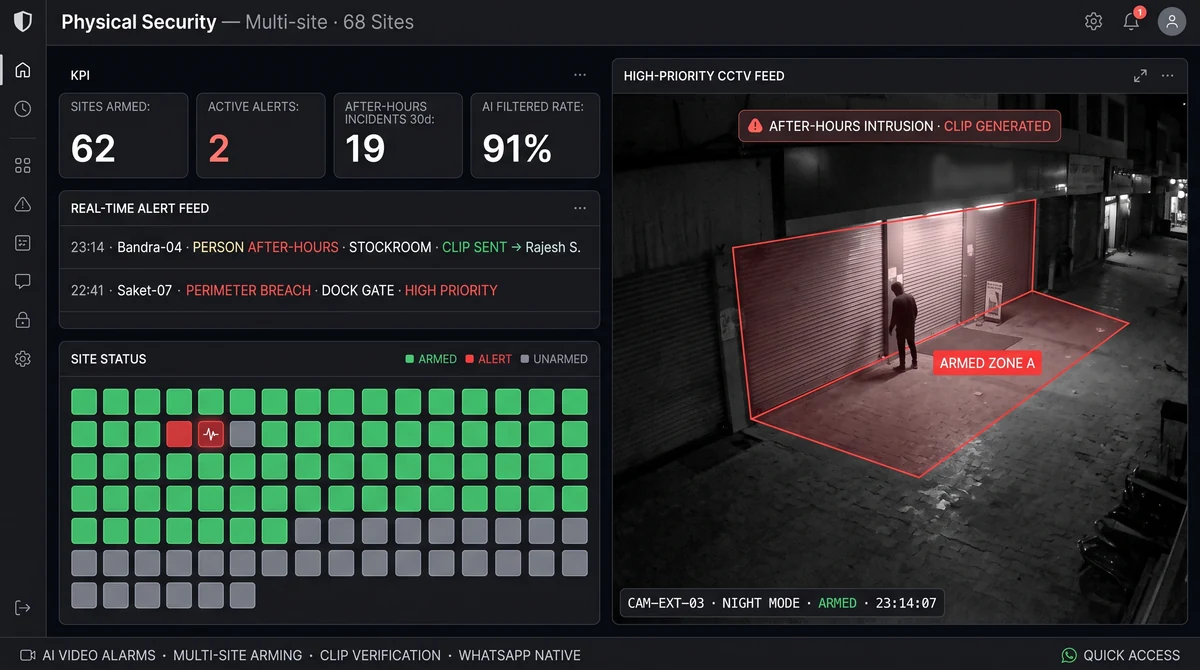
What is Slinai physical security?
Slinai physical security is an AI-filtered intrusion and perimeter alerting layer built on your existing CCTV. Zone rules detect people and vehicles entering protected areas, crossing virtual fences, or loitering in restricted spaces — during after-hours windows or around the clock. Detections are filtered by object class and confidence before a clip leaves the platform, so your security team receives evidence worth acting on rather than a stream of motion pixels. Alerts reach your designated contacts on WhatsApp, SMS, Slack, or email within seconds; clip verification, escalation, and audit logging all happen inside your organisation — Slinai does not provide professional central alarm monitoring, manned response, or guaranteed emergency dispatch.
False alarm reduction figure reflects median outcome after 2–4 weeks of dismiss-feedback tuning across retail, logistics, and campus deployments. Individual results vary by camera placement, environment, and zone configuration.
What is AI-powered physical security monitoring?
Physical security monitoring is the ongoing protection of premises, assets, and people from unauthorised access, intrusion, and theft — through a combination of detection, deterrence, and response. Conventional security approaches in India rely on three main layers: uniformed guards at entry points, passive CCTV recording to NVR or DVR systems, and alarm systems triggered by motion sensors or door contacts. Each layer has well-documented limitations at scale. Guards displace risk rather than eliminate it — a guard at the front entrance does not monitor the loading dock, the rooftop plant room, or the rear compound perimeter simultaneously. Passive CCTV records everything but monitors nothing — footage is reviewed only after an incident is reported, by which time the perpetrator has been gone for hours and the investigation depends on retention-period luck. Motion-sensor alarms generate high false-positive rates in commercial environments, creating alert fatigue that causes security teams to mute or deprioritise the notification channel within weeks of deployment.
AI-powered physical security monitoring addresses these limitations by applying computer vision to the live camera streams that organisations already have, classifying what the cameras see in real time, and surfacing only the detections that match your configured security rules. Virtual perimeter fences trigger when a person or vehicle crosses a boundary you define — not when a moth flies past a PIR sensor. Restricted-zone loitering rules fire when a person dwells in a sensitive area for longer than a configurable threshold — distinguishing a passing glance from deliberate loitering. After-hours arming schedules arm specific zones automatically when the last staff member exits — without requiring manual arming by a duty manager who may be rushing to close the site. The result is a security layer that monitors continuously, generates alerts with sufficient evidence for immediate verification, and maintains a complete audit trail without requiring an outsourced monitoring desk between your cameras and your security team.
For multi-site operators across India — retail chains, logistics networks, franchise restaurants, manufacturing groups, education campuses — the physical security challenge compounds with scale in the same way operational management does. A security policy defined for the flagship store cannot be replicated consistently across 40 or 200 sites when each site's zone configuration, arming schedule, and alert routing is managed locally by whichever staff member last logged into the DVR. Slinai solves the consistency problem by managing zone geometry, arm schedules, sensitivity thresholds, and escalation routing from a central cloud interface — so HQ security defines policy once and pushes it to every site, while regional and local contacts continue to receive alerts through the WhatsApp channel they already use.
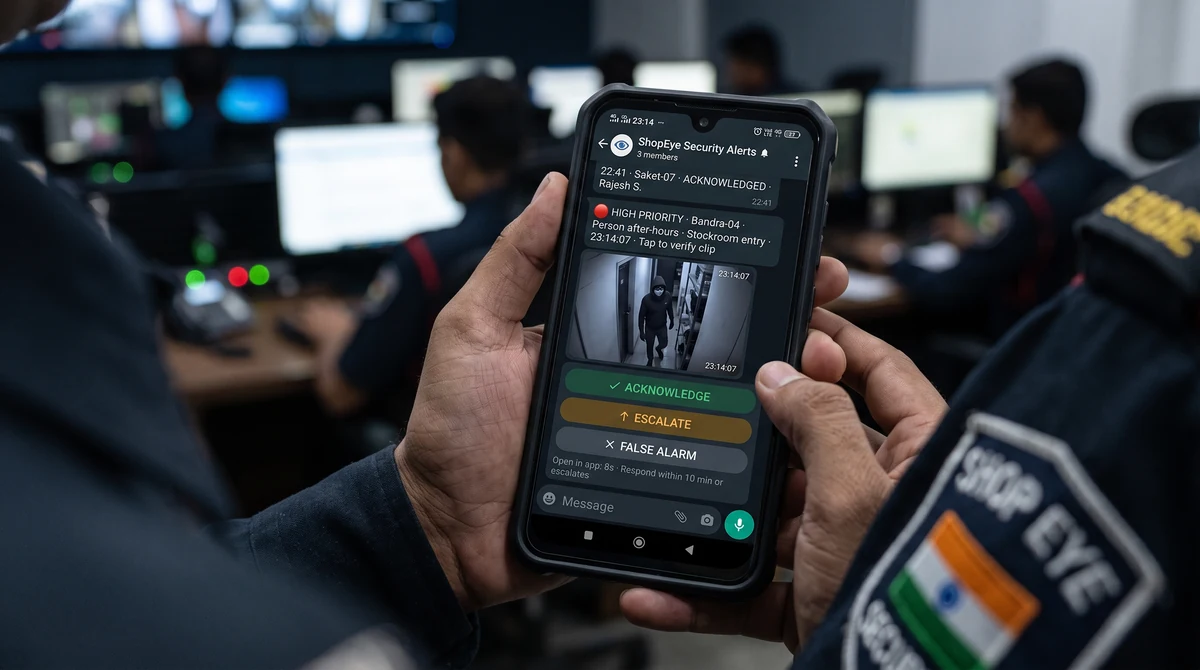
The alert delivery mechanism matters as much as the detection accuracy in determining whether physical security monitoring delivers real security outcomes. India's security operations run on WhatsApp. On-call guards, store managers, and regional security leads are already active on the app during the hours when physical security matters most. Slinai delivers a thumbnail and a 15-second playback link into the WhatsApp thread your team already monitors — verified clip evidence arriving in under 30 seconds of a genuine intrusion detection. One tap opens the clip in the browser without a VPN, without a new app install, without a login over a 4G connection with erratic bandwidth at 2 AM. The recipient watches the clip, decides whether to dispatch a guard or forward to a backup contact, and logs the acknowledgement — all from the WhatsApp thread. This is not a convenience preference; it determines whether verified intrusion events receive a response in minutes or sit unacknowledged until the following morning.
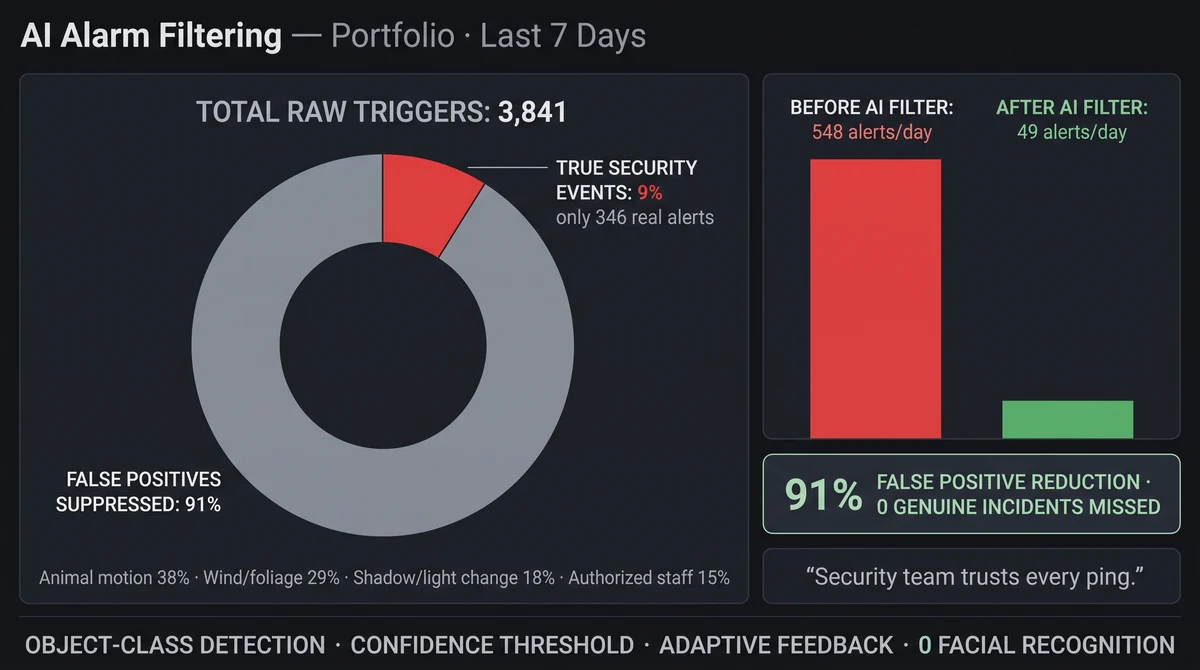
The false-alarm problem is the defining challenge in commercial security monitoring, and it is the reason most organisations stop monitoring their CCTV in real time within weeks of attempting to do so. A conventional motion-alert system at a busy commercial site generates 50 to 500 motion events per day — from delivery vehicle shadows, HVAC vibration on ceiling-mounted cameras, stray animals in yards, and the reflection of a car headlight sweeping across a car park at night. Slinai addresses false alarms through object classification, confidence scoring, and dismiss feedback: alerts fire only when the detected object is classified as a person or vehicle (not a cat, not a shadow, not a moving branch), when the confidence exceeds the per-zone threshold, and when the event falls within the arm window for that zone. Dismiss feedback from the first two to four weeks of operation tunes per-zone thresholds individually, reducing false-positive rates in comparable deployments by 70 to 85 percent without degrading genuine intrusion detection. The security team starts receiving one to three actionable alerts per night rather than 50 events to triage — and their response discipline holds because every alert is worth opening.
Ask your cameras anything about security
Security managers query overnight events, arm status, and perimeter activity in plain language — no NVR login, no VPN, no footage scrubbing required.
- INTRUSION
AI-filtered intrusion detection
Zone geometry, object classification, and confidence scoring reduce false positives by 70–85% compared to motion-only alarms — so your security team receives alerts worth acting on, not a stream of HVAC vibrations and passing shadows.
- WHATSAPP
Clip verification on WhatsApp
Verified intrusion clips reach your on-call security contact on WhatsApp within 30 seconds — with a 15-second playback link that opens in-browser without a VPN or app install. Response decisions made from the evidence, not from an alarm beep.
- MULTISITE
Central security policy for all sites
Define arm schedules, zone geometry, and escalation routing once from HQ — push to every site. Area managers adjust trading-hour windows without touching zone sensitivity. No per-site technician visits for policy changes.
Which of our sites had verified intrusion events last night?
Two sites had verified intrusion events last night. Koramangala Store had one confirmed event at 02:18 AM — a single individual entered through the rear stockroom door zone, clip delivered to duty security within 24 seconds, acknowledged and escalated to on-site guard. The individual left the premises without entering the sales floor. Naraina Warehouse had one vehicle entry at 03:47 AM via the dock approach lane — classified as an unscheduled vehicle, not matching any pre-registered delivery partner. Both clips are in your security event queue.
Walk me through a typical after-hours retail intrusion alert.
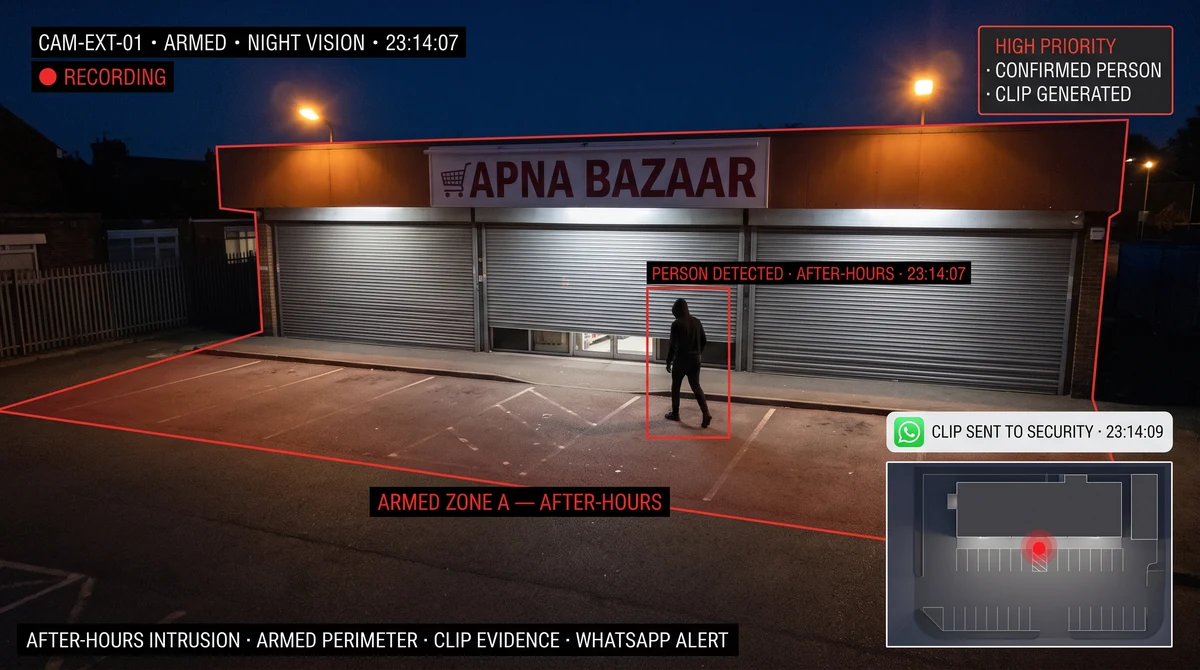
At 01:54 AM, Slinai detects a human presence in the armed stockroom zone of a South Delhi outlet — 36 minutes after POS close triggered automatic arming. AI filtering confirms the detection as a person, not an HVAC shadow or animal. Within 27 seconds, the duty security contact receives a WhatsApp message with a thumbnail and 15-second clip link. They tap to view, confirm the intruder is at the electronics bay, and forward the time-limited link to the on-site guard in the same thread. The guard reaches the stockroom in under 4 minutes. The full response timeline — detection, alert delivery, clip verification, guard dispatch, and arrival — is logged automatically in the audit trail with precise timestamps.
Show me the arm status for all our NCR sites right now.
Of your 18 NCR sites, 16 are currently armed. Connaught Place Store and Saket Mall are showing as disarmed — Connaught Place had a late event close at 23:12 (within normal range) and is still in the staff-exit buffer window; it will arm automatically at 23:30. Saket Mall shows no POS close event today — this may indicate a system sync issue or a missed close procedure. I've flagged Saket Mall to your area manager's alert queue for follow-up. All 16 armed sites show active streams with no current events.
How many false alarms did our manufacturing plant generate last month?
Your Pune manufacturing plant generated 847 motion events last month. After AI object-class filtering, 712 were suppressed before leaving the platform — HVAC vibration on roof cameras (41%), stray animals in the yard (28%), and weather artefacts (31%). 135 events passed the confidence threshold and delivered clips to the security team. Of those, 112 were acknowledged as genuine detections and 23 were dismissed as false positives — a false-positive rate of 2.7%, down from 31% in the first week before dismiss-feedback tuning completed.
Can Slinai tell me which cameras are offline across my estate right now?
Currently, 4 cameras across your estate are offline. Gurgaon Warehouse has 2 offline cameras — Bay 3 and the yard east corner — both went offline at 14:22 today, likely a network switch issue. Bhopal QSR Outlet has 1 camera offline (front counter view) since yesterday 19:45. Indore Store has 1 camera offline (stockroom entry) since this morning 08:10. I've sent camera-offline alerts to the relevant site IT contacts for all four. Gurgaon is the most critical — those two cameras cover armed zones in tonight's security schedule.
Six layers across the intrusion problem
From zone draw to WhatsApp clip — every step your security team needs, without an alarm desk in the middle.
After-hours arming schedules
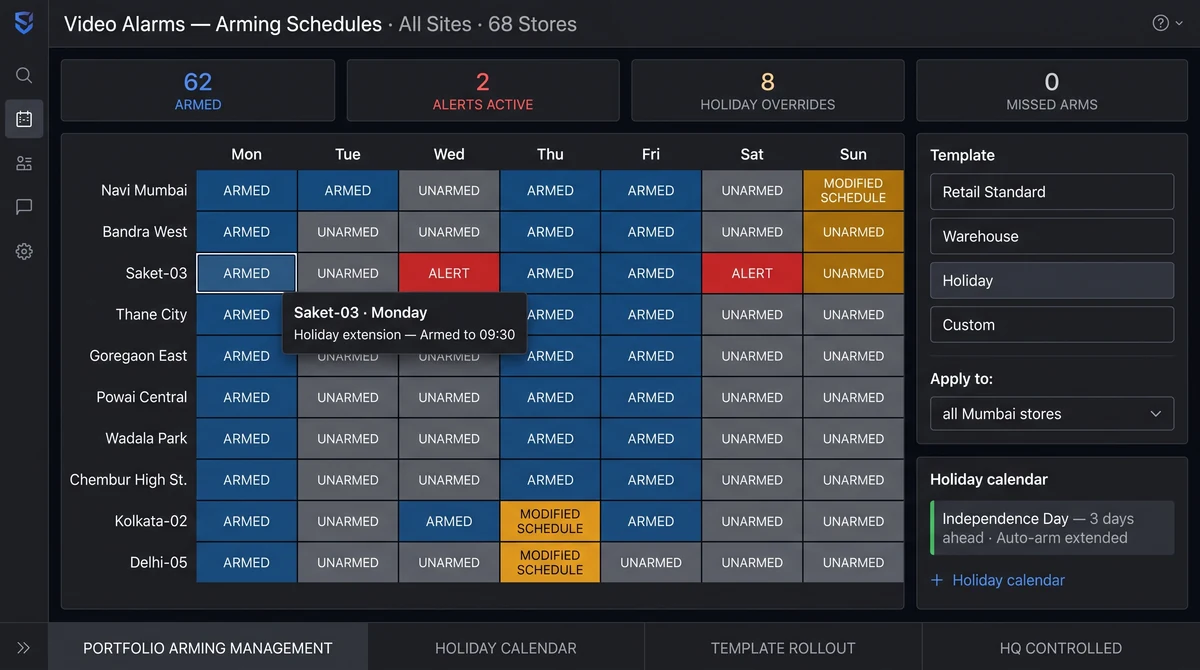
Arm sites by trading-hour calendar — stockrooms, cash desks, and yard gates disarm when staff arrive, arm when they leave. Schedules sync to all sites from HQ without on-site visits.
Perimeter & line-crossing
Draw virtual fences on dock edges, compound boundaries, and campus gates. Alerts fire the moment a person or vehicle crosses the line — day or night, with per-zone object-class filters.
Restricted-zone loitering
Cashier back-offices, server rooms, exam storage, and chemical labs get polygon zones that alert after a configurable dwell time — distinguishing a passing glance from deliberate loitering.
AI-filtered alert delivery
Wind, shadows, HVAC vibration, and stray animals are suppressed before an alert leaves the platform. Confidence thresholds and dismiss feedback tune per zone over 2–4 weeks — not a one-size setting.
Clip verification on WhatsApp
Alerts arrive as a thumbnail plus 15-second loop. Recipients ack, escalate to backup contacts, or forward the time-limited link to a guard — no VPN, no separate app, no monitoring desk required.
Privacy-first, no biometrics
Zone geometry and object classification only. Slinai does not identify individuals by face or biometric signature. DPDP-aligned design with configurable data retention per site.
See physical security on your cameras
Book a walkthrough — we'll map detections, alerts, and dashboards to your sites.
How Slinai sets up AI-powered physical security
From camera connection to live intrusion alerting in under two weeks — with per-zone tuning that reduces false positives in the first month without degrading genuine detection.
- 1
Connect existing cameras
Slinai ingests RTSP or ONVIF streams from Hikvision, CP Plus, Dahua, Axis, TVT, and mixed-vendor NVR setups already installed at your sites — no hardware replacement, no rewiring. A site survey confirms camera angles for security zone calibration.
- 2
Draw zones and configure arm schedules
Security zones — perimeter fences, restricted-area polygons, loitering detection areas — are drawn on your camera feeds. After-hours arming schedules are configured per zone, synced to each site's trading-hour calendar automatically.
- 3
Configure alert routing and escalation
WhatsApp recipients, SMS contacts, Slack channels, and escalation tiers are set per site — store security, area manager, regional security director. Escalation timers and unacknowledged-alert cascade paths configure without engineering involvement.
- 4
Tune per-zone false-positive rates
Over 2–4 weeks, dismiss feedback from alert recipients refines per-zone sensitivity — suppressing HVAC vibration, stray animals, and weather artefacts while keeping genuine intrusion detection intact. Most sites reach stable false-positive rates below 5% within the first month.
- 5
Expand and centralise policy
Once the first site is live and tuned, zone templates and arm-schedule configurations push to additional sites from the cloud dashboard. HQ security manages policy for the entire estate without dispatching technicians to each location.
Armed before the last shutter drops
An electronics retail chain operating 30 stores across seven cities ran a legacy passive-infrared alarm system that generated 15–20 push notifications per night to its security lead. Fans, loading-dock reflections, and a poorly positioned PTZ accounted for nearly all of them. Within two weeks of go-live the security lead had muted his alarm app. Post-close stockroom entries went undetected for hours; playback confirmation happened the next morning over coffee. A back-door breach at a South Delhi store was identified only because a staff member noticed displaced inventory on the Monday open.
Slinai arm schedules tie arming windows to each store's trading-hour calendar plus a configurable staff-exit buffer — typically 10 to 15 minutes after POS close. Zone detection switches on automatically; the security lead now receives zero to three alerts per night, each carrying a 15-second clip already filtered for object class and confidence. Genuine entry events are escalated to the local guard in the same WhatsApp thread within the minute. No central monitoring station. No per-site alarm-desk subscription. The same policy — and the same WhatsApp routing table — rolls out to every new store the chain opens.
Electronics chain eliminates alarm fatigue across 30 stores
An electronics retail chain operating 30 stores across seven Indian cities had a passive-infrared alarm system that generated 15–20 push notifications per night to its security lead — almost all of them false positives from fans, loading-dock reflections, and camera positioning issues. The security lead muted the notification channel within the first month of deployment. A back-door stockroom breach at a South Delhi store was discovered only when a staff member noticed displaced inventory on the Monday open — the alarm had fired and been ignored three times during the night. After deploying Slinai with per-zone object-class filtering, the security lead began receiving zero to three verified alerts per night, each with a 15-second clip showing the actual event. Response discipline returned because every alert was worth opening. The same configuration pushed to all 30 stores without per-site technician visits.
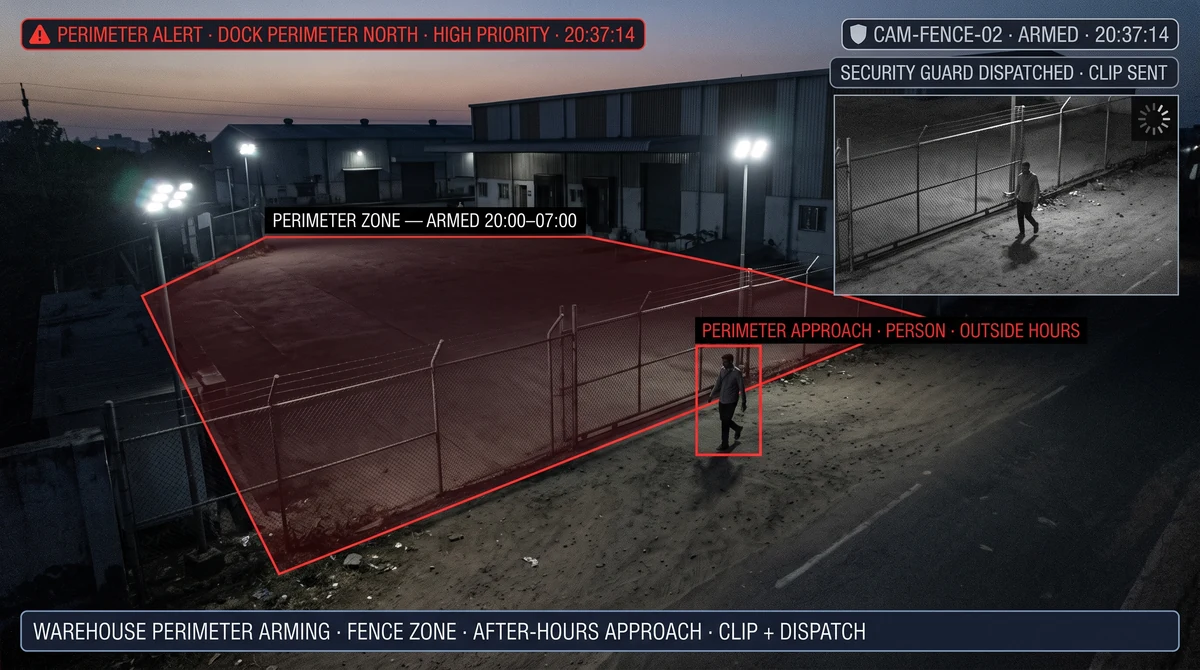
Long perimeters, lean overnight guard teams
A third-party logistics operator running three fulfilment hubs in Tier-2 cities could not justify a full overnight guard roster at each site on current margins. Existing CCTV covered dock doors, yard approach lanes, and emergency exits — but footage reviews happened only after an incident report was filed, and confirmed shrink events often couldn't be assigned to a specific date without hours of manual scrubbing. Two separate pilferage incidents in the same financial year went unresolved because timestamps from the local DVR didn't match the event window that operations could narrow down.
Perimeter line-crossing rules across dock edges and the compound boundary now alert the rotating on-call guard and the site manager simultaneously. Vehicle-class detection distinguishes authorised post-close delivery trucks — whose licence plates are pre-registered — from unauthorized pedestrian or unscheduled-vehicle entry. Cloud zone management lets the national security coordinator update zone polygons, sensitivity thresholds, and alert routing from HQ without dispatching a technician to any of the three cities. A single on-call guard verifying clips from a phone at home covers the overnight window that previously required two on-site staff per hub.
3PL operator covers three hubs overnight with one on-call guard
A third-party logistics operator running three fulfilment hubs in Tier-2 cities was operating two on-site overnight guards per hub — a staffing cost the business could not sustain on current margins. The alternative, reducing to one guard per site, would have left each hub with significant unmonitored periods across the overnight window. After deploying Slinai perimeter detection with vehicle-class filtering, the operator moved to a single rotating on-call guard covering all three hubs from a central location — receiving verified clip alerts via WhatsApp when a genuine perimeter breach occurred. Pre-registered authorised delivery trucks during scheduled overnight windows generated no alerts; unscheduled vehicle entries and pedestrian perimeter breaches surfaced immediately. Two pilferage attempts in the first six months were intercepted from clip evidence before any goods left the compound.
Ready to improve physical security?
Tell us about your sites — we'll map physical security to your cameras.
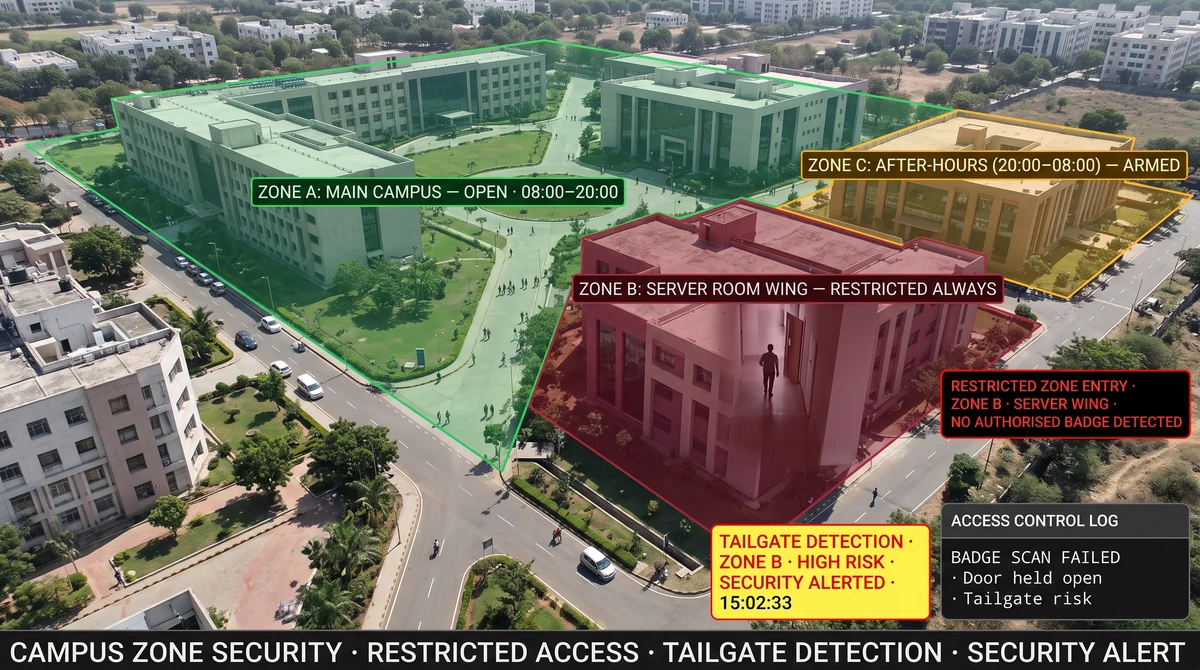
Server rooms and exam halls need more than a padlock
Campus IT teams across India manage server infrastructure, exam question-paper storage, and lab equipment valued in crores — typically secured by a single physical lock and a CCTV system recording to a local DVR that nobody monitors in real time. A university in a western metro reported two separate server room entries in one academic year that were confirmed only because a technician noticed cable rerouting during a scheduled maintenance visit. Neither triggered any alert at the time of entry.
Loitering polygon rules on camera feeds outside server room doors flag unauthorised dwell time during off-hours without requiring badge-access system integration — a meaningful saving on campuses running legacy door hardware. Exam storage areas arm from the end of the last session through the following morning's invigilator arrival; chemistry and biology labs run restricted-zone polygons around reagent-storage cupboards on a 24/7 schedule. A duty warden receives a 15-second clip on WhatsApp when someone enters a lab unsupervised — not a three-day-old entry in a paper log. No facial recognition. No biometric logging. Geometry and time-window rules only.
Engineering campus reaches zero server room incidents with loitering detection
A western-metro engineering university had experienced two confirmed server room entries in one academic year that were discovered only during scheduled maintenance — cable rerouting consistent with network-tap attempts, identified weeks after the entry. The CCTV system recorded continuously to a local DVR but had no real-time monitoring configured, and the IT team reviewed footage only when prompted by a specific incident. After deploying Slinai loitering polygon rules on server room door cameras and restricted-zone detection in four lab buildings, the university recorded zero unauthorised entries to server or lab spaces in the following eight months. Two after-hours door-zone events — a maintenance contractor arriving outside their pre-approved window — were caught within 22 seconds and resolved before any equipment access occurred. The IT director described the change as 'having eyes on the rooms we could never physically watch.'
Ready to improve physical security?
Tell us about your sites — we'll map physical security to your cameras.
The noise problem that defeats every alarm rollout
A packaging manufacturer rolled out a conventional CCTV motion-alert system at its 4-acre plant on the outskirts of a major industrial city. Within three months the security officer's phone held more than 2,000 unread alerts. HVAC vibration on roof-mounted cameras, stray dogs moving through the yard, and reflections off polished machinery surfaces had turned the alert stream into ambient noise. The team muted the channel as a matter of practical survival. When a confirmed unauthorised entry into the tool-and-die store occurred on a Sunday at 2 AM, no alert was acted on — the event surfaced only during Monday shift change when a supervisor noticed a forced shutter latch.
Slinai object-class filters suppress animal motion, weather artefacts, and HVAC-linked micro-vibration before an alert ever leaves the platform. Confidence thresholds are configured per zone: higher sensitivity on the tool store and raw-materials cage where genuine entry warrants immediate response; lower sensitivity on the external yard perimeter where a passing cyclist shouldn't interrupt the security manager's sleep. Dismiss feedback from recipients over the first two to four weeks tunes each zone individually — false-positive rates in comparable manufacturing deployments typically fall 70 to 85 percent without degrading genuine intrusion detection. Zone-level false-positive dashboards surface which cameras still need positional adjustment or sensitivity recalibration.
Packaging manufacturer recovers from 2,000 unread alerts to verified intrusion response
A packaging manufacturer at a 4-acre industrial plant had deployed a conventional motion-alert CCTV system that generated over 2,000 alerts in the first three months — primarily HVAC vibration, stray animals, and machinery reflections. The security officer muted the notification channel within eight weeks as a matter of practical survival. A confirmed tool-and-die store entry on a Sunday at 2 AM surfaced only during Monday shift change when a supervisor noticed a forced shutter latch. The CCTV footage was intact — the alert had fired, been muted, and been ignored. After switching to Slinai with per-zone object-class filtering and four weeks of dismiss-feedback tuning, the security officer received an average of two verified alerts per week. Response discipline fully recovered within the first month — and a subsequent perimeter breach at the materials cage was intercepted in under 8 minutes from first alert to guard arrival.
Your team sees the clip before they act on it
India's security operations run on WhatsApp. On-call guards, store managers, and regional security leads are already on the app — asking them to log into a separate monitoring platform at 3 AM is a friction point that kills response rates in practice. Slinai delivers a thumbnail and a 15-second playback link into the WhatsApp thread your team already monitors. One tap opens the clip in the browser — no VPN, no new app install, no login over a 4G connection with erratic bandwidth. The recipient watches five seconds, decides whether the event warrants a response, and either acks in the thread or escalates to the on-site guard in the same message.
Escalation timers fire when the primary contact does not acknowledge within a configurable window — five to ten minutes for high-value sites, configurable longer for lower-risk locations. Unacknowledged alerts cascade to backup contacts, then to a regional security supervisor if required. Every clip view, acknowledgement, escalation, and dismiss action is logged to the audit trail with a precise timestamp. Security teams export the log to PDF for insurer claims, police first-information reports, or internal HR investigations — without waiting for IT to pull DVR footage or reconstruct a timeline from partial playback.
Security team reduces alert-to-response time from 14 minutes to under 3 minutes
A multi-format electronics retailer operating 27 stores across Karnataka and Tamil Nadu had been running post-close monitoring with a passive alarm system that required an on-call security officer to log into a web portal, navigate to the relevant camera, and manually review footage after receiving an SMS notification — a process that averaged 14 minutes from alarm trigger to confirmed response decision. Under this workflow, genuine intrusion events were often not verified until the guard was already at the site, creating situations where response decisions were made on incomplete information. After switching to Slinai WhatsApp clip delivery, the average time from intrusion detection to verified response decision dropped to under 3 minutes — the clip arrived in the WhatsApp thread the officer was already monitoring, opened in-browser with one tap, and the escalation to the on-site guard happened from the same message. In the following two quarters, all 27 stores recorded zero undetected after-hours intrusions.
Ready to improve physical security?
Tell us about your sites — we'll map physical security to your cameras.
The yard is the most exposed part of your estate
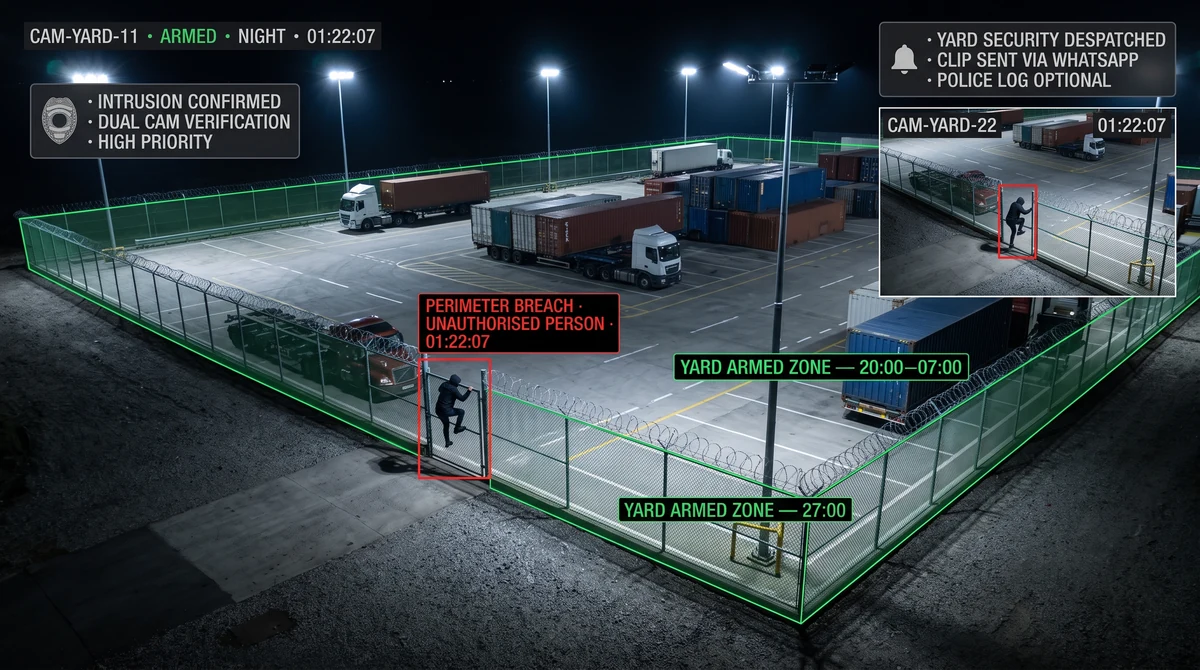
A last-mile logistics operator delivering across 12 cities found that three confirmed pilferage events in a single calendar year happened in the dispatch yard between 10 PM and 4 AM — not inside the warehouse where CCTV coverage and alarm rules were already mature. Dock doors were monitored. The open yard, bike-rack area, and staging zone for high-value consignments were covered by cameras that recorded to NVR but had no detection rules active outside operating hours.
Line-crossing zones on yard entry lanes, dock approach paths, and a separate restricted polygon around the high-value staging area now run full-night on an arm schedule that activates 20 minutes after the last dispatch rider clocks out. Vehicle intrusion outside scheduled night-delivery windows alerts the ops manager and rotating security lead within 15 seconds of breach. Scheduled night deliveries from pre-approved courier partners are on a vehicle-class allow-window that suppresses alerts during their arrival slot — the team is woken only for unscheduled entries. Cloud zone management lets the central ops team adjust the allow-window remotely without contacting the site.
Last-mile operator intercepts yard pilferage with perimeter line-crossing detection
A last-mile logistics operator delivering across 12 cities had recorded three confirmed pilferage events in a single calendar year — all in the dispatch yard during the 10 PM to 4 AM window, outside the operating hours when active staff were present. The warehouse interior was fully monitored with mature alarm rules. The yard perimeter cameras recorded to NVR but had no active detection rules after hours. After deploying Slinai line-crossing zones across yard entry lanes and a restricted polygon around the high-value staging area, the first month of overnight monitoring detected two unscheduled vehicle entries — one a late delivery from an unregistered courier partner, one a confirmed pilferage attempt at the staging zone that was intercepted by the on-call security lead from a WhatsApp clip before any consignment was removed. The allow-window for pre-registered partners was configured remotely from HQ within 10 minutes of identifying a legitimate late-delivery pattern, without any on-site visit.
Ready to improve physical security?
Tell us about your sites — we'll map physical security to your cameras.
Branch floors and cash desks after close
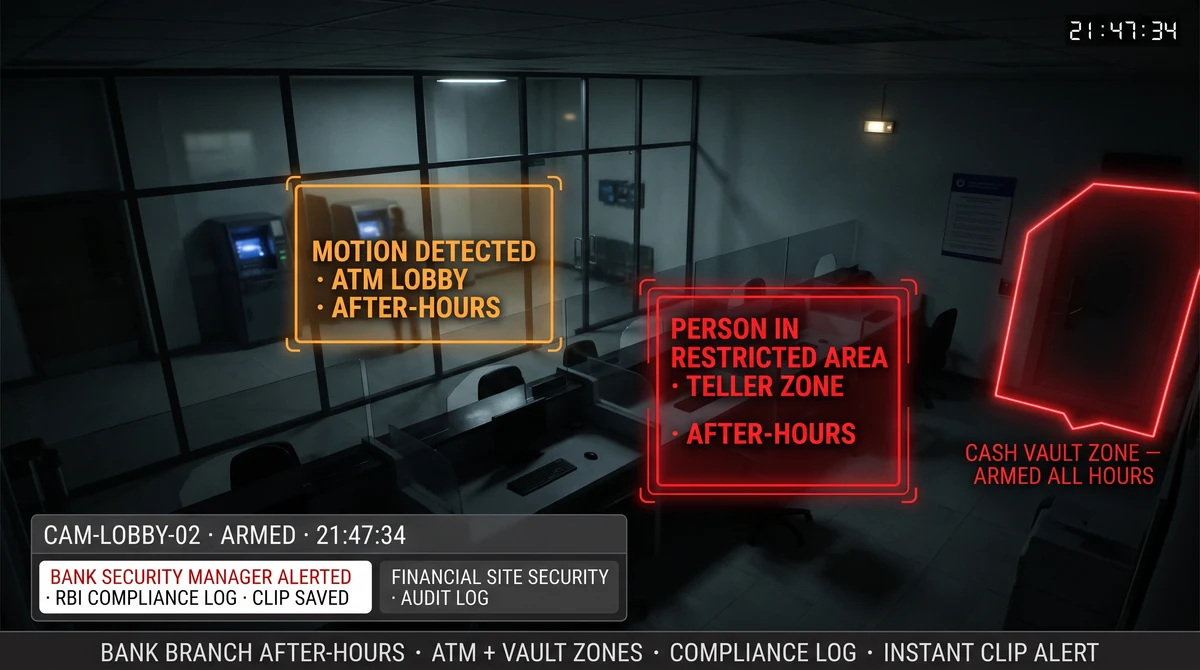
Consumer banking and financial-services branches in India face a nuanced after-hours pattern: ATM vestibule entries are expected and should not trigger security alerts; branch-floor entries after trading close should trigger immediate response. Treating the entire branch as a single zone generates either constant false alerts from ATM engineering visits or a configuration that misses real after-hours branch entry entirely. A regional NBFC with 40 branches across two states reported both failure modes in consecutive quarters before separating zone policy by area.
Slinai zone schedules separate the ATM vestibule — on a lower-sensitivity, time-windowed policy that accommodates pre-registered engineering teams — from the branch sales floor and cash-desk area, which arms 15 minutes after trading close at maximum sensitivity. Night-mode calibration handles the mixed-light environment typical of Indian bank branches: overhead tube lighting on a timer plus streetlight spill through glass facades. Regional security receives a clip within 30 seconds of a branch-floor detection; branch managers receive the same clip two minutes later if the primary contact has not acknowledged. No outsourced alarm desk. DPDP-aligned design with no biometric capture.
Regional NBFC resolves ATM vs branch-floor false alarm problem with zone separation
A regional NBFC with 40 branches across two states had experienced two consecutive quarters of conflicting failure modes from its alarm system. In Q1, a uniform high-sensitivity configuration generated constant false alerts from ATM vestibule engineering visits — creating the alarm fatigue that caused the security team to reduce response priority. In Q2, an attempt to solve this by reducing overall sensitivity resulted in two genuine branch-floor entries going undetected until the following morning. The root cause was treating the ATM vestibule and the branch sales floor as a single security zone with identical arm logic. After deploying Slinai with separate zone configurations for the vestibule (low sensitivity, time-windowed for pre-registered engineering teams) and the sales floor and cash desk (maximum sensitivity, armed 15 minutes after trading close), both failure modes resolved simultaneously across all 40 branches from a single cloud configuration update — no per-site technician visits required.
Ready to improve physical security?
Tell us about your sites — we'll map physical security to your cameras.
One security policy deployed across every location
A fast-casual restaurant chain managing 200 outlets and a fashion retailer with 60 stores share the same operational constraint: there is no full-time security architect in every city, and per-site alarm configuration managed by local staff produces wildly inconsistent coverage quality across the estate. Stores with attentive managers end up with precise zone geometry and accurate schedules. Stores where the security setup was delegated to the assistant manager in month two end up with cameras that record to a local DVR and nothing armed at all.
Slinai zone templates and arm-schedule libraries let the HQ security function define policy once — stockroom arms at 11 PM, cash desk at trading close, full floor at last staff exit — and push it to all sites as a starting baseline. Regional managers adjust trading-hour windows for their city without being able to alter zone geometry or sensitivity thresholds below the floor set by HQ policy. The multi-site security dashboard shows arming status per location in real time: which sites are armed, which had overnight events, which cameras are offline. Drill-down to any camera for live or recorded playback without a VPN. Alert routing and escalation tiers are managed from a single interface; local security leads stay on their own WhatsApp threads with no platform login required.
Fashion retailer standardises security coverage across 60 stores from one interface
A fashion retailer with 60 stores across 14 cities had discovered during an insurance audit that only 28 of its stores had functioning alarm rules configured — the other 32 had cameras recording to local DVRs but no active arming or detection. The inconsistency had accumulated over three years of individual store openings, each configured by whoever happened to be the store manager at launch. After deploying Slinai, the HQ security function defined a standard zone template — stockroom, cash desk, and full floor with staggered arm schedules — and pushed it to all 60 stores from the cloud dashboard. The deployment covered all stores within five days without a single on-site technician visit. The multi-site security dashboard confirmed arm status for all locations in real time; the insurance underwriter's subsequent audit found 100% armed coverage, reducing the annual security surcharge on the commercial property policy.
AI physical security monitoring for every industry
Zone configurations, arm schedules, and alert routing calibrated for the specific security risk profile of each operational format.
Retail stores & chains
- After-hours arming tied to POS close and staff-exit buffer per store
- Stockroom, cash-desk, and sales-floor zone separation with independent schedules
- 0–3 verified alerts per night after false-positive tuning
- Multi-site arm-status dashboard for HQ security oversight
- Policy push to new store openings without per-site technician visits
Logistics & warehousing
- Compound perimeter and dock-approach line-crossing detection
- Vehicle-class filtering to distinguish scheduled from unscheduled entries
- High-value staging zone restricted-polygon with override-window for pre-registered couriers
- Single on-call guard covering multiple hubs via WhatsApp clip verification
- Cloud zone management for national security coordinator without site visits
Manufacturing & industrial
- Tool store, raw-materials cage, and plant-room restricted-zone detection
- HVAC and animal motion suppression to resolve chronic false-alarm fatigue
- Per-zone sensitivity calibration: high on critical assets, lower on yard perimeter
- Overnight guard alert routing for multi-building plant layouts
- Audit trail export for insurance claims and HR proceedings
Education campuses
- Server room and lab restricted-zone loitering detection on 24/7 schedule
- Exam storage arm window from end of last session to invigilator arrival
- After-hours entry alerts to duty warden within 30 seconds of zone breach
- No biometric integration required — geometry and time-window rules only
- Campus-wide arm-status dashboard for safety officer and IT oversight
Consumer services & financial branches
- Separate zone policies for ATM vestibule versus branch sales floor
- Cash-desk arming 15 minutes after trading close at maximum sensitivity
- Night-mode calibration for mixed indoor and streetlight environments
- Two-tier alert: regional security first, branch manager two minutes later if unacknowledged
- DPDP-aligned design — no facial recognition or biometric logging
QSR & restaurant chains
- Kitchen and cash-register area arming after the last crew exit
- Delivery-zone allow-windows for pre-approved overnight suppliers
- Zone templates replicating standard arm schedules across 50–200 outlets
- Alert routing to area manager without requiring local staff to configure anything
- Overnight event summary per site for regional security daily digest
Call us now — or book a live walkthrough
Share your camera count and sites. We'll show detections on sample footage from your industry.
AI physical security: with Slinai vs without
The security coverage gap between passive CCTV recording and AI-filtered, clip-verified intrusion alerting — across every site in your estate.
| Capability | Without Slinai | With Slinai |
|---|---|---|
| Alert quality | Motion-based alarm systems generate 15–500 false alerts per night from HVAC, animals, and reflections — creating fatigue that causes security teams to mute the channel within weeks | AI object-class filtering and confidence thresholds deliver 0–3 verified alerts per night after tuning — each carrying a 15-second clip of an actual person or vehicle entering a zone |
| Response speed | Post-incident NVR review the following morning — or during shift change when a staff member notices displaced inventory — typically hours after the intrusion occurred | Verified clip delivered to on-call security on WhatsApp within 30 seconds of detection — while the intrusion is still in progress and response can prevent loss |
| Multi-site policy consistency | Per-site configuration by local staff produces inconsistent zone geometry, outdated arm schedules, and inactive cameras across the estate — discovered only during audits | Zone templates and arm-schedule libraries push from HQ to all sites — consistent policy across every location without per-site technician visits or local staff involvement |
| Verification requirement | Security team must log into web portal, navigate to camera, and manually scrub footage to verify — 5–20 minutes per event, often skipped entirely under alarm fatigue | 15-second clip opens with one tap from WhatsApp — no VPN, no app install, no login. Verification decision in under 60 seconds from alert delivery |
| False alarm cost | Outsourced alarm monitoring stations charge per false dispatch; internal teams absorb the labour cost of triaging unverified alerts that compound overnight across multi-site estates | False positives suppressed before leaving the platform — no dispatch cost for false events, no per-site monitoring subscription, no labour cost for triaging motion noise |
| Evidence for insurance and legal | NVR footage of uncertain quality, availability dependent on retention period, with no audit trail of who accessed it or when — difficult to use as evidentiary anchor | Timestamped clips with site metadata, access-controlled exports, and full audit log of who opened each clip and when — chain-of-custody documentation for insurers, police FIRs, and HR proceedings |
| After-hours arming reliability | Manual arm by duty manager — missed arming is common at busy closing times, especially in franchise or high-turnover environments where the process depends on individual discipline | Automatic arming triggered by POS close event, last badge swipe, or trading-hour calendar — arms without manual action, alerts HQ if arming does not complete within the expected window |
| Perimeter monitoring coverage | Guard patrols covering limited routes at 2–4 hour intervals — leaving the yard, loading dock, and compound boundary unmonitored for most of the overnight window | Continuous virtual perimeter on dock edges, compound boundaries, and yard entry lanes — person or vehicle crossing triggers a clip alert within 15–30 seconds regardless of guard patrol schedule |
| Facial recognition and biometrics | Some commercial systems offer facial recognition as an upgrade — adding regulatory complexity under DPDP Act 2023 and creating biometric data obligations most operators cannot sustain | Zone geometry and object classification only — no facial recognition, no biometric logging, no DPDP biometric data obligations. Privacy-first by design. |
AI physical security monitoring for Indian retail, logistics, manufacturing, and education
India's commercial security landscape is defined by two structural realities that most Western enterprise security software was not designed to address. First, the camera infrastructure already exists: the majority of Indian retail stores, warehouses, manufacturing plants, and education campuses already have CCTV installed — often from Hikvision, CP Plus, or Dahua — recording to a local NVR that nobody monitors in real time. The security gap is not a hardware gap; it is an intelligence gap between recorded footage and actionable real-time detection. Slinai is built to close that gap on the cameras organisations already have, without rip-and-replace procurement cycles or new sensor installations. Second, the security response channel is WhatsApp: not a corporate security operations centre, not a separate monitoring app, not an email thread. India's on-call guards, store managers, and regional security leads work on WhatsApp — which is precisely where Slinai delivers verified intrusion clips, within 30 seconds of detection, in the thread your team is already monitoring.
The Digital Personal Data Protection Act (DPDP Act, 2023) introduces compliance obligations for security camera monitoring in commercial premises that Indian operators must factor into their technology decisions. Slinai's physical security monitoring is designed with DPDP alignment as a foundational requirement: detections use zone geometry and object classification only — no facial recognition, no biometric matching, no identity logging. Video data is processed for documented security purposes with configurable retention periods per site and per zone. Role-based access controls restrict footage access to authorised security personnel, with a full audit log of every clip access, acknowledgement, escalation, and dismiss action. For organisations operating across multiple states or deploying monitoring for the first time, Slinai's onboarding documentation includes disclosure templates aligned with DPDP best practices — reducing the compliance preparation burden for security teams establishing formal monitoring programmes.
India's commercial insurance market is beginning to reflect the security monitoring posture of insured premises in commercial property and burglary-cover premiums — a trend already established in the UK and Australian markets and emerging across major Indian insurers since 2022. Documented continuous CCTV monitoring with verified intrusion alerting and a complete audit trail of all security events is increasingly cited in policy documentation as a condition for full burglary cover without co-insurance requirements. Slinai's audit export — timestamped event logs, access-controlled clip packs, and zone configuration documentation — provides the insurer-facing evidence of active monitoring that passive NVR recording alone cannot demonstrate. For multi-site operators renewing annual commercial property policies across large estates, the ability to demonstrate consistent armed monitoring across all sites from a single centralised dashboard represents both a risk management improvement and a negotiating position in premium discussions.
AI-filtered intrusion alerting on your existing cameras — in weeks, not months
Slinai connects to your current CCTV, draws your security zones, and starts delivering verified clip alerts to your team on WhatsApp. Our security team will scope zone coverage and alert routing across your estate and show you a live demo before you commit.
Privacy by design: no facial recognition, DPDP-aligned from the start
Slinai physical security monitoring is built on a privacy-first detection architecture: zone geometry, virtual fences, loitering dwell thresholds, and object classification (person, vehicle) — not facial recognition, biometric matching, or individual identity logging. This is not a feature limitation; it is a deliberate design choice that reflects both the regulatory requirements of India's DPDP Act 2023 and the operational reality that commercial security monitoring does not require identifying individuals to be effective at preventing and responding to intrusion. A warehouse perimeter alert that fires when an unclassified person crosses a virtual fence at 2 AM generates the same security response as one that identifies the person by face — and without the biometric data obligations, consent requirements, and regulatory complexity that facial recognition introduces under DPDP.
Video retention in Slinai is configurable per site and per zone — allowing operators to set archive periods that match their specific insurance documentation requirements, HR investigation cycles, and DPDP data-minimisation obligations. Standard configurations retain verified intrusion clips with full metadata for security audit purposes while cycling background monitoring footage on shorter schedules, reducing the total volume of personal data held at any point in time. All access to retained footage is logged with user ID, timestamp, and purpose. Slinai recommends that operators include camera monitoring disclosure in employment agreements, post visible CCTV notices at monitored premises, and document the security purpose of each monitoring zone — practices that align with DPDP fiduciary obligations and additionally serve as a deterrent to opportunistic intrusion by staff and visitors who know the premises are actively monitored.
For organisations considering facial recognition upgrades to their security monitoring programmes, Slinai's position is straightforward: the security outcomes achievable from zone-geometry-based intrusion detection on existing cameras are substantial — 80%+ false alarm reduction, 30-second verified clip delivery, continuous multi-site coverage — without any biometric data processing. The regulatory and operational complexity of adding facial recognition to a commercial security programme in India under DPDP typically outweighs the marginal security benefit in most use cases. Slinai does not offer facial recognition or biometric identification capabilities and will not do so for standard commercial security monitoring deployments.
Questions teams ask about physical security
Does Slinai provide a professional alarm monitoring station?
No. Slinai delivers AI-filtered intrusion alerts with short video clips to the contacts your organisation designates — via WhatsApp, SMS, Slack, or email. Your security team verifies the clip and decides escalation. Slinai does not provide a central alarm monitoring desk, manned physical response, or any guarantee of police dispatch.
Is facial recognition used for intrusion or perimeter detection?
No. All physical security detections use zone geometry, virtual line-crossing rules, loitering time thresholds, and object classification — people and vehicles. No facial identification, biometric matching, or identity logging is performed at any stage.
Can we arm and configure sites remotely without visiting each location?
Yes. After initial camera calibration during onboarding, arm schedules, zone polygons, alert routing, sensitivity thresholds, and escalation timers are all configured and updated from the cloud dashboard. No on-site technician visit is required for policy changes.
What notification channels do intrusion alerts use?
WhatsApp, SMS, Slack, and email are all supported. WhatsApp is the most common primary channel for Indian deployments — clip thumbnail and playback link open in-browser without a VPN, app install, or separate login. Multi-tier escalation routes can mix channels per contact and priority level.
How quickly does a clip reach the security team after an intrusion?
Typically within 15 to 30 seconds of the triggering event, depending on camera stream latency, upload bandwidth at the site, and notification channel delivery time. WhatsApp delivery is near-instant once the clip is generated.
Do intrusion alerts still work during internet outages?
Edge deployments continue local detection and log events during connectivity loss; alerts and clips queue and deliver automatically on reconnect. Cloud-only deployments require a stable internet connection for real-time notifications — local NVR recording continues regardless.
Can different zones on the same site arm at different times?
Yes. Zone-level arm schedules are fully independent. A common pattern: sales floor arms at 10 PM after close, stockroom arms at 8 PM after the last picker leaves, and cash desk arms at trading close. All three windows are managed per zone from the cloud interface.
What happens if the primary contact doesn't acknowledge an alert?
Escalation timers are configurable per site — typically 5 to 10 minutes for high-value locations. Unacknowledged alerts escalate automatically to secondary contacts, then to regional security if still unacknowledged. Every notification, view, acknowledgement, escalation, and dismiss action is recorded in the audit log with precise timestamps.
Keep exploring
Industries
- Retail video analytics
Footfall, conversion, loss prevention
- Logistics & warehouses
Dock TAT, PPE, perimeter security
- Education campuses
Campus safety, attendance, exam integrity
- Manufacturing
PPE, safety zones, line monitoring
- Consumer services
Walk-ins, wait times, branch security
Product modules
- Video alarms
Intrusion & verified alerts
- Cloud VMS
Multi-site video layer
- Video AI
Detection & agentic intelligence
- Alert channels
WhatsApp, Slack, SMS
Related use cases
- Loss prevention & shrink
Shrinkage, cashier fraud, incident response
- Safety & compliance
PPE, hygiene, SOP verification
- Multi-site oversight
Regional dashboards, benchmarking
Talk to us — or see it live
Tell us about your sites and goals, and we'll show you exactly what Slinai surfaces on your existing cameras.
Book a live demo
A focused 30-minute session, tailored to your operation.
- Live walkthrough on footage like yours
- Your top use-cases mapped to detections
- Deployment plan for your cameras & sites
- Indicative pricing and ROI estimate
Or reach us directly