Retail conversion funnel: visitors to billed
· Updated · Slinai
Key facts
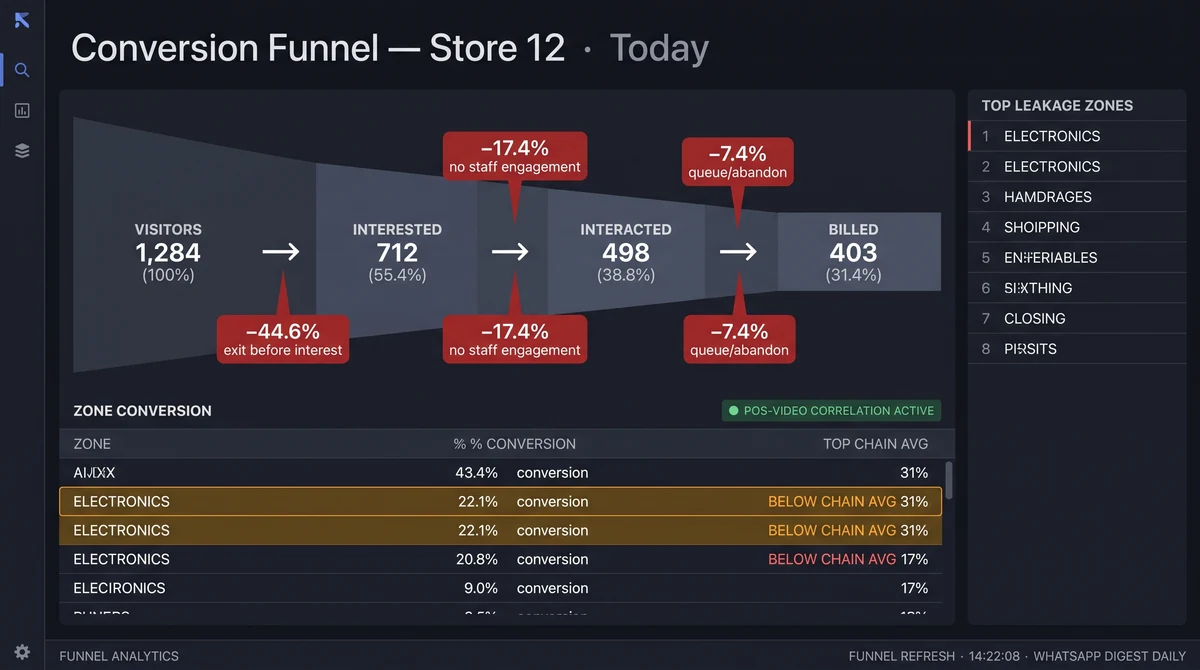
| Funnel | Visitors → Interested (zone dwell) → Interacted (staff/product) → Billed (POS) |
|---|---|
| Without POS | You can see leakage before the desk; you cannot close ‘billed’ honestly |
| Primary leak clues | High interest / low billed = VM or price; high interact / low billed = queue or stock |
| Module | Video AI for stages; Data & integrations for POS correlation |
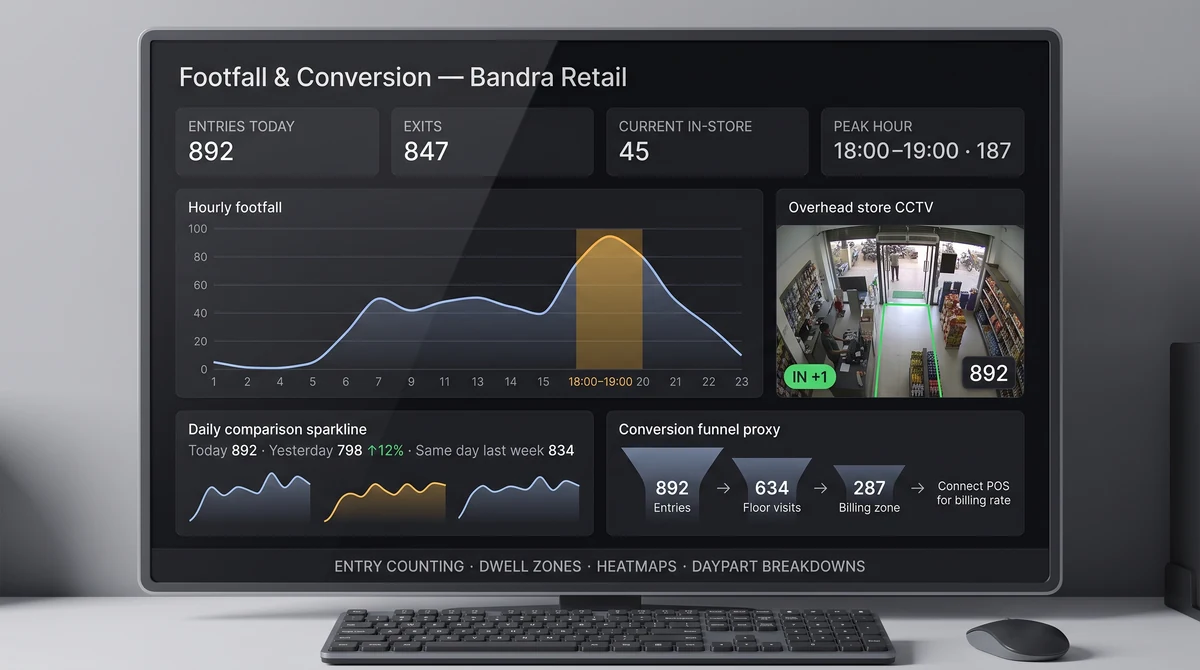
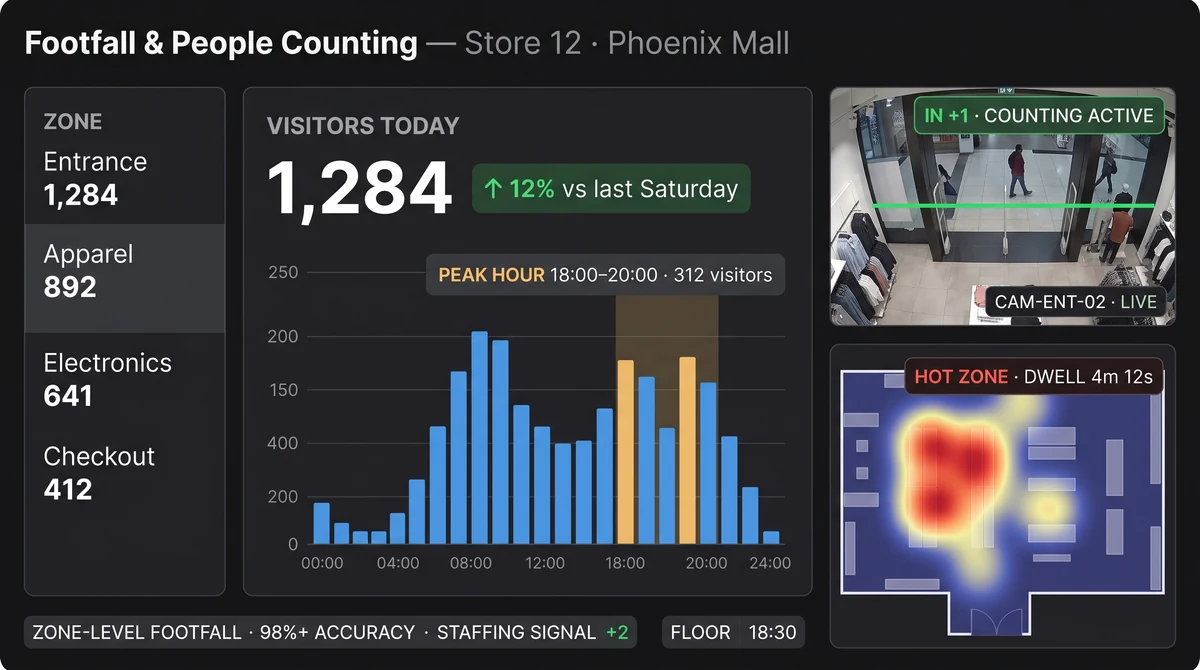
| Related count | Footfall analytics is the visitor denominator — tune that first |
Most retailers know sales. Few can answer: of the people who walked in, where did the other 70% go?
That gap is the conversion funnel. Retail footfall analytics gives you the denominator. This post is the stages between the door and the bill. Slinai maps Visitors → Interested → Interacted → Billed on existing cameras plus POS via data & integrations. The industry overview lives on retail video analytics.
The four stages (write them down)
If HQ and stores disagree on definitions, the dashboard becomes politics.
| Stage | Typical evidence | Common false friend |
|---|---|---|
| Visitors | Entrance count (staff excluded) | Mall corridor traffic counted as walk-ins |
| Interested | Dwell in a category zone above a threshold | Someone tying a shoelace in the aisle |
| Interacted | Staff in the same zone, or agreed product-touch heuristic | Greeter hello at the door (too cheap) |
| Billed | POS ticket in the time window | A bill from a regular who never “dwelt” in your promo zone |
UAT is where you pick thresholds. A jewellery store and a grocery express do not share a dwell clock.
Why POS is not optional for “billed”
Computer vision can estimate that someone stood at a desk. It cannot lawfully or reliably read every tender type, split bill, or “pay at the app.”
The join is operational, not academic:
- Video says who reached the journey.
- POS says what closed.
- Together you see high-interest / low-billed zones (VM, price, stock) vs high-interact / low-billed (queue — see retail queue analytics — or dead stock).
Slinai’s data module is built for that correlation (REST, webhooks, scheduled KPI exports). If a vendor only sells “conversion %” from pixels, ask how they handle UPI, split tenders, and staff sales.
Reading drop-off like an operator
Leak at Interested: people enter but never stop. Cause is often layout, sightlines, or a dead front third. Fix is VM and adjacency — not more cashiers.
Leak at Interacted: they stop, nobody helps (or the product is locked). Cause is coverage. Overlay staff presence from the same cameras.
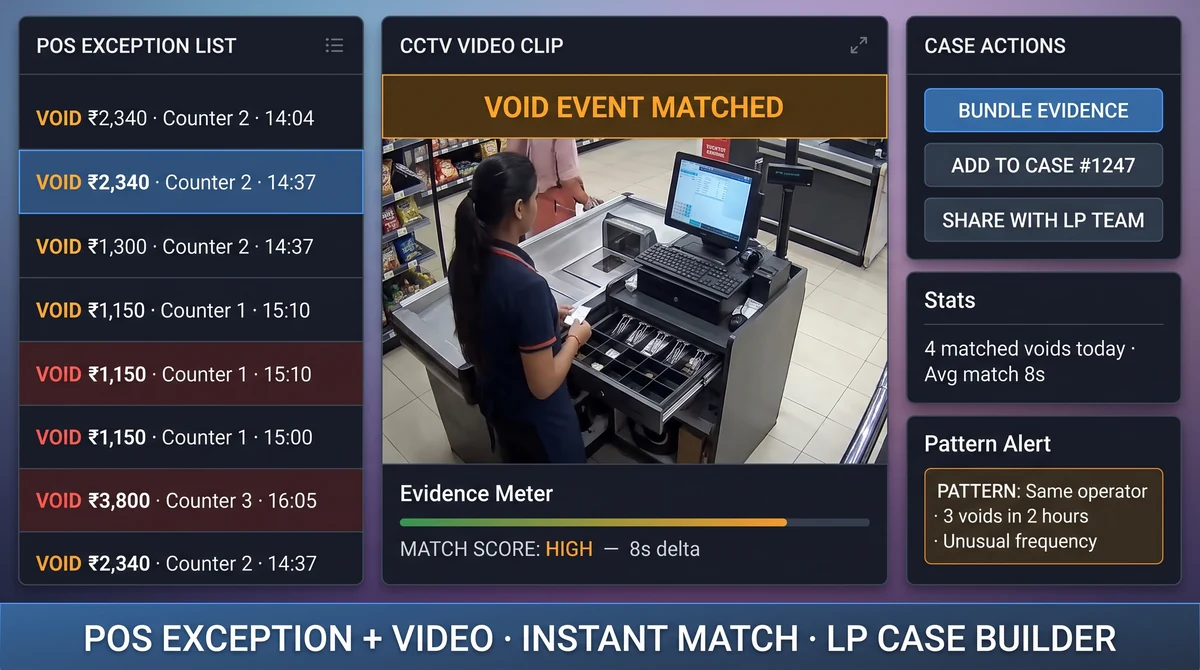
Leak at Billed: they engaged and still left. Cause is often checkout wait, stock-out at the last metre, or price shock. POS voids and long queues in the same hour are a combined story — also relevant to loss prevention if sweethearting is in play.
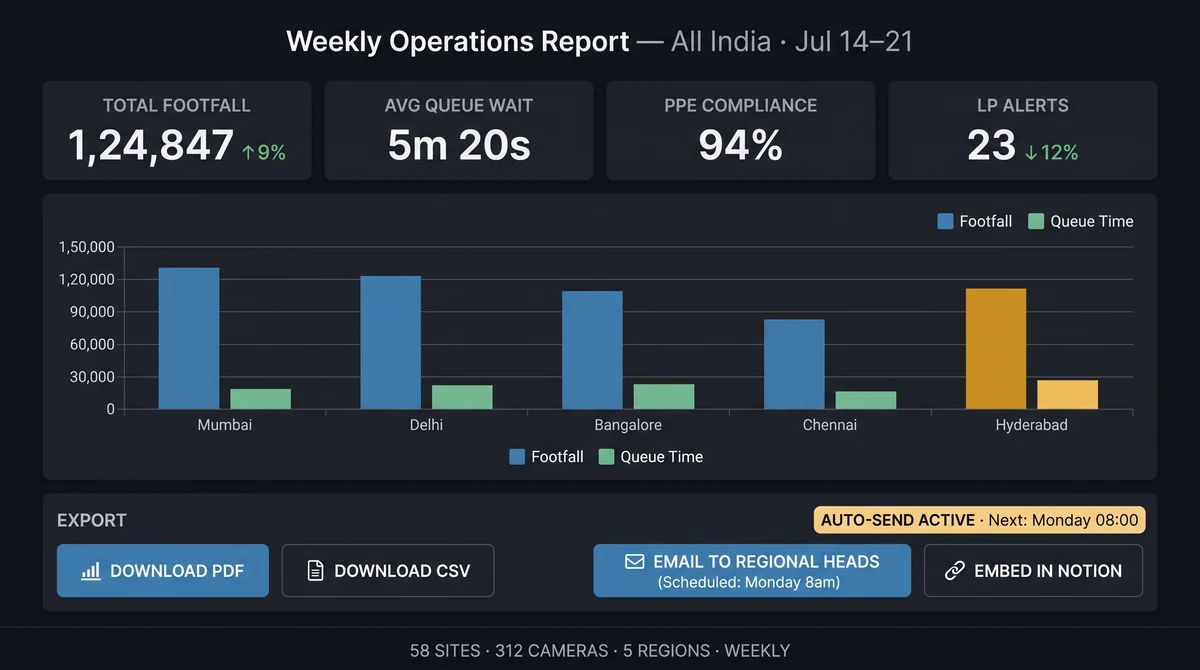
Slice by hour and day. A 22% conversion at 11:00 and 9% at 19:00 is a staffing and queue problem, not a “brand problem.”
A/B tests that survive a rain day
- Change one fixture or one endcap.
- Hold hours and promo calendar as still as you can.
- Measure zone Interested → Billed, not Instagram likes.
- Run across two weekends if the first Saturday is a washout.
This is how visual merchandising stops being taste and starts being a controlled experiment.
How this ties to Slinai
- Stages and questions: Video AI, agentic Q&A (“where did we lose people after 6 pm in Store 14?”).
- POS join: data & integrations.
- Labour context: operations & productivity.
- Denominator: footfall.
Book a demo with one store that already has a usable entrance camera and a POS export. That pair is the shortest path to a funnel that finance will believe.
Common questions
Is conversion just billed ÷ footfall?
That ratio is the last step. A funnel also needs mid-stages (dwell, engagement) so you know whether the leak is merchandising, service, or checkout. Slinai’s four-stage model is Visitors → Interested → Interacted → Billed.
Why do I need POS if I have cameras?
Pixels cannot reliably see a completed tender. POS tells you billed, voids, and basket. Video tells you who never reached the desk. Data & integrations is the join.
What is ‘Interested’ vs ‘Interacted’?
Interested is typically dwell above a zone threshold (they stopped). Interacted is staff engagement or a product-touch heuristic you agree in UAT. Definitions must be written down or stores will argue the chart.
Can I A/B a display?
Yes — same door, same hours, one changed fixture, compare zone conversion and billed. Run long enough to survive a rain day.
Does this identify shoppers?
No. Stages are anonymous paths and counts. Slinai does not use facial recognition by default.
Related pages
Guides in this cluster point to live product, industry and use-case pages.
Related guides
Retail footfall analytics: how stores count visitors
Retail footfall analytics counts store visitors on existing cameras — zone traffic, dwell, and staffing — without infrared sensors or new hardware.
Retail loss prevention AI on existing cameras
Retail loss prevention AI flags concealment, cashier fraud and after-hours intrusion on the CCTV you already own — with clip proof for review.
Retail queue analytics and checkout wait time
Retail queue analytics measures checkout wait time on existing cameras and alerts managers before lines drive walkaways and abandoned baskets.